
CODAP Accessibility Discovery Report
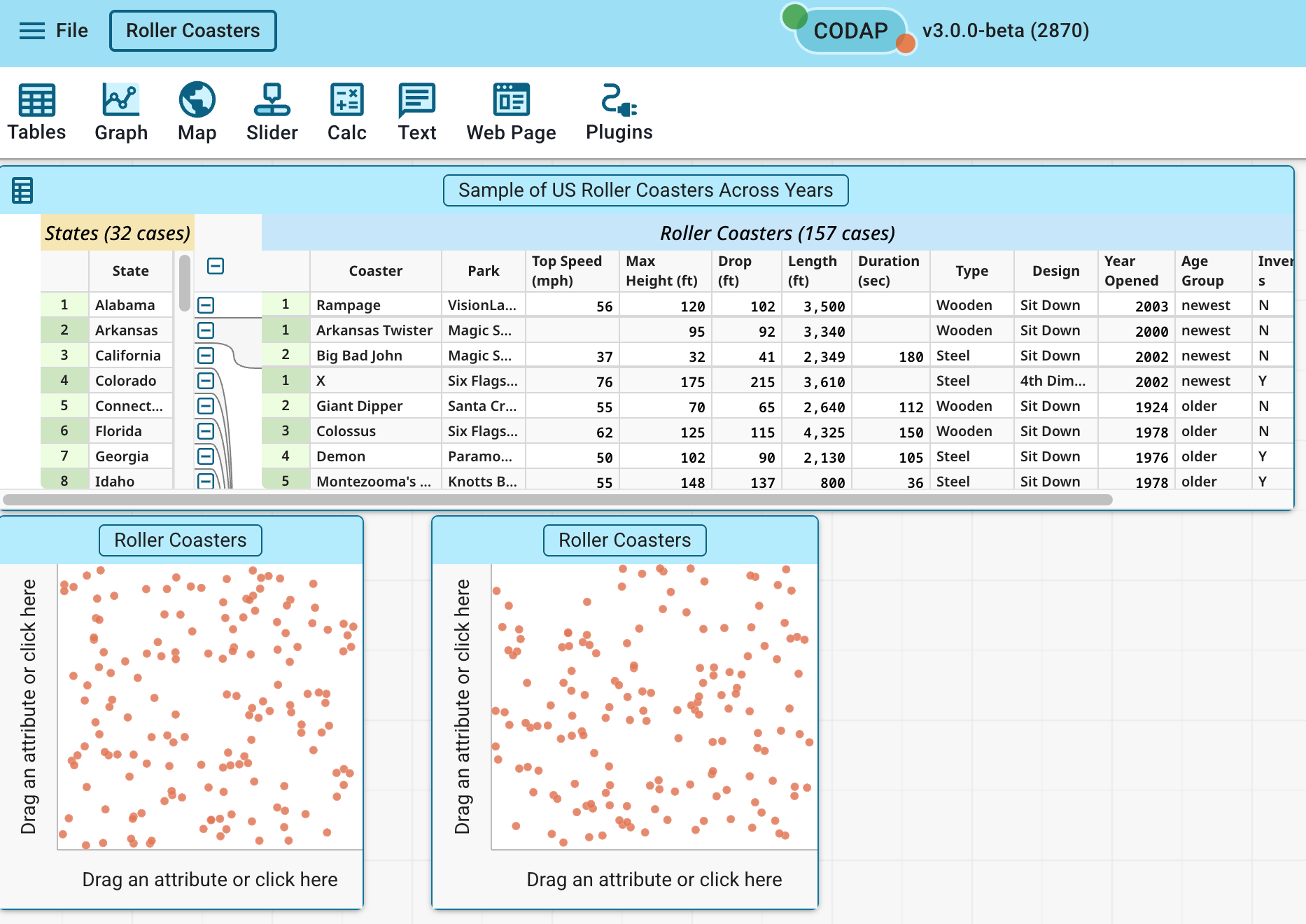
PAC worked with the Concord Consortium to produce the CODAP Accessibility Discovery Report, an in-depth review of CODAP v3 Beta and support documentation with a prioritized roadmap for improving accessibility across the learner journey.
Project Description
CODAP is a free, open-source environment developed by the Concord Consortium to help learners, educators, and researchers build data literacy through direct, interactive engagement with datasets. Its mission is to make authentic data exploration available to everyone. For that mission to hold, CODAP must be accessible to everyone who comes to it, including people who use access technologies, alternative input methods, magnification, speech recognition, or tablets as their primary device.
Prime Access Consulting (PAC) was engaged by the Concord Consortium to conduct an in-depth discovery review of CODAP’s current accessibility. The resulting report examined the full ecosystem a learner encounters, including the CODAP v3 Beta application and external support documentation. Because a user’s experience begins before they ever open the application, each layer of this ecosystem was treated as part of a continuous journey: one that any learner should be able to navigate independently, regardless of how they access it.
Discovery Review and Human Impact
PAC’s evaluation combined structured exploration of the CODAP v3 Beta environment with targeted testing of supporting external documentation. Rather than cataloging issues in isolation, the review traced the pathways a learner actually follows: discovering CODAP online, finding support materials, importing data, building graphs, and iterating through analysis. That workflow orientation surfaced not only individual barriers, but also the ways those barriers can compound across a learning experience.
Findings were organized by functional area, including keyboard navigation and focus, screen reader compatibility, visual design, switch control, zooming and scaling, speech recognition, and error recovery. The report also examined the Concord Consortium’s experimental DAVAI plugin, which uses voice input, AI, and sonification to provide an alternative pathway for blind and low vision learners.
At the center of the report was a clear account of how current barriers affect students and teachers in practice. Students using screen readers or full keyboard navigation could not independently navigate CODAP’s current interface. Students who cannot execute key actions fall behind peers who can, not because of lack of interest, effort, or analytical ability, but because the platform does not yet offer them a viable pathway into the work.
That distinction matters. In a data literacy environment, access is not only about reaching content. It is about being able to ask questions of data, manipulate variables, build representations, identify patterns, test ideas, and communicate findings. When the interface blocks those actions, it blocks participation in the learning itself.
Roadmap
The report closed with a prioritized roadmap organized into short-, medium-, and long-term phases, each designed to build on the last.
Near-term priorities focused on resolving entry-level barriers that prevent users from reaching or operating the platform at all. These included non-focusable controls, missing focus indicators, inaccessible carousels, low-contrast colour combinations, and images and icon buttons without accessible names.
Medium-term recommendations addressed deeper structural work, including application-level keyboard models, screen reader semantics across tables and graphs, voice input compatibility, accessible help documentation, and more consistent interaction patterns across the application.
The long-term vision positioned CODAP as a potential model for accessible educational technology. This phase emphasized accessibility governance, systematic user testing with diverse learners, integration of accessibility into product planning and release processes, and a technical foundation from which new features can be built accessibly from the start.
PAC’s recommendations at each phase were structured as starting points for ongoing collaboration rather than a checklist to complete once and set aside. The barriers identified were significant, but the Concord Consortium’s commitment to modernizing CODAP’s architecture, along with its investment in projects like DAVAI, demonstrated that the will to address them was already present. What the report provided was a clear-eyed account of where the gaps were, why they mattered, and how the team could move toward a CODAP where every learner can explore, analyze, and succeed.
Concluding Thoughts
PAC and the Concord Consortium’s partnership is ongoing. The discovery report established a shared understanding of CODAP’s current accessibility landscape, the human cost of its gaps, and the sustained work required to close them.
The Concord Consortium’s modernization efforts and the potential of DAVAI as an integrated feature give the next phase a strong foundation. What comes next is the structured, collaborative work of turning that foundation into a more accessible data exploration environment, one where learners are not merely able to reach the tool, but able to participate fully in the intellectual work it is designed to support.