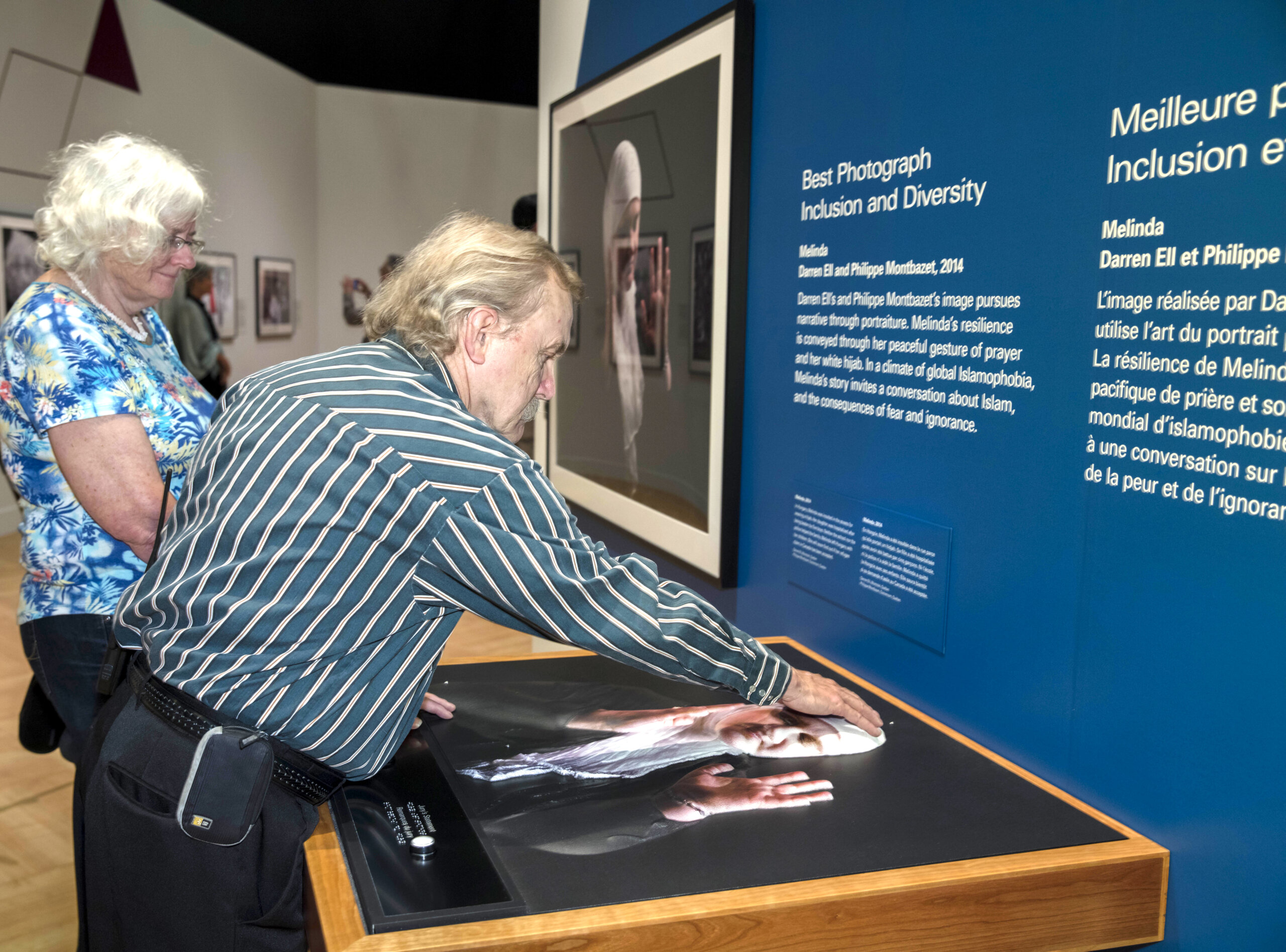
Two older people with light pink skin tone stand on our left at a photography exhibit titled, "Best Photograph, Inclusion and Diversity," in French and English. In the foreground, an older man in a striped teal shirt leans over a tactile image of a woman with light skin tone in a white Hijab, hands up in prayer. The man touches her head with one hand. Buttons with text and Braille labeling line the bottom of the tactile photo. Behind him, an older woman with white hair, glasses, and a blue floral shirt looks on. In the background is an out of focus framed portrait of the same image.

PAC worked with the Canadian Museum for Human Rights on Points of View to deliver detailed visual descriptions, tactile reproductions with audio guides, braille texts, and tactile wayfinding, enabling accessible exploration of 70 photographs—now in the museum’s permanent collection—and helping the exhibition earn an estimated $8M in media coverage.

Media
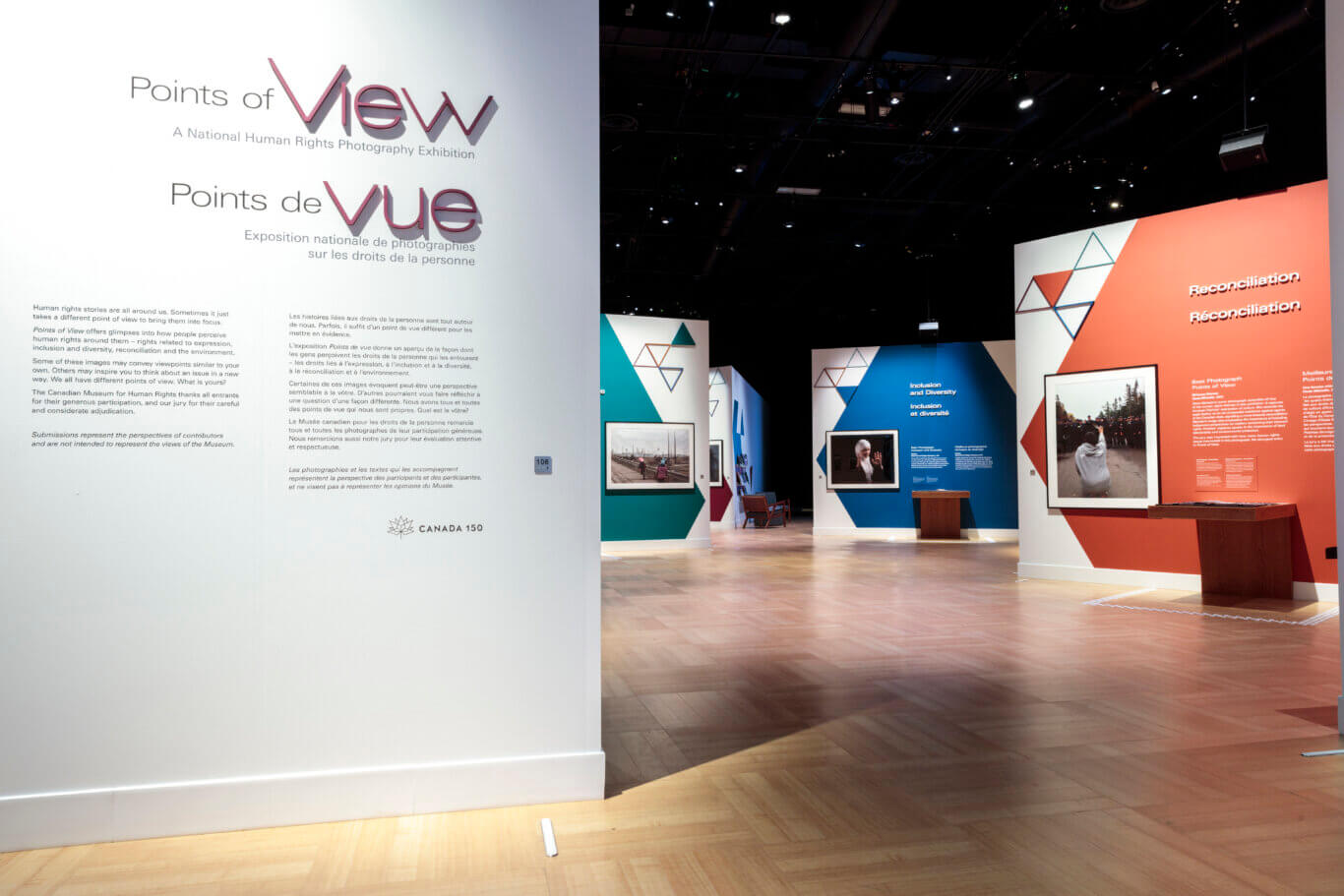
An indoor museum exhibition space with a large white wall in the foreground displaying the title "Points of View, a National Human Rights Photography Exhibition" in English and French. Illegible explanatory text appears in both languages beneath the title, along with a Canada 150 logo near the bottom. Beyond the entrance wall, the gallery contains brightly colored geometric display panels in teal, blue, and orange, with framed photographs, tactile replicas of the images, and the category headings, "Reconciliation" and "Inclusion and Diversity." The space has polished wood flooring, dark ceilings with track lighting, and tactile floor markers.
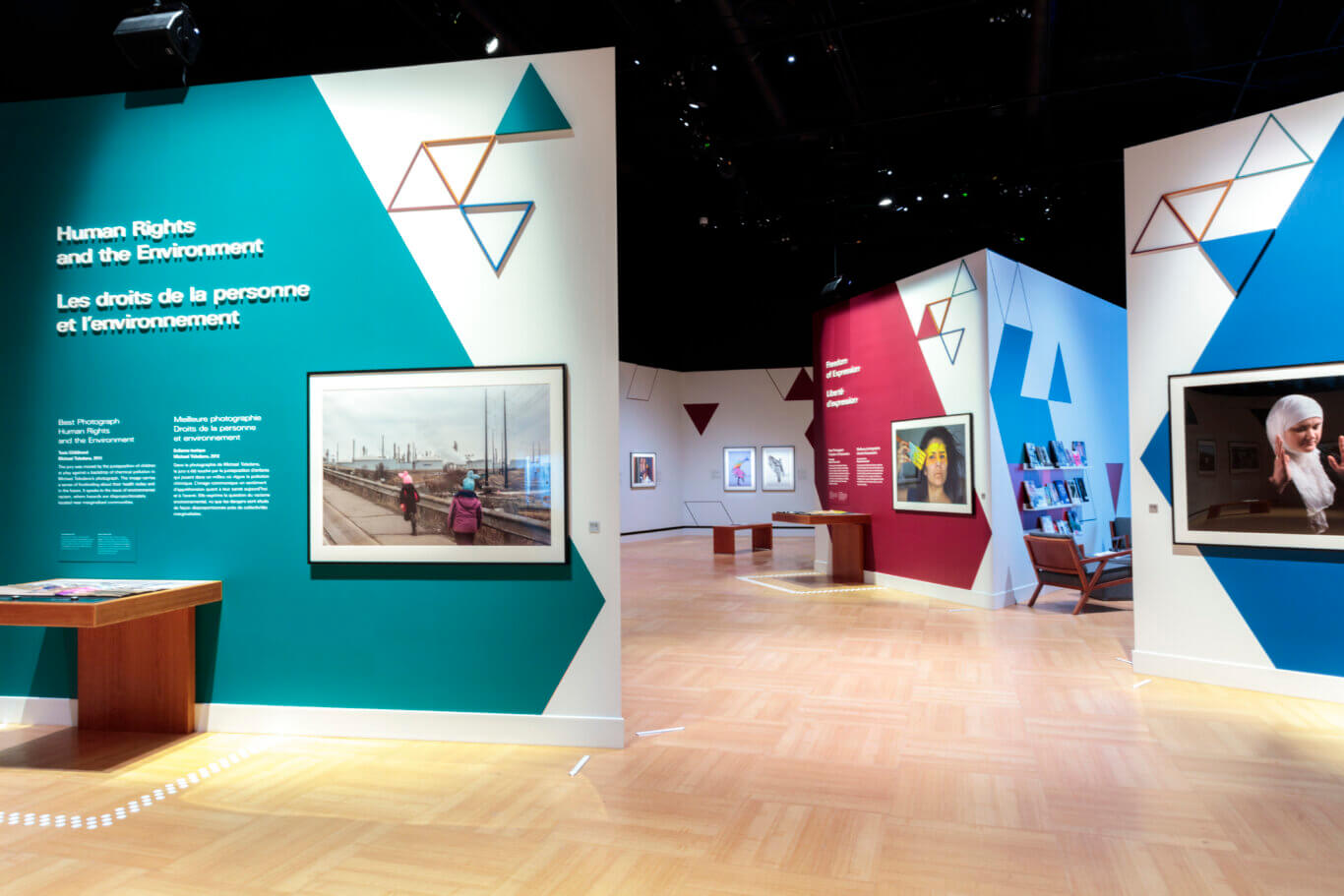
A brightly lit exhibition gallery titled "Human Rights and the Environment" in English and French with large teal, blue, white, and red wall sections decorated with triangular geometric shapes. On our left, the title wall contains wall text with the sub title, "Best Photograph, Human Rights and the Environment," alongside a framed photograph. The photo depicts two children in winter coats and pink and blue bunny ear hats running away from us on a sidewalk along side a large bleak industrial compound. Underneath the wall copy is a wooden platform jutting out from the wall with a tactile printed image of the photo. Throughout the gallery, tactile floor dots surround the tactile photos and lozenge shaped tactile floor markers are positioned perpendicular at the end of walls and partitions between the various galleries. Farther back in the gallery, another section appears to focus on "Freedom of Expression," with additional framed artworks, tactile images, and informational labels. The space has polished wood flooring, overhead track lighting, display cases, benches, and shelves.
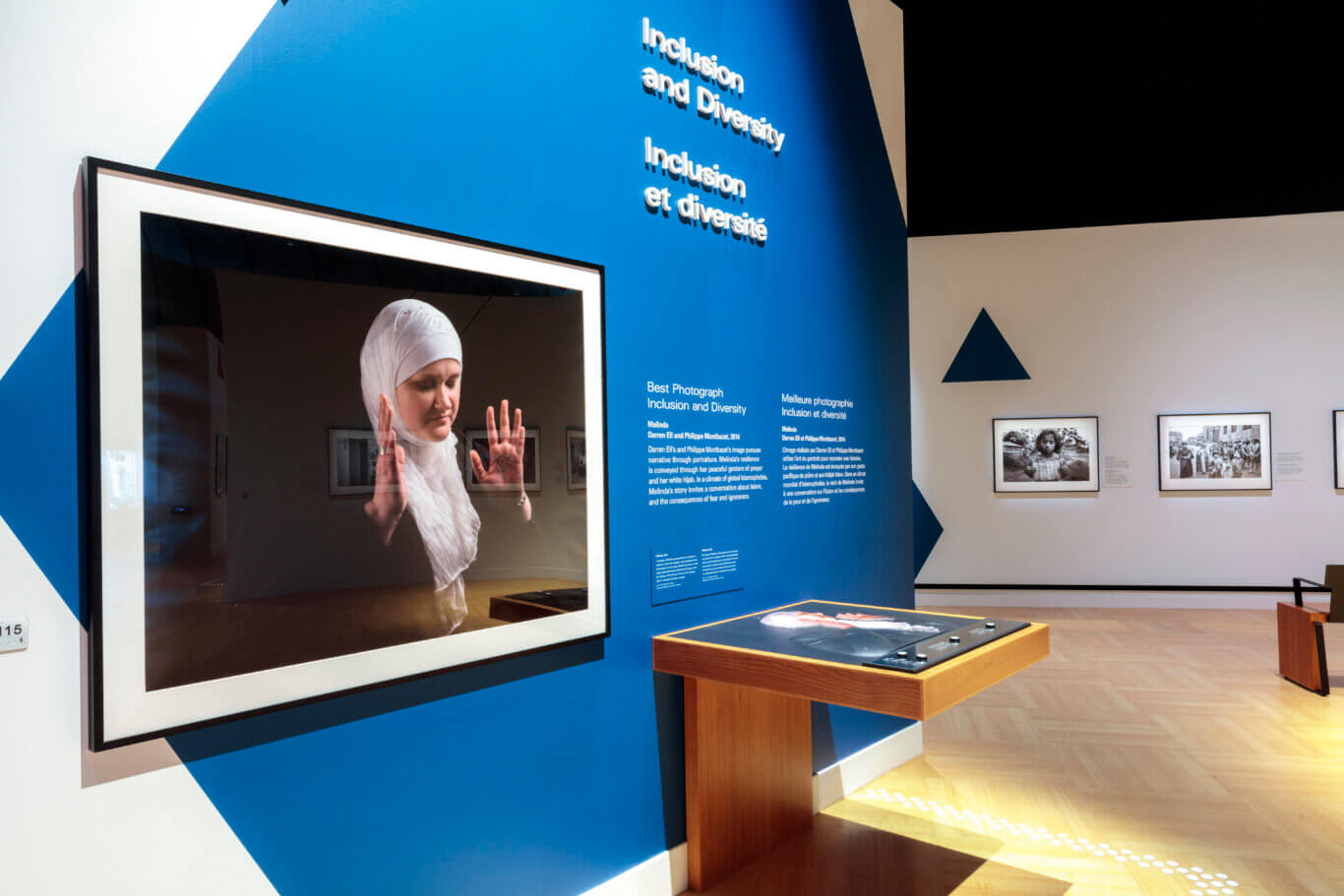
An exhibition space with a large photographic portrait of a woman with light skin tone wearing a white hijab holding her hands up in front of her, palms open, eyes closed. Below and to our right of the photo is a tactile graphic of the photo protruding from the wall with tactile floor dots on the floor framing the image. It is on a flat surface so the details are not visible. At the base of the tactile are four buttons. The items are set against a bright blue wall with the title "Inclusion and Diversity" and exhibition text in English and French. The subtitle underneath is, "Best Photograph: Inclusion and Diversity," with illegible paragraph text below. Additional framed black-and-white photographs hang in the background.
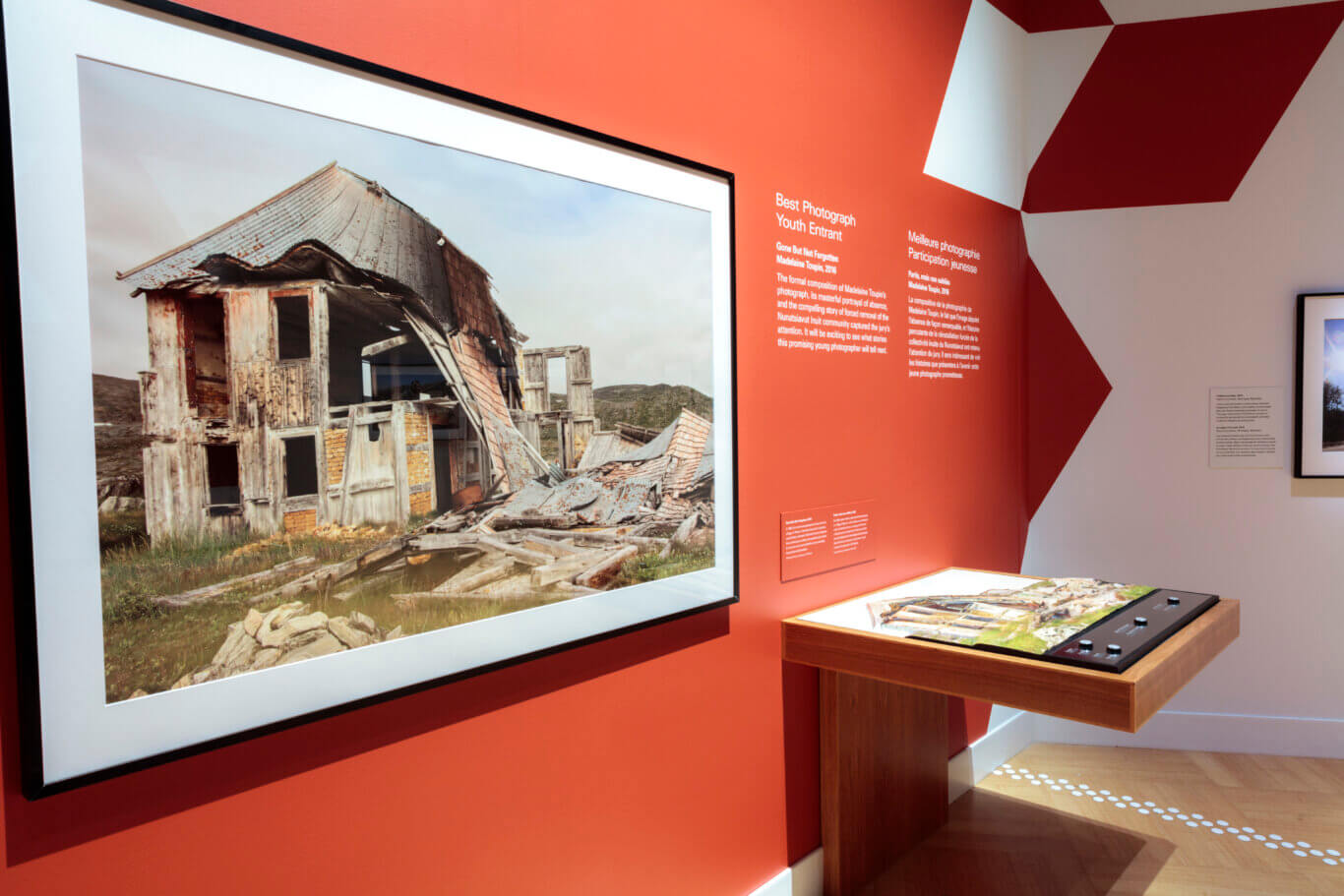
An indoor exhibition space with a large framed photo of a crumbling building on our left set against bold reddish orange-and-white geometric wall design. The photograph depicts a weathered, partially collapsed wooden structure, possibly a house, with rusted metal roofing and debris scattered around it set amongst grassy rolling hills and a grey sky. Wall text on our right says, "Best Photograph Youth Entrant," in English and French with illegible body text below. Underneath the wall text is a tactile reproduction of the photograph set on a wooden table jutting out from the wall. Four large buttons sit at the edge of the table. On the floor, white tactile floor dots frame the edge of the display table.
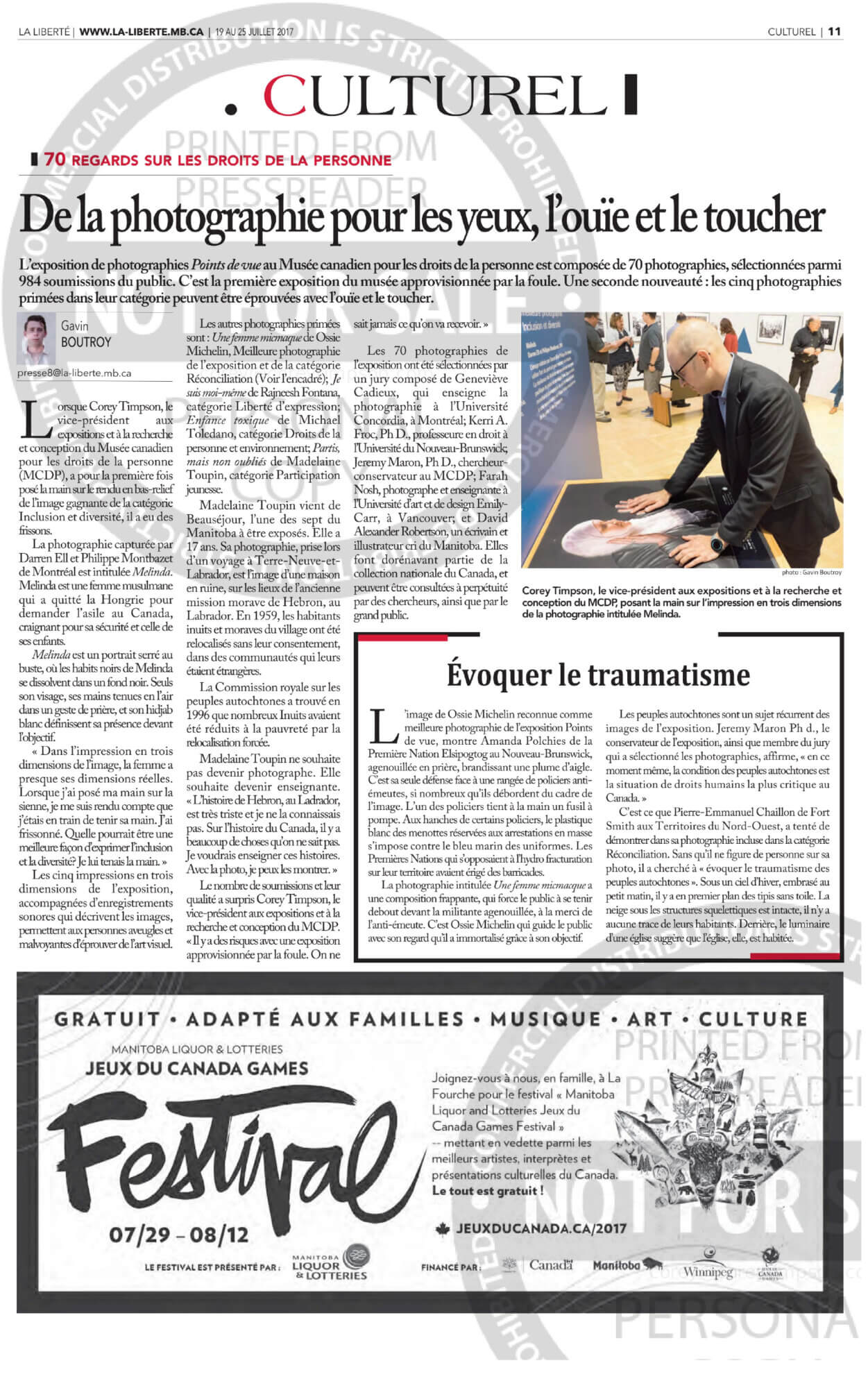
A French-language newspaper culture page presents an article about an accessible human-rights photography exhibition, arranged in narrow columns beneath a large headline, with a color photograph at upper right, a boxed sidebar below it, and a wide festival advertisement across the bottom. The newspaper is "La Liberté," the article is printed in the "Culturel"section, and the title of the article is, "De la photographie pour les yeux, l'ouïe et le toucher." The introductory text reads: "L'exposition de photographies Points de vue au Musée canadien pour les droits de la personne est composée de 70 photographies, sélectionnées parmi 984 soumissions du public. C'est la première exposition du musée approvisionnée par la foule. Une seconde nouveauté : les cinq photographies primées dans leur catégorie peuvent être éprouvées avec l'ouïe et le toucher." The color photograph shows Corey Timpson, a light-skinned white adult man with closely cropped hair and glasses, leaning over a table in a gallery and placing both hands on a raised, three-dimensional portrait of a person wearing a white hijab. Several visitors and framed photographs appear in the background. The page is overlaid with a pale repeated watermark reading "PRINTED FROM PRESSREADER" and a large circular watermark reading "OFFICIAL DISTRIBUTION IS STRICTLY PROHIBITED".

Project Description

For Points of View, the Canadian Museum for Human Rights invited people across Canada to share photographs that expressed what human rights and social justice meant to them. To make that invitation accessible, the project team adapted the Smithsonian Institution’s online submission platform to accept entries in English and French and to meet the Web Content Accessibility Guidelines (WCAG).

A jury selected 70 photographs from more than 1,000 submissions on the themes of Inclusion and Diversity, Freedom of Expression, Reconciliation, and Human Rights and the Environment. The museum acquired all 70 photographs for its permanent collection, giving photographers who answered a public call a direct role in shaping what a national museum would preserve.

Exploring Photography Through Sound and Touch

We worked with the museum to provide detailed visual descriptions for all 70 photographs. For each of the four category winners, visitors could also explore a tactile reproduction while listening to a description that guided them across the image. As they moved their hands, the description helped them locate individual details and understand how those details fit together in the photograph. Elsewhere in the gallery, visitors could read exhibition text in braille and use tactile cues to find their way between works.

Holding Hands With a Portrait

The winning photograph in the Inclusion and Diversity category shows a woman dressed in black against a black background. She wears a white hijab and holds her hands out in prayer. Before making the tactile version, the team spoke with both the photographer and the woman in the portrait. Visitors exploring the reproduction would be able to trace the contours of her body, and the team wanted to know how she felt about sharing her likeness in that way. She welcomed the idea and was enthusiastic about giving visitors access to her portrait through touch.

It was only when the team was prototyping the nearly life-size portrait and authoring the guided tactile description for it that they understood what its scale made possible. A visitor exploring the image by touch could reach the woman’s outstretched hands and find themselves holding hers.

At a time of heightened racial and ethnic tensions, the story of that intimate gesture traveled far beyond the gallery. The museum had no budget to promote Points of View and had counted on word of mouth from the call for entries, yet the exhibition went on to receive earned media coverage valued at an estimated $8 million!

Concluding Thoughts

The open call gave photographers across Canada a voice in what the museum would preserve, and the conversation about the portrait brought the woman in front of the camera into the decision about how her likeness would be shared. What has stayed with us at PAC is how much we learned about the photograph ourselves by making it accessible in a way she welcomed. We knew a visitor could trace the shape of her hands, but it took having the finished portrait in front of us to appreciate what it might feel like to reach for them. Her gesture of prayer had been there in the photograph all along, and now a visitor could meet it with a gesture of their own.