Projects: Canadian Museum for Human Rights

Inclusively Designed Mobile Application
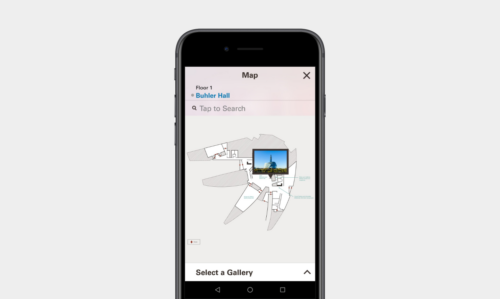
A black smartphone centered on a light gray background. On the phone screen is a map page titled "Map," with a close "X" icon in the top-right corner. Below the title, the interface lists "Floor 1" and highlights "Buhler Hall" in blue. A search field labeled "Tap to Search" appears beneath it. The main area displays a detailed floor plan with pathways and room outlines, including a small photo preview overlay of a building or landmark. At the bottom of the screen, a collapsible bar reads "Select a Gallery" with an upward arrow, suggesting more options can be expanded.
Canadian Museum for Human Rights

PAC supported the Canadian Museum for Human Rights in shaping and validating an inclusively designed mobile application that extends the museum’s Universal Access Point strategy, connecting gallery interfaces, beacon-based location content, and accessible exhibition media in English and French.

Empowering Women
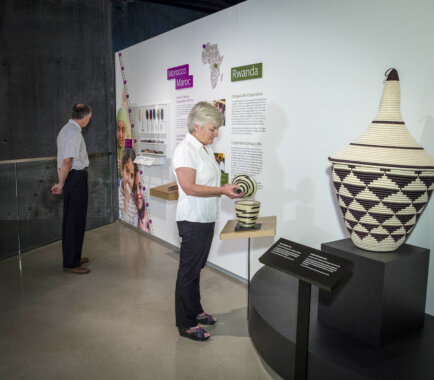
A museum exhibit with informational panels labeled "Morocco / Maroc" and "Rwanda." A map of Africa highlights locations, and wall text describes the Gahaya Links Cooperative in Rwanda with large woven baskets with black and cream patterns displayed on pedestals on our right. A woman with light skin tonepicks up the lid of a small basket that looks like a smaller version of the towering basket on our left. The Morroco exhibit features a large photo of smiling children with light brown skin tone arm in arm and a base with jewlery. The space has a modern, minimal design with white exhibit walls, dark structural elements, and polished concrete flooring.
Canadian Museum for Human Rights

PAC worked with the Canadian Museum for Human Rights to expand Empowering Women into a multimodal, accessible exhibition experience featuring tactile objects, multilingual description, and a user-tested virtual reality component extending its stories beyond the museum.

Mandela
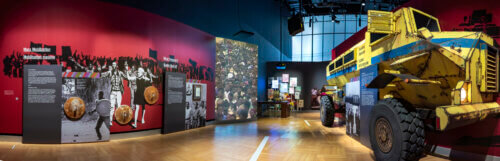
A dramatic indoor museum display focused on mass mobilization and anti-apartheid struggle. On our left, large red walls are covered with archival photos and black-and-white silhouettes of crowds of Black South African protesters holding rusty trash can lids, with prominent bilingual text such as "Mass Mobilization" and "What Freedom?" Across the room stands a massive yellow armored tank, towering twice as high as the protestors. Around it are tall dark information panels with historical text, photographs, posters, and archival imagery. Through the middle of the room on the floor is a white strip of raised tactile floor markers.
Canadian Museum for Human Rights

For the Canadian Museum for Human Rights, PAC Principal Corey Timpson directed and produced Mandela: Struggle for Freedom, a bilingual touring exhibition with immersive, interactive, and fully accessible media exploring Nelson Mandela’s life, the anti-Apartheid movement, and his legacy.

Capital Project
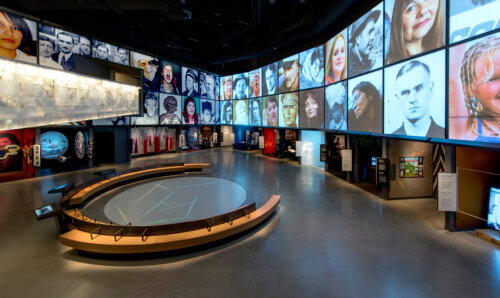
A modern, dark exhibition space with immersive multimedia displays. Large wall screens feature a city skyline, portraits of people, and text from the Universal Declaration of Human Rights, including "All human beings are born free and equal in dignity and rights" in English and French. A video of a person has captions in both French in English with two smaller inset sign language interpreters placed next to the main video. In the foreground are glass display cases set into angular wooden platforms and benches, with reflective polished floors and blue-toned lighting.
Canadian Museum for Human Rights

At the Canadian Museum for Human Rights, the Capital Project established a foundational precedent for PAC’s inclusive design practice, embedding accessibility across exhibitions, architecture, digital platforms, the Universal Keypad, Universal Access Point, and Enterprise Content Management System to create a coherent, accessible museum experience.

Inclusive Design Policy

Canadian Museum for Human Rights

PAC helped the Canadian Museum for Human Rights craft an Inclusive Design Policy that formalized accessibility requirements across websites, internal systems, exhibition technologies, and visitor-facing digital experiences within the museum’s governance structure.

Footer

Prime Access Consulting