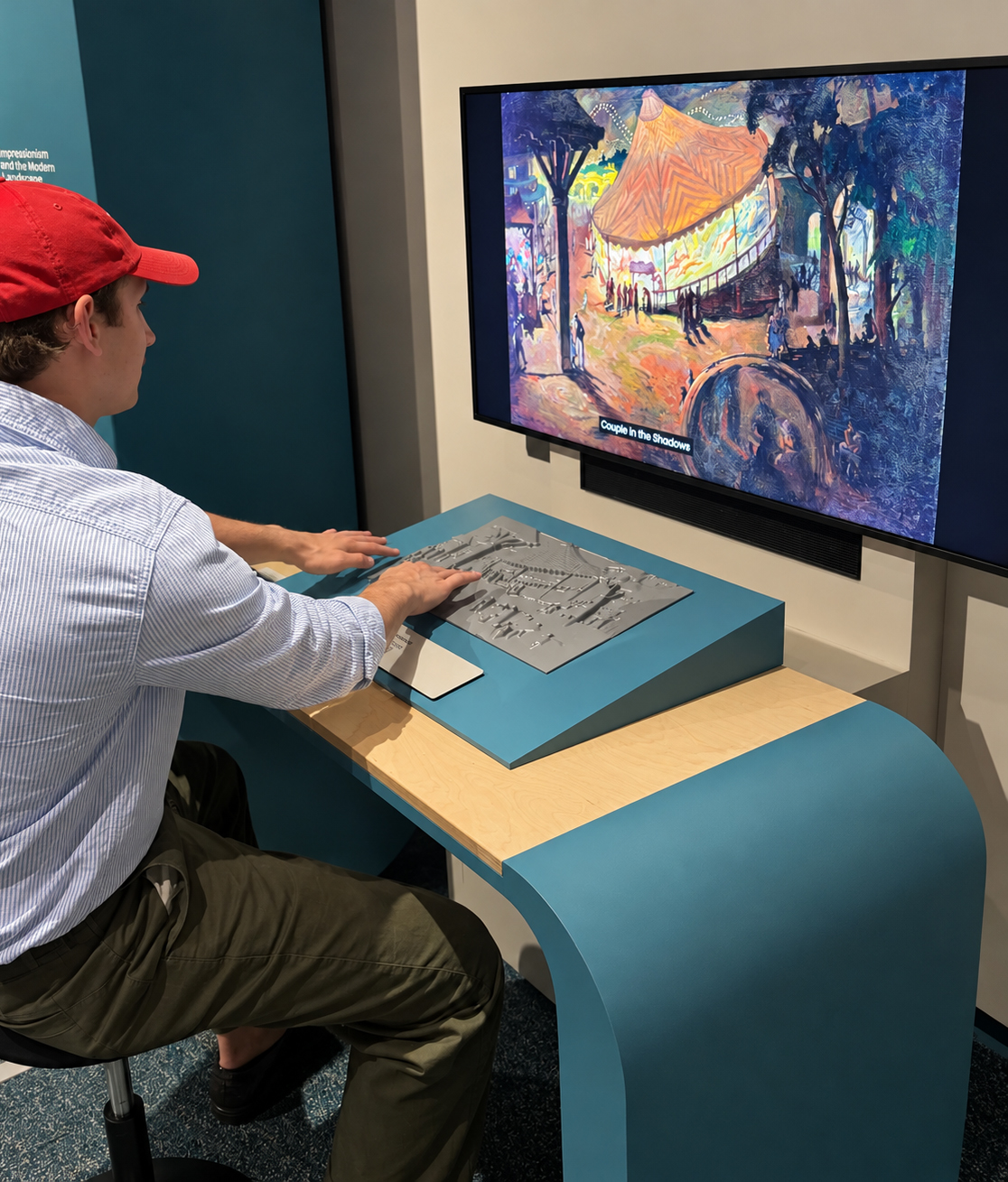
A seated museum visitor with light skin tone touches a slightly sloped grey tactile relief of a circus tent in front of a digital screen with an image of the painting on the screen. His fingertips rest on raised shapes and textured lines. The screen displays a colorful painting of a nighttime outdoor scene, with an orange-roofed carousel glowing among dark blue trees and small silhouetted figures; a caption at the bottom reads, "Couple in the Shadows." A black speaker is mounted directly below the screen. The visitor is wearing a red baseball cap, a pale blue-and-white striped shirt, and olive-green trousers.

PAC partnered with the Cleveland Museum of Art, Design I/O, Dome Collective, and Line Break on ArtLens Reimagined, the third iteration of the museum’s ArtLens gallery, leading inclusive experience design, tactile design, and the digital accessibility of the companion ArtLens app so the reimagined gallery is accessible by design rather than by afterthought.

Media
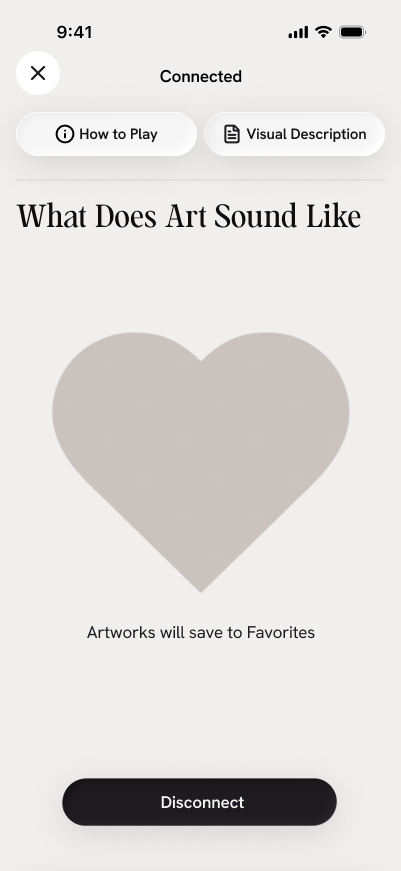
A smartphone app screen on a pale gray background shows a screen with the title, "What Does Art Sound Like" and a large grey heart. Starting at the top, the screen reads, "Connected," a circular close button with an X sits to the left. Underneath, two rounded white buttons appear side by side: the left has an information icon and reads "How to Play," and the right has a document icon and reads "Visual Description." Beneath a thin horizontal divider, a large serif heading reads "What Does Art Sound Like." A large pale gray heart fills the center of the screen. Under the heart, text reads "Artworks will save to Favorites." Near the bottom, a wide black rounded button reads "Disconnect."
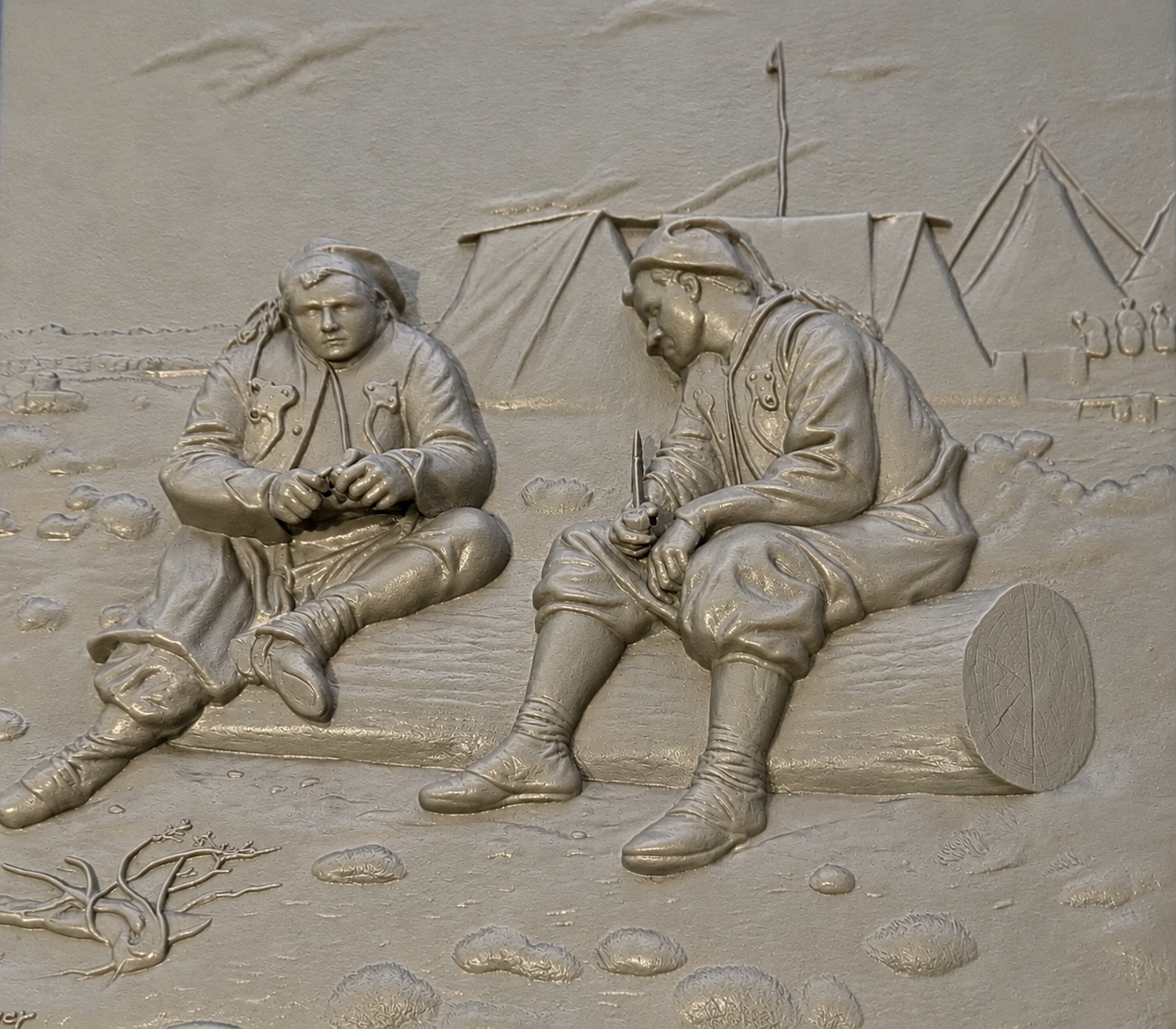
A monochrome gray tactile relief depicts two soldiers resting in a sparse encampment, whittling wood. On our left, the man sits on the ground with one leg extended and the other bent across the body. He wears a soft cap or head covering, a heavy decorated coat, loose trousers, and ankle-high footwear, and he holds a small indistinct object between both hands while looking downward. On our right, the man sits hunched forward on a horizontal log, wearing a headband or close-fitting cap, a similarly decorated coat, loose knee-length trousers, wrapped lower legs, and soft shoes. He holds a narrow pointed tool upright in one hand and steady another small object near their lap. The circular cut end of the log faces us at the far right and is incised with tree-ring and crack patterns. Several angular canvas tents rise across the background, with poles and taut seams rendered in shallow relief. A partial raised marking on the tent at the right edge is cropped. Scattered stones, tufts of grass, and a bare branching limb cover the foreground, while faint birds or clouds appear in the shallowly textured sky.
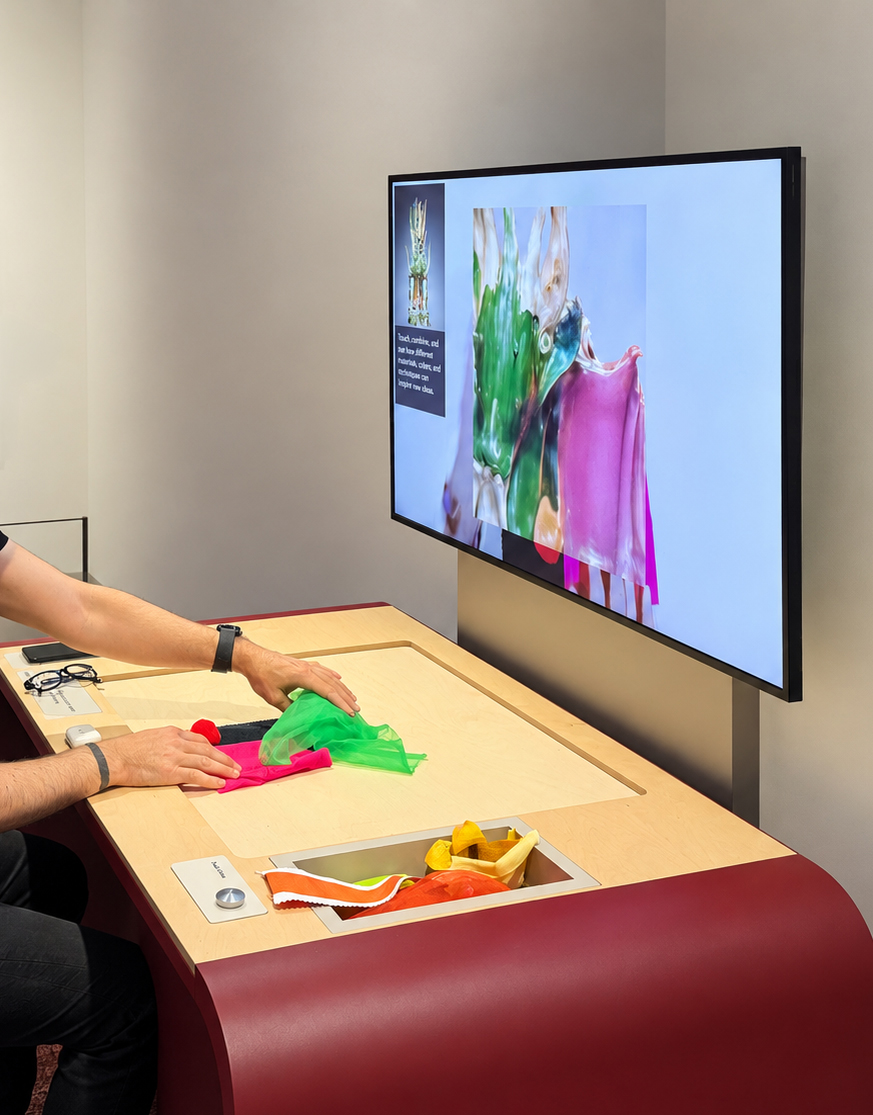
A museum-style interactive station where a seated adult with light skin tone, visible only from the torso and arms, presses bright green, pink, and dark fabric across a large pale wooden tabletop in front of a large screen. A recessed compartment near the front holds additional yellow, orange, white, and green fabric pieces, and a silver control panel beside it has a round knob with a small label that appears to read "VOLUME." A large monitor mounted above the table displays a sculpture with similar colors and shapes as the materials on the table. Along the monitor's left edge, a narrow black panel contains a small image of a glass-like object and five lines of white blurred instructional text. The installation stands against plain off-white walls, and the tabletop curves downward into a deep burgundy-red base.
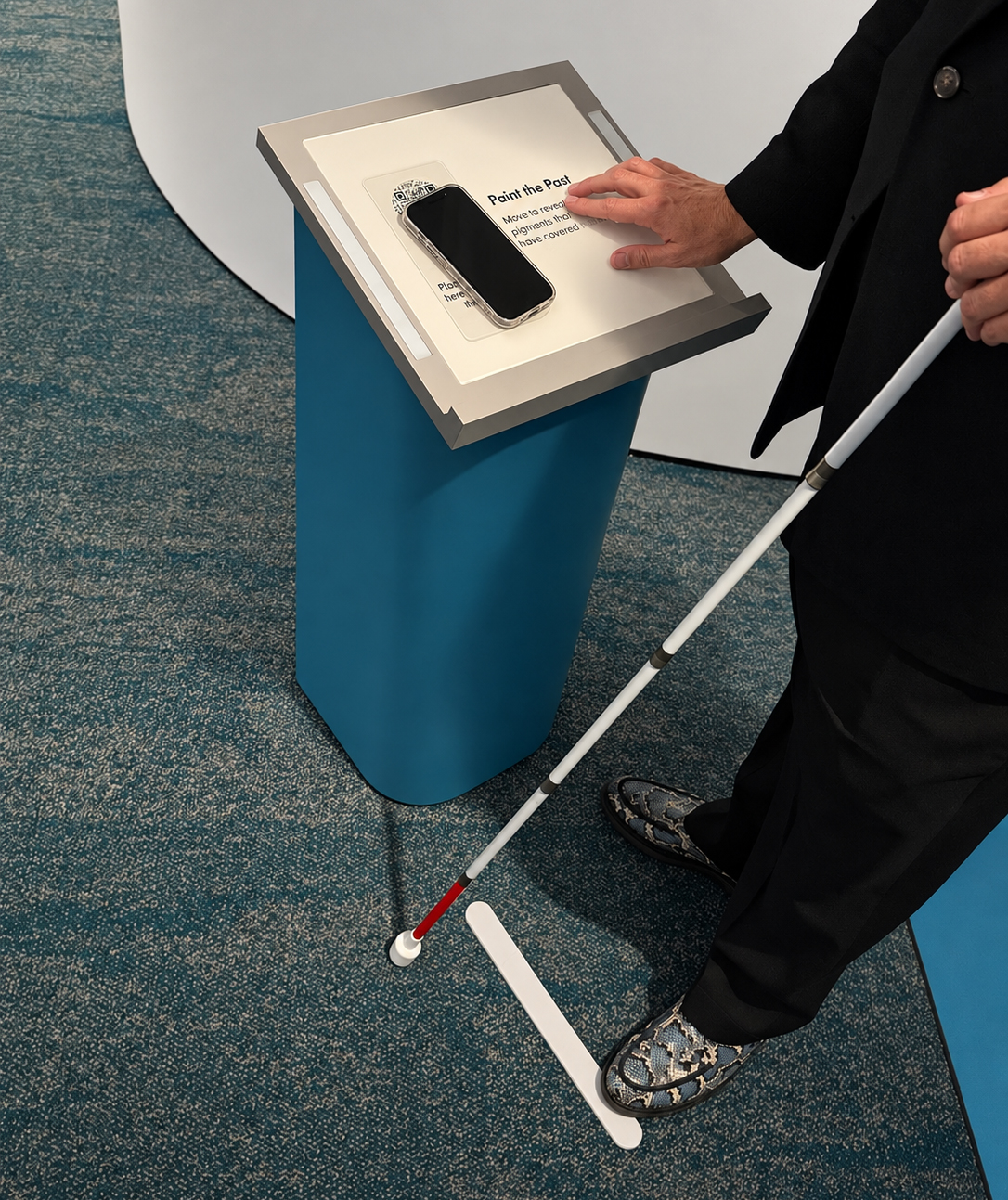
An adult with light skin reading Brailed on a short podium with a smart phone sitting on top while holding a white mobility cane. The person stands on our right in a black coat and trousers with gray, black, and blue snake skin patterned shoes. His left hand rests on the slanted rectangular display, which is mounted on a tall blue pedestal, while their right hand holds the cane. A black-screened smartphone in a clear case lies diagonally across the display, partly covering a QR code and printed instructions. The visible heading reads "Paint the Past." Beneath it, partly covered text reads "Move to reveal pigments that have covered"; the rest is obscured by the hand. Near the phone, another block of small text is largely obscured and unreadable. A long, raised white floor marker juts out from the podium and the person's shoe rests on the end. The floor has a mottled teal-and-beige carpet, and a curved white wall or display panel fills the background.
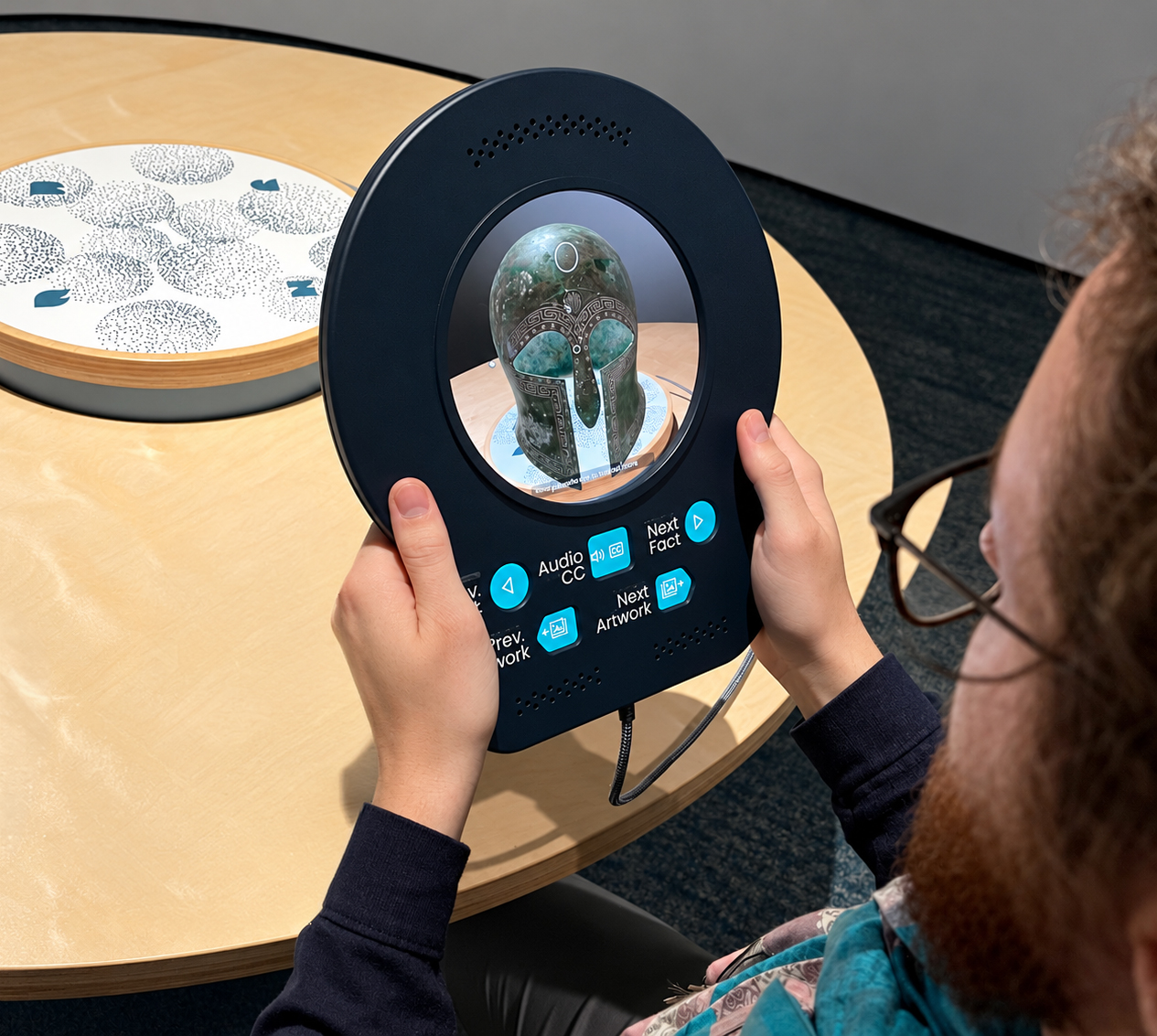
A seated person with light skin holding a large black interactive museum viewer above a pale wooden table. The viewer has a rounded top, perforated speaker holes, a circular screen, illuminated turquoise controls, and a cable extending from its lower edge. On the screen, an ornate dark green helmet is shown from the front, with turquoise eye areas, silver geometric borders, a long nose guard, and a small oval marking near the crown. The viewer's visible labels read "V.", with the rest obscured by the visitor's hand; "Audio CC"; "Next Fact"; "Prev. Artwork"; and "Next Artwork." Turquoise buttons display a left-pointing triangle, a speaker symbol, "CC," a right-pointing triangle, and small artwork icons. Behind the viewer, a round inset display on the table contains a white surface patterned with gray stippled shapes and several small dark teal forms. The visitor grips the device with both hands and looks toward the helmet image.
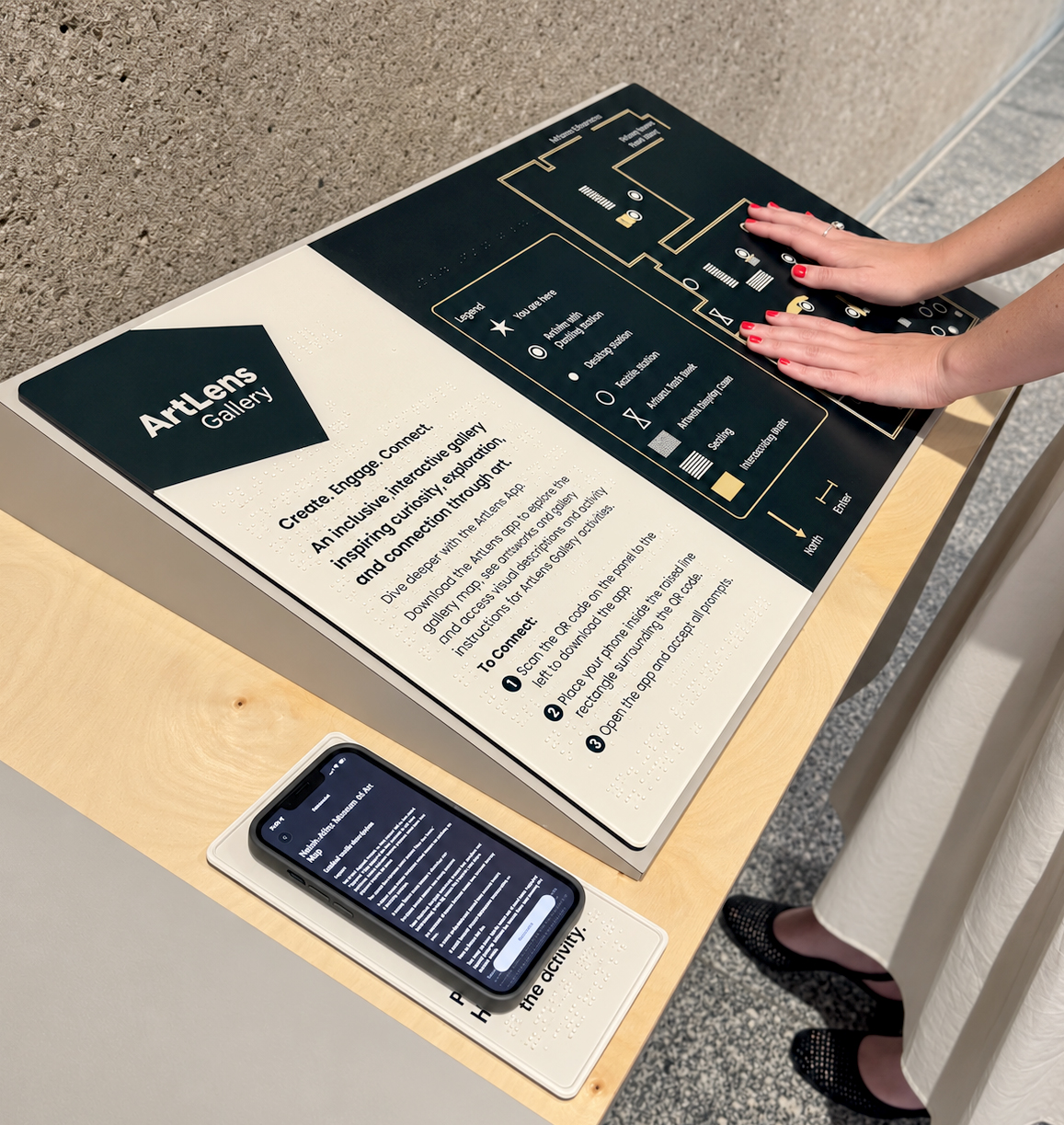
An ArtLens Gallery tactile map table viewed from above and at an angle, with a large black-and-cream tactile map, raised Braille, and a smartphone resting on a smaller panel. At right, a person with light skin tone, red-painted fingernails, and a silver ring places both hands on the map. The large panel's dark logo block reads "ArtLens" and "Gallery." Beneath it, bold text reads: "Create. Engage. Connect. An inclusive, interactive gallery inspiring curiosity, exploration, and connection through art." Smaller instructions read: "Dive deeper with the ArtLens App. Download the ArtLens app to explore the gallery map, see artworks up close, and easily access audio descriptions and activity instructions for ArtLens Gallery activities." A section headed "To connect:" continues: "1 Scan the QR code on the panel to the left to download the app. 2 Place your phone inside the iridescent rectangle surrounding the QR code. 3 Open the app and accept all prompts." The black map uses thin gold outlines for rooms and white, gold, and gray accessibility symbols. Its key reads "Legend," "You are here," "ArtLens Exhibition Digital Display," "Drawing station," "Practice station," "Manual door button," "Seating," and "Interactive art"; one additional legend label and the small room names at the top are too blurred to transcribe reliably. Direction labels at the lower right read "North" and "Entrance." Numerous lines of raised Braille accompany the printed information, but the individual Braille characters cannot be reliably transcribed at this resolution. The smartphone shows a dark webpage whose heading appears to read "ArtLens Mobile Museum of Art." The table has a pale wood surface beside a rough gray wall and speckled gray floor.
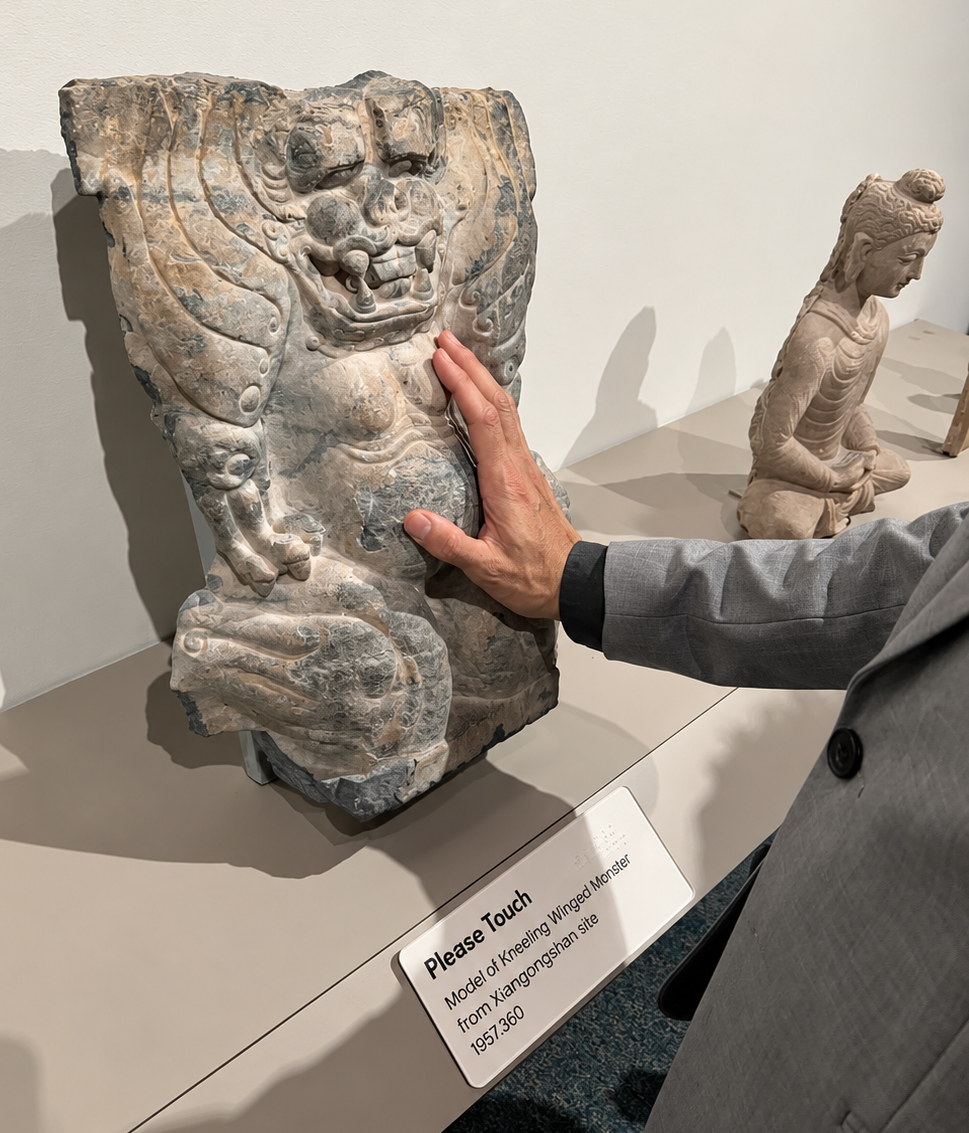
A museum display features a weathered gray-beige stone model of a kneeling winged monster, which a person touches with an open hand. The blocklike sculpture stands upright on a low beige platform against an off-white wall. Its high-relief figure has a broad head, bulging eyes, a wide toothy grin, two downward-pointing tusks, curling decorative forms, large wings framing its upper body, a rounded belly, bent legs, and worn, mottled surfaces. At right, only part of the visitor is visible: a light-toned hand rests flat against the monster's chest and abdomen, extending from a gray suit sleeve with a black cuff. Farther back on the right sits a smaller pale stone figure of a seated Buddha with wavy hair gathered in a bun, layered robes, a bowed head, and hands resting on his lap. An angled white label at the front reads in Braille and text: "Please Touch" followed by "Model of Kneeling Winged Monster" and "from Xianglongshan site" and "1957.360".
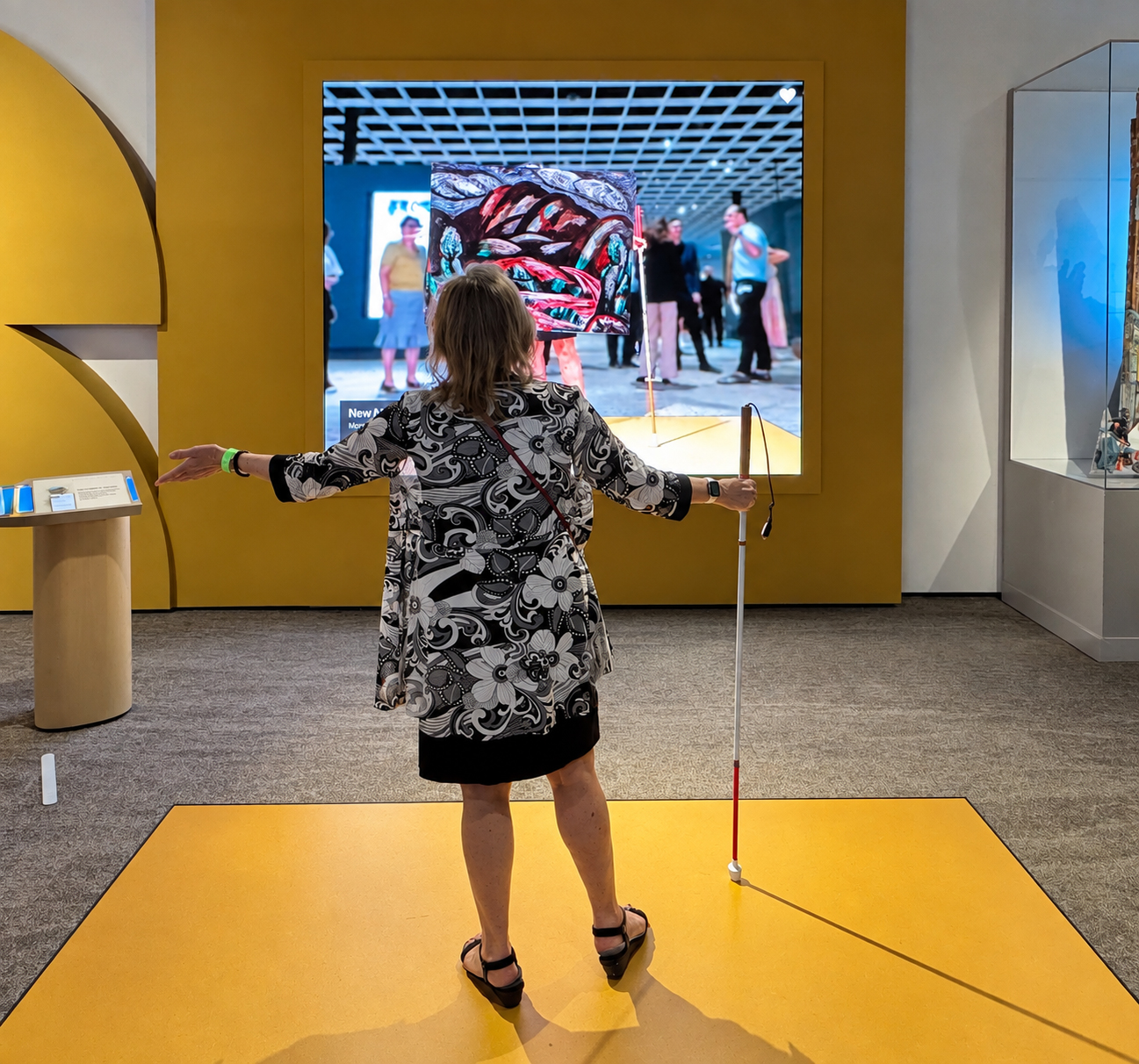
An adult from behind, standing on a large yellow platform in a museum gallery and facing a wall-mounted interactive screen. The visitor has light skin and shoulder-length light brown hair and wears a loose black, white, and gray floral-patterned top over a black skirt or dress. Their arms extend outward to either side; their right hand holds a long white cane with a red end, its tip resting on the platform. The screen displays a blurred gallery scene with several visitors beneath a white grid ceiling, overlaid at center by a vivid rectangular artwork filled with twisting red, black, white, turquoise, and blue forms. A small white heart icon appears in the screen's upper-right corner. The display is set into a mustard-yellow wall framed by large curved yellow architectural panels on the left. A small pedestal on our far left holds several labels or controls with blue-lit edges. On our right, a tall glass display case glows blue and contains only a cropped portion of an object near the image edge. Gray patterned carpet surrounds the yellow flooring.

Project Description

The Cleveland Museum of Art’s ArtLens gallery has evolved through three iterations, from the original Gallery One to ArtLens Reimagined, a fully rebuilt, 10,000-square-foot gallery that opened on July 28, 2026. With 21 new interactive experiences, the gallery brings together art, technology, and hands-on exploration. The museum engaged PAC to lead inclusive experience design, tactile design, and digital accessibility for the companion ArtLens app, working alongside collaborators including Design I/O, Dome Collective, and Line Break.

The project builds on PAC’s longstanding relationship with the museum in [digital accessibility and visual description(https://pac.bz/projects/using-ai-as-a-tool-for-visual-descriptions/). This includes recent work exploring how artificial intelligence can support the development of visual descriptions at scale for blind and low vision visitors, culminating in the museum writing descriptions for every primary image in its permanent collection.

Experience Design

PAC’s work began with the premise that access should be born into an experience. Decisions about materials, geometry, and interaction shape who can participate and how. By bringing inclusive design into those decisions from the outset, the team could develop more ways for visitors to engage with each interactive and its learning objectives.

PAC conducted detailed design build reviews during each of the project’s three major design phases: concept design, schematic design, and design development. At each phase, PAC provided guidance directly to the museum’s design team and its technology and fabrication partners, helping carry inclusive design from initial ideas through to the built experiences.

Dedicated inclusive design charrettes brought collaborators together across disciplines and organizations to explore possibilities, work through challenges, and develop solutions that connected each interactive’s learning objectives with practical approaches to access.

PAC’s guidance also extended throughout the built environment. This included an inclusive seating system that offers visitors options for rest and engagement; specifications for table and interactive surface heights, reach distances, and clearances; and reviews of environmental graphics for legibility and contrast.

Tactile Design

For Sacred Sites Revisited, a multimedia installation that reconnects dispersed Asian sculptures and architectural fragments with their original sacred, ritual, and cultural environments, PAC worked with the production and fabrication teams to develop touch objects that would be both understandable and engaging through tactile exploration.

PAC also led the design and production of tactile reliefs of two paintings: Flying Ponies (Euclid Beach Park), painted by Carl Gaertner in 1932, and The Brierwood Pipe, painted by Winslow Homer in 1864. Working with its fabrication partner, PAC developed an initial relief prototype and conducted in-person prototyping with project stakeholders. This process explored how the relief worked through touch and with the hand-tracking technology Design I/O was developing, informing the production of both final pieces.

In the resulting interaction, What Does Art Sound Like?, visitors hear descriptions of elements in each painting’s composition as they move their hands across the relief. Touch and sound work together to help visitors explore the artwork’s details and spatial relationships.

PAC designed and produced tactile maps for both gallery entrances and every Braille panel across the experience. PAC also advised on a tactile wayfinding system that uses changes in flooring to communicate how spaces function: concrete marks circulation areas, carpet identifies places to dwell, and rubber distinguishes the interactives. Tactile floor markers, designed and installed with PAC’s support, help visitors locate the phone docking stations where interactive experiences begin.

Digital Accessibility

PAC worked closely with Dome Collective and Line Break to rebuild the ArtLens app, connecting digital accessibility with the inclusive design features throughout the gallery. For the ArtLens gallery, the app provides an overview of each space, descriptive introductions and instructions for each interactive, visual descriptions of artworks, guided tactile descriptions of maps and touch objects, and general accessibility information.

The new app (available now for iOS and Android devices in the app stores) offers much more beyond the ArtLens gallery experiences. All users can explore and discover the museum’s collection whether they are on or off site via the app’s map to find and favorite artworks. PAC worked with the development partners to surface all information visually present in the map as dynamic and structured text to ensure all users can navigate throughout the galleries and take tours. Together, the app and physical features support visitors in orienting themselves, understanding how to participate, and exploring the collection.

Concluding Thoughts

PAC’s involvement across experience design, tactile interpretation, the built environment, and digital accessibility helped connect individual design decisions into a cohesive visitor experience. From finding an interactive to exploring a painting through touch and sound, the gallery offers blind and low vision visitors, alongside visitors with a wide range of abilities and disabilities, multiple ways to participate in a shared encounter with art.