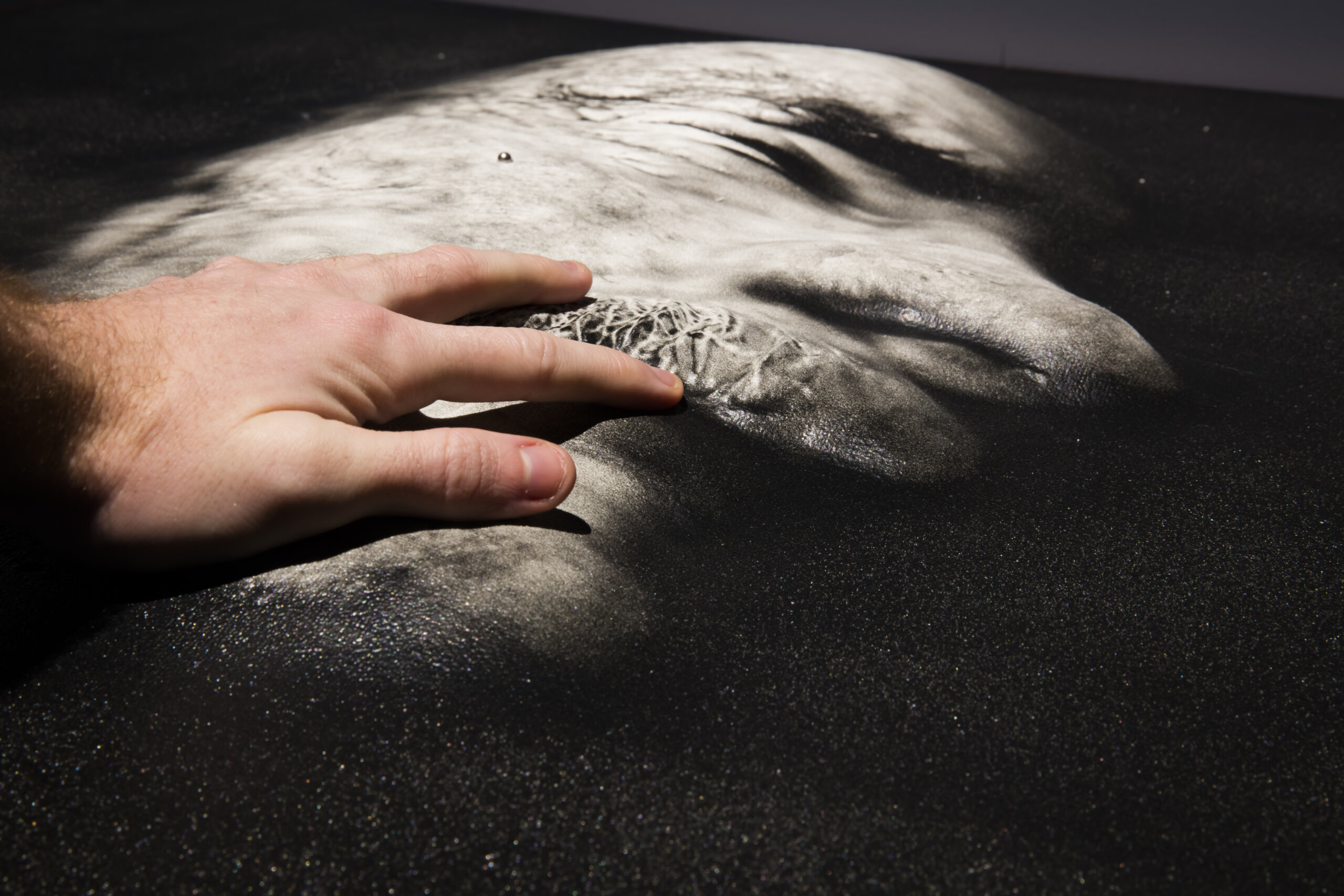
A close-up view of a hand with light skin touching a black and grey, shiny textured and raised black and white image of a distored human face with light skin tone. Across the surface are cloudy white streaks and raised textured patches on the person's mustache. Bright sunlight creates strong contrast, deep shadows, and sparkling reflections in the dark areas. A small raised silver bead is embedded into the middle of the person's cheek.

PAC partnered with the Canadian Museum for Human Rights to design Sight Unseen, a multimodal photography exhibition by blind photographers, integrating tactile wayfinding, 3DPhotoworks sculpted reliefs with touch-activated audio, and participatory nonvisual photo-taking and swell-form tactile drawing activities that democratized content and made accessibility the creative driver.

Media
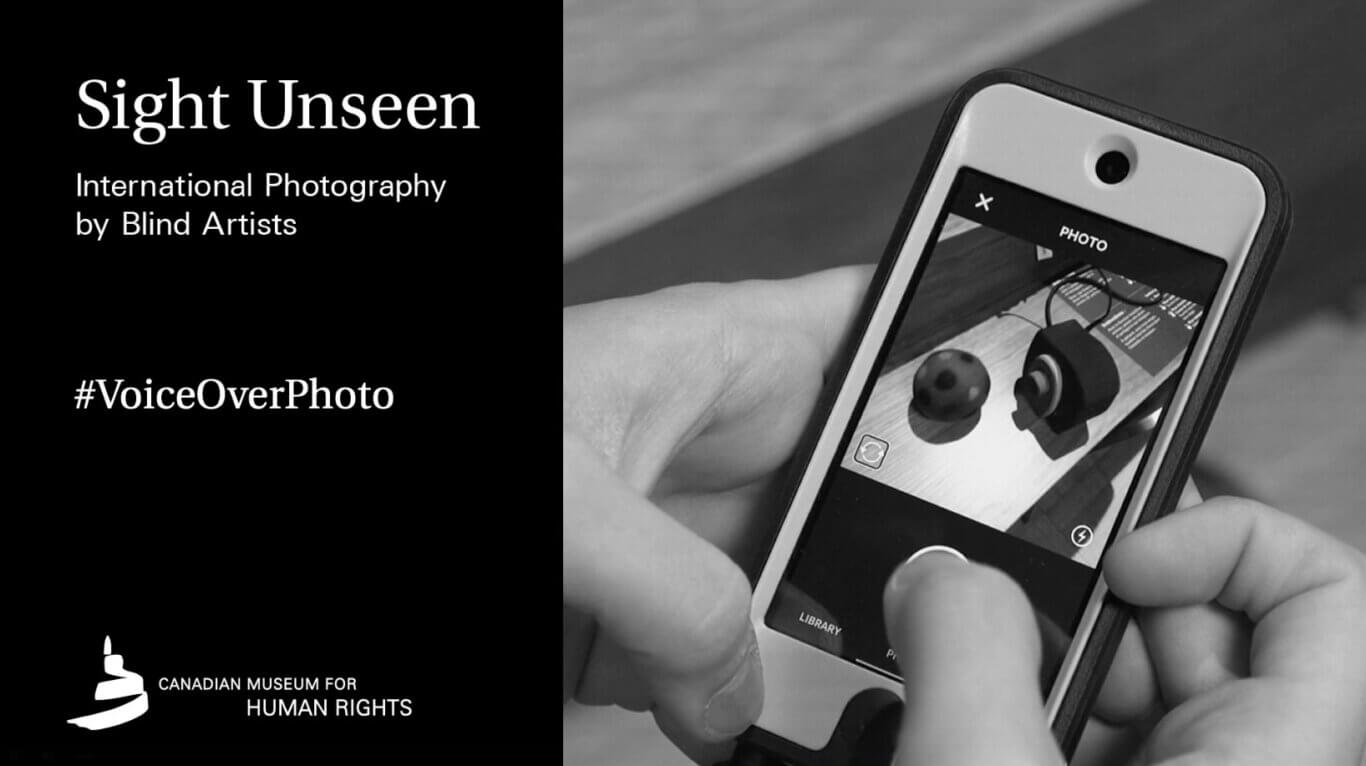
A black-and-white promotional graphic is divided vertically between a solid black text panel on our left and a close-up photograph of a smart phone on our right. Large white text at the upper left reads: "Sight Unseen". Beneath it, smaller text reads: "International Photography by Blind Artists". Midway down the panel is the hashtag "VoiceOverPhoto". At the bottom, a white abstract logo resembling a curled ribbon or candle appears beside the words "CANADIAN MUSEUM FOR HUMAN RIGHTS". On our right, two light toned hands hold a smartphone at an angle while a thumb touches its screen. The phone displays a camera interface photographing a tabletop with a small spotted ball, a dark angular device with a circular center, coiled cables, and a printed page whose tiny text is too blurred to read. Legible interface text includes an "×" at upper left, "PHOTO" near the top, "LIBRARY" at lower left, and a partially obscured "P" near the bottom center. Circular interface icons appear near the lower corners of the displayed photograph.
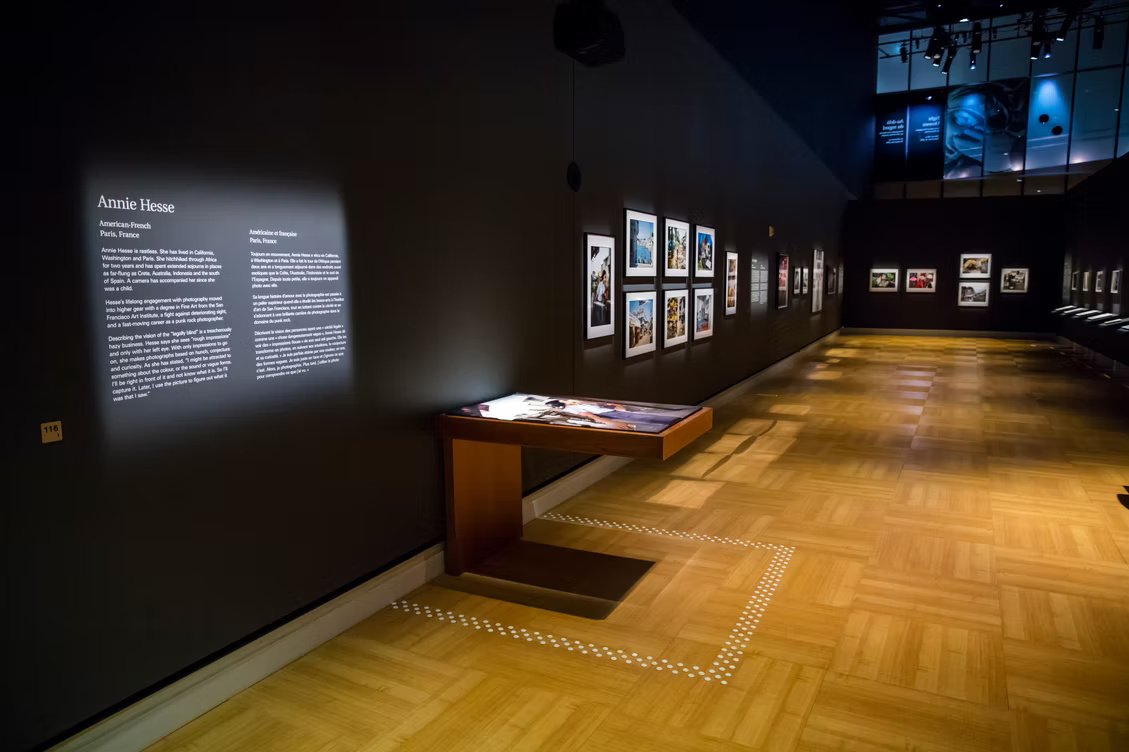
A dimly lit photography gallery displays framed color photographs along dark walls, with a wooden interactive table projecting from the left wall and white tactile dots outlining a path across the parquet floor. A large illuminated bilingual wall label on the left reads "Annie Hesse," followed by "American/French" and "Paris, France" in English and French followed by illegible wall text. A small yellow marker below the label reads "116." Farther along the left wall, photographs of people and outdoor scenes hang in white mats and dark frames. More framed photographs line the distant back and right walls. High above them, blue illuminated panels include a large close-up photograph of a person's face and several blocks of white text that are too small and blurred to read. Overhead spotlights and the display table cast warm rectangular reflections and long shadows across the honey-colored wooden floor.
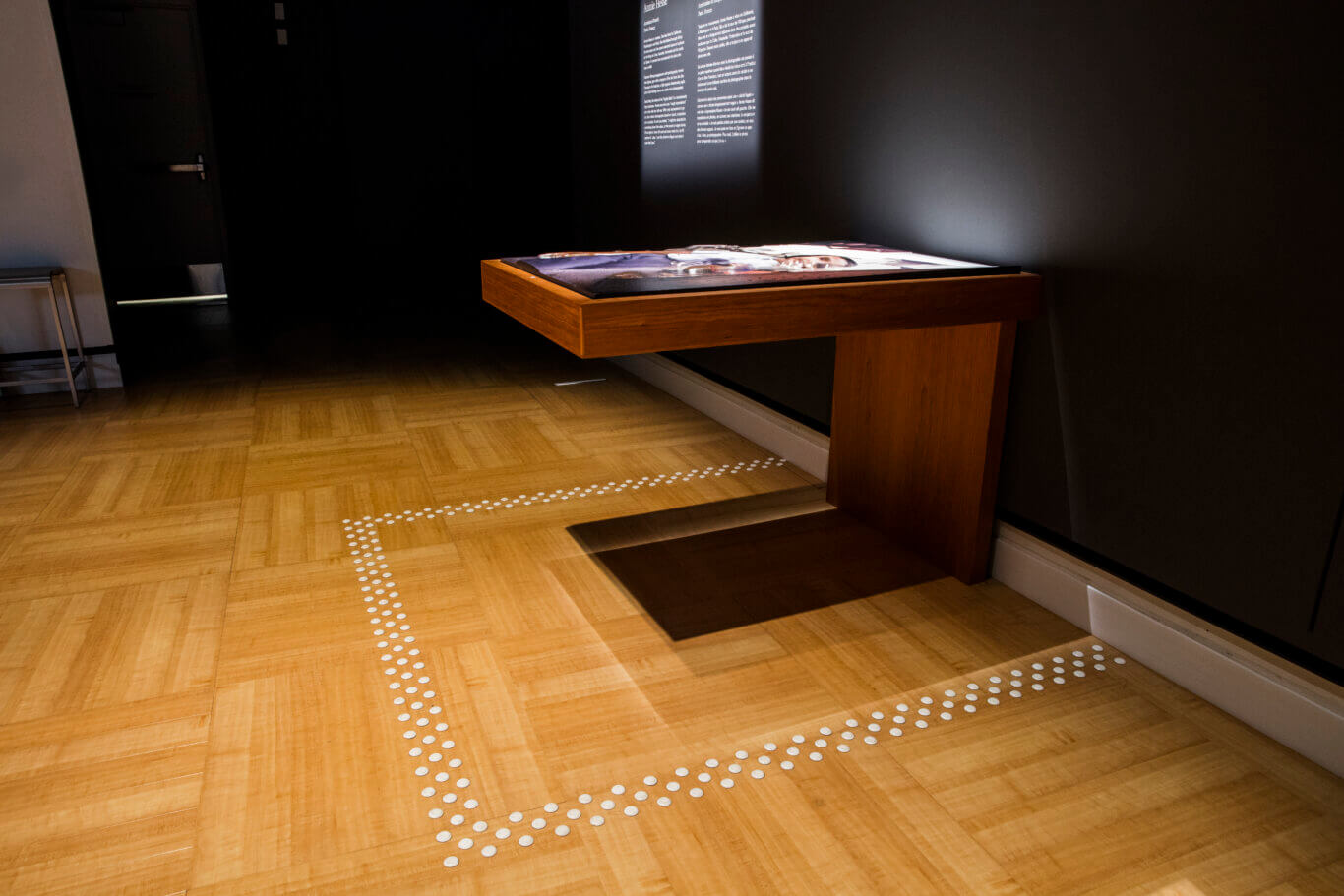
An exhibition space with a table top featuring a barely visible tactile image and white tactile floor markers on a blonde wooden floor. On our right, a wooden display table stickes out from the dark grey wall holding a brightly lit tactile photographic, while a wall panel above it and to the left contains illegible text. The floor is made of warm, light-colored wood parquet and includes rows of raised white tactile markers around the edge of the table.
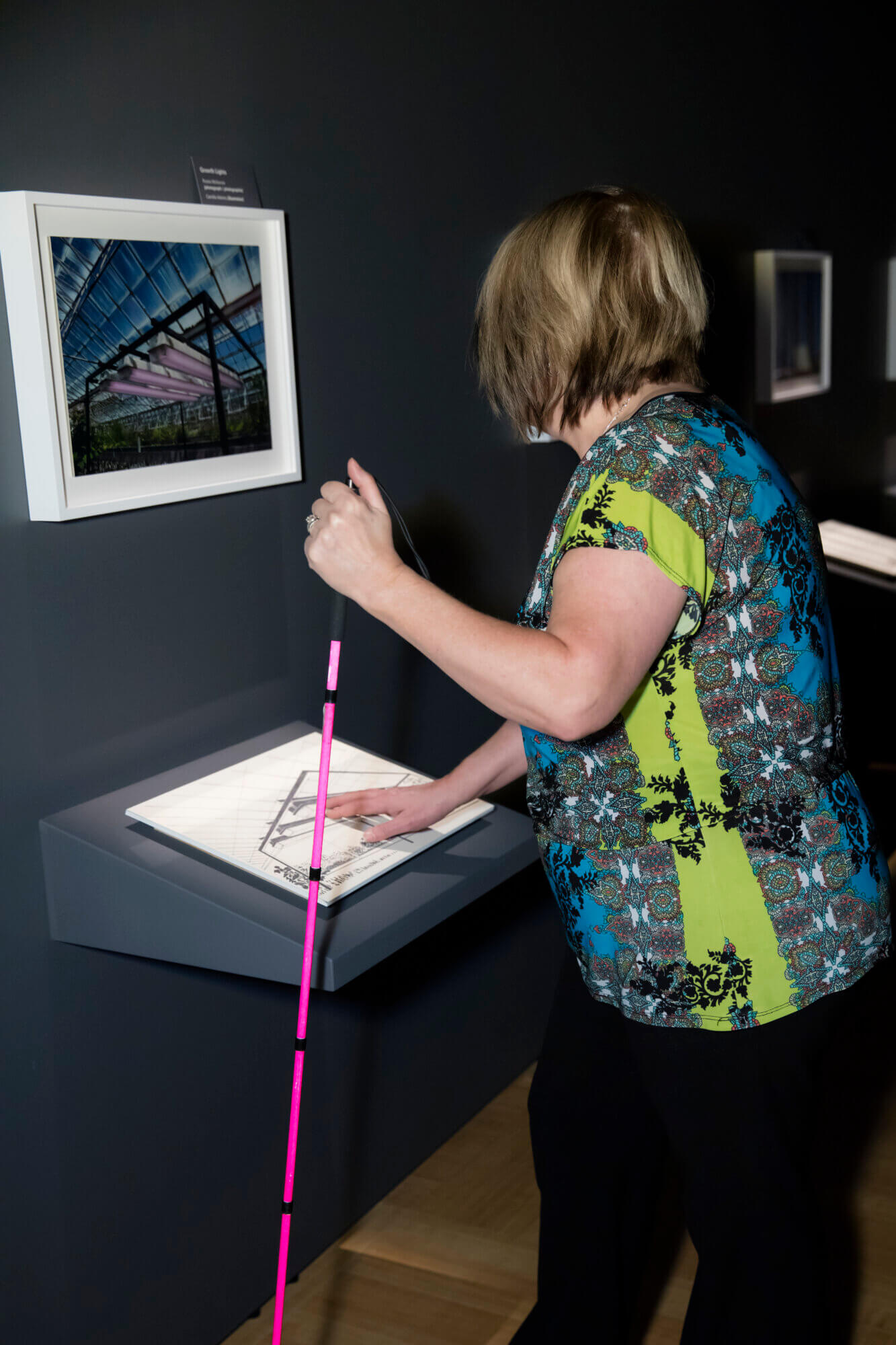
A person with pale skin standing in a dimly lit exhibition space, viewed mostly from behind and the side. She is holding a bright pink long cane in one hand and placing her right hand on a raised tactile image of a simplified black and white glass roofed structure or greenhouse interior displayed on a tilted ledge. In front of her, on the dark grey wall, is a color photograph, framed in white, of the same scene. Additional framed works are visible blurred in the background.
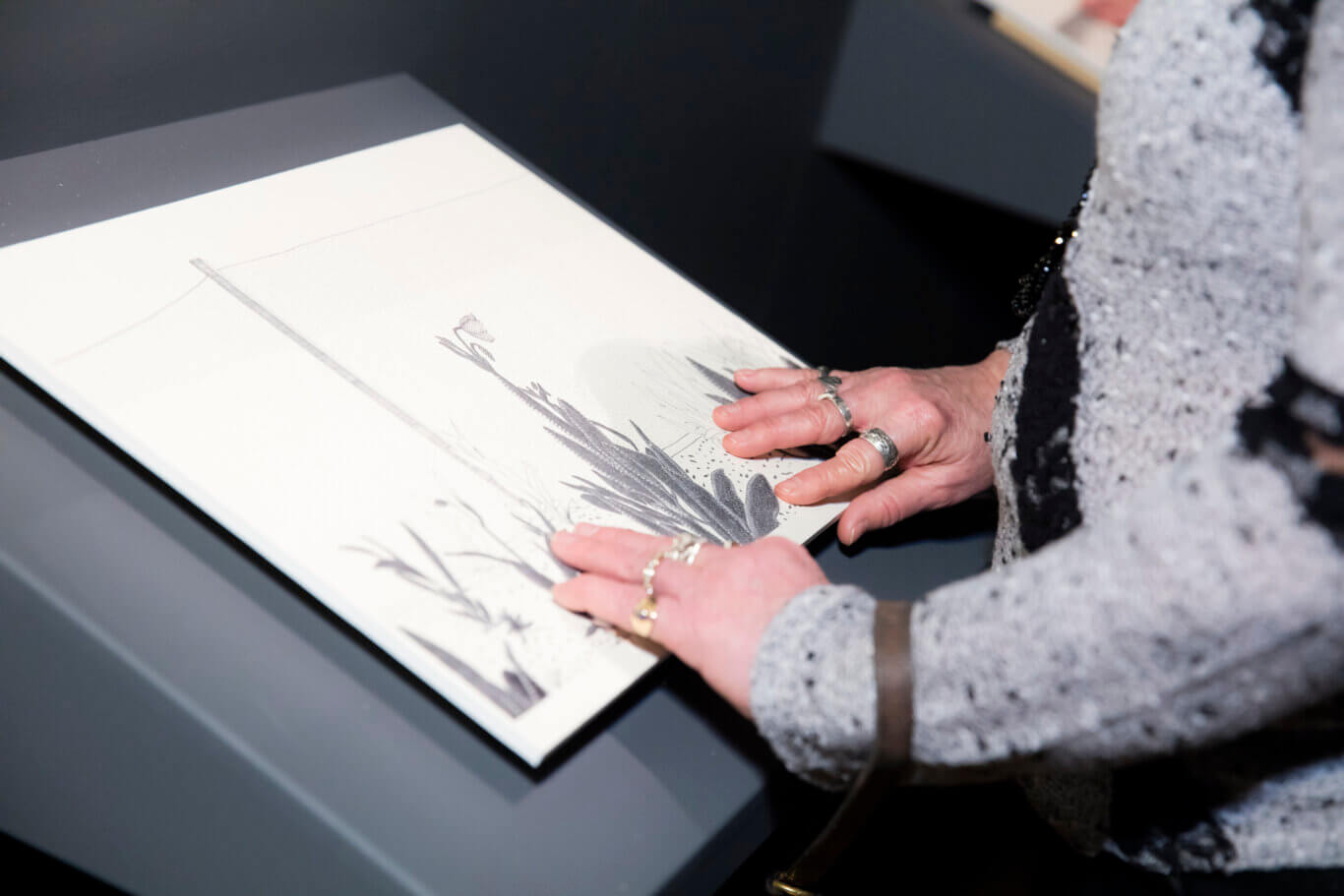
A close-up, angled view of someone with light skin tone touching a titled tactile image of plants in an empty landscape. The artwork appears to be fine black-and-gray botanical line drawings, possibly leaves or flowers, with a dotted background texture. Their hands, wearing several silver rings, rest near the lower-right edge of the print exploring the texture of the flecked dirt and spear shaped leaves. Much of the foreground is softly blurred by the person's fuzzy gray-and-black sleeve.
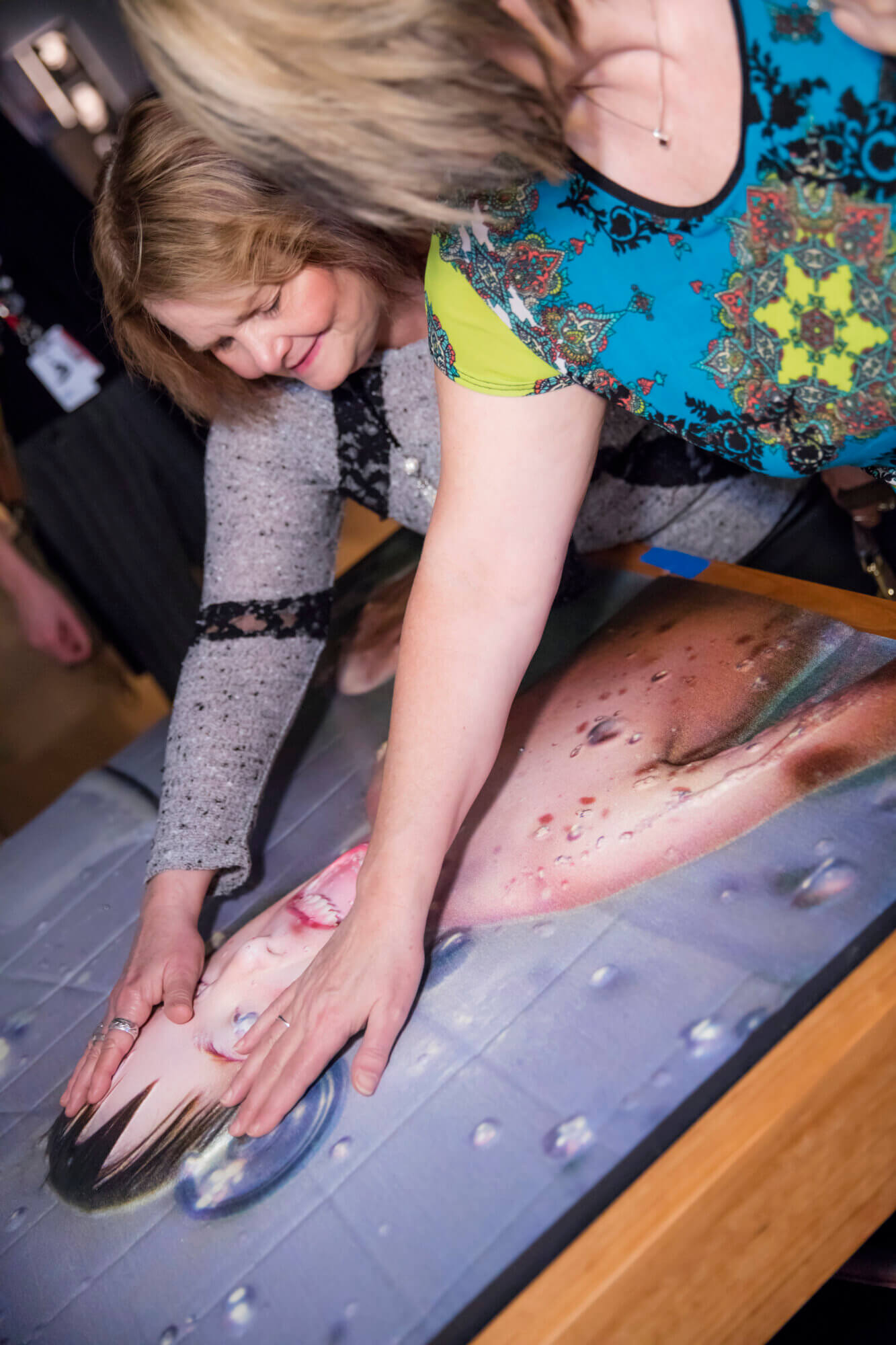
Taken from a tilted overhead angle, two woman with light skin tone reach out touching a large tactile photograph of a laughing child covered with water droplets. The image is of a child with light skin tone from the waist up possibly in the shower laughing wide mouthed, with large water droplets all over the image. The child's eyes are a milky white and their dark short hair is wet and plastered on their head. The two women explore the raised elements of the image, one of them with their eyes closed, the other's face is hidden by her hair.
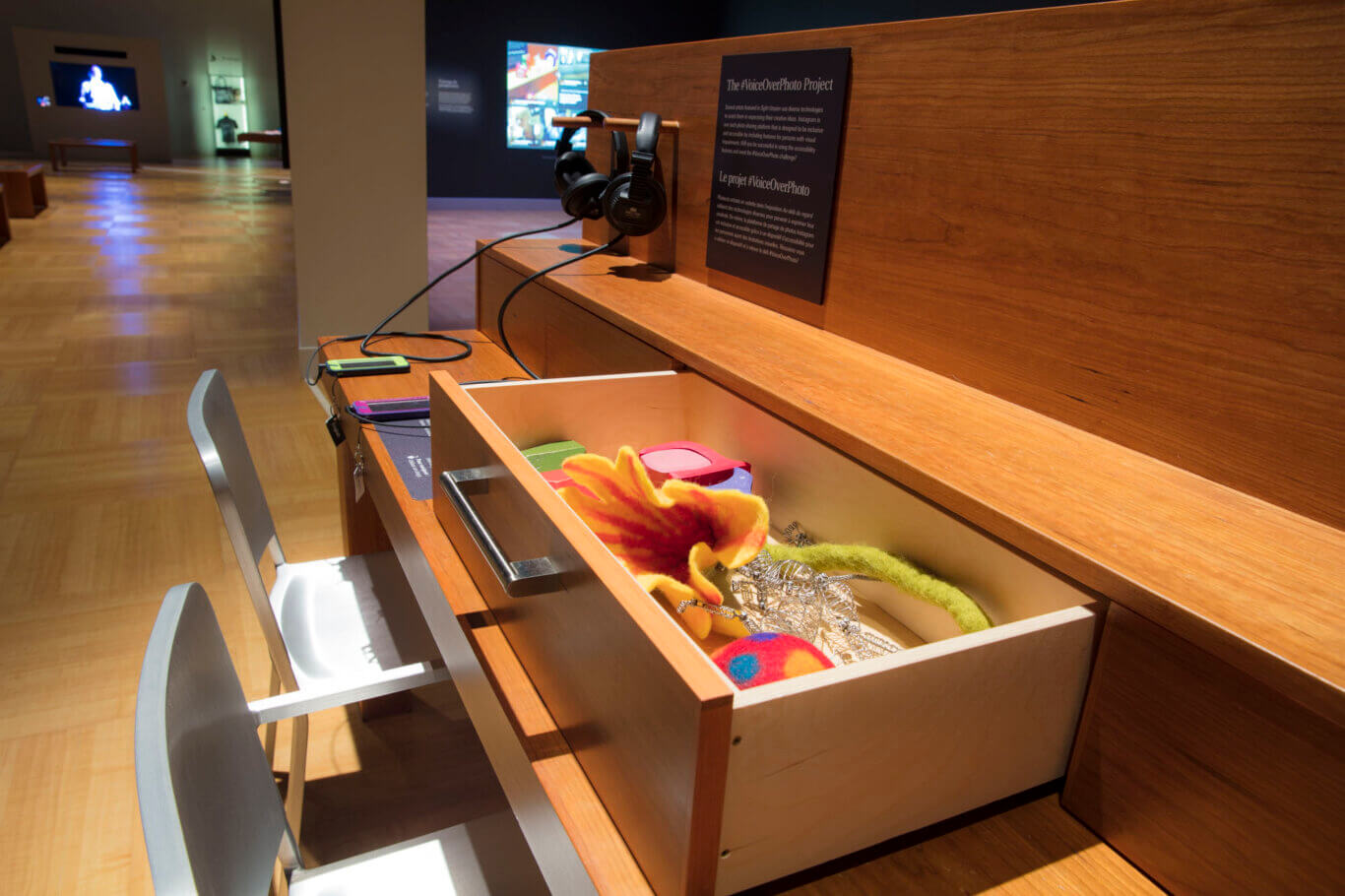
Two metal chairs pulled up to a tactile interactive display table in a warmly lit exhibition space. The long table has a second ledge behind it where a pair of black headphones hangs from a small wooden rod connected by cords to two mobile devices on the tabletop. A sign on the wooden wall reads "The VoiceOverPhoto Project." An open drawer in the foreground contains bright, textured objects, including a felt flower, a wire sculpture, and colorful soft forms. In the background, the gallery continues with polished wood floors, benches, wall displays, and a glowing video screen.
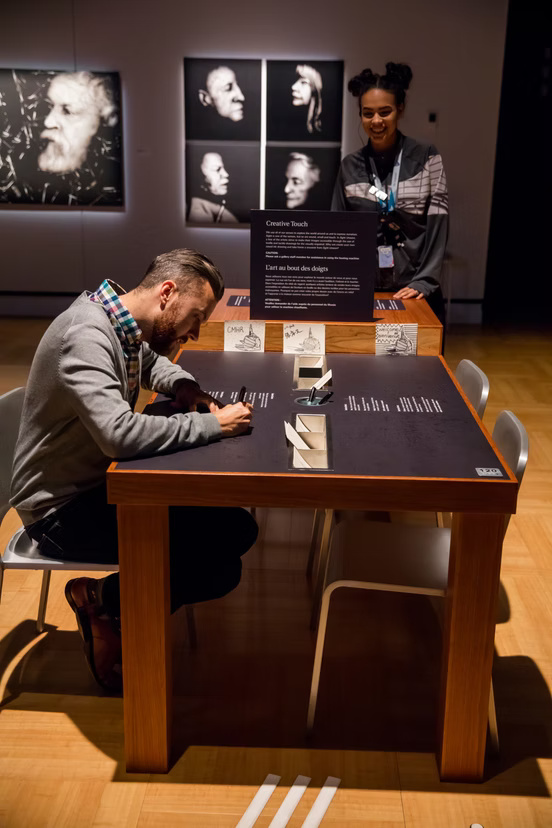
A color photograph shows two adults at an interactive museum table in a softly lit portrait gallery. In the foreground at left, Rob Itri-Vincent, a Metí man with light skin, short brown hair, and a beard leans over the black tabletop, using both hands to write on a card. Behind the table laughing is a standing person with medium-brown skin and dark hair arranged in two high buns wearing a lanyard. The large wooden table has a black display surface printed with blocks of small white text, most of which are too blurred to read, and several raised or recessed geometric elements aligned down its center. A black upright panel at the far end is headed "Creative Touch." Paper samples attached to the wooden edge include the legible letters "CMR"; other printed and handwritten markings are indistinct. Gray chairs surround the table, and three white tactile floor strips approach it from the bottom edge. On the wall behind the visitors hang black-and-white portrait photographs: at our left, a large close-up profile of an older person with white hair and a full white beard; at center, four smaller profile portraits arranged in a two-by-two grid, with pairs of faces turned toward one another.
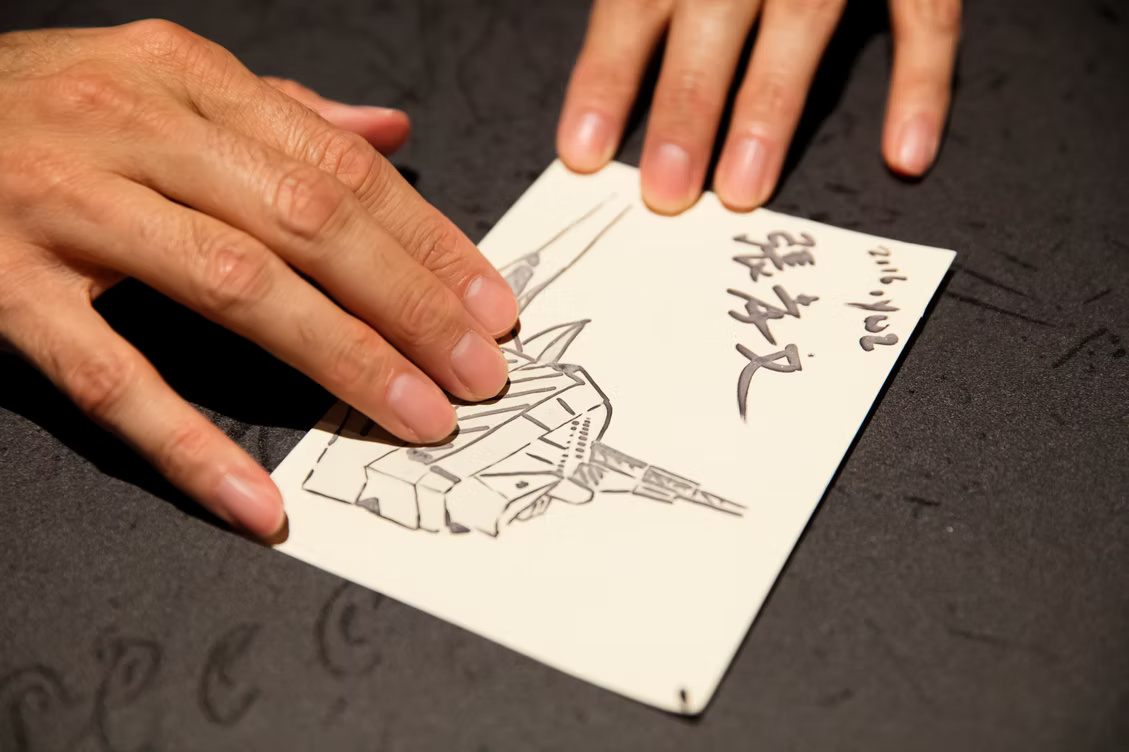
A close-up color photograph shows two light toned hands holding a cream-colored postcard or drawing card diagonally against a dark, subtly patterned tabletop. The left hand spreads across the lower-left portion of the card, partially covering a fine black-and-gray drawing of an angular architectural shape with long pointed forms extending above and to the right. The other hand steadies the card along its upper edge. Large, dark handwritten Japanese characters appear near the upper-right area.

Project Description

The Sight Unseen exhibition, curated by Douglas McCullough, was designed for, and presented at the Canadian Museum for Human Rights. The exhibition challenges audiences to consider perception, ability-disability, and how we, as people, consume and present information.

A photography exhibition featuring the work of blind photographers could not simply surface visual description information – we needed to do much more. This position was the driver for not only our approach to multimodal engagement, but for visitor participation in the exhibition as well.

Integrated System of Physical and Digital Components

A rich tactile vocabulary was created and implemented throughout the built environment, facilitating multimodal and independent wayfinding irrespective of ability or disability. This approach extended to the overall layout of the exhibition itself, intentionally designed so that a cane user could simply follow the left-hand wall and encounter all content throughout the exhibition.

Visual descriptions were created and provided for all static media in the exhibition, and 3DPhotoworks was engaged, for its first museum project, to create sculpted tactile reliefs of the photographs. Working in partnership with 3DPhotoworks, PAC led the concept development for integrating touch-activated audio sensors into each tactile artwork, with both teams collaborating on their fabrication and implementation. As visitors explored the features of each photograph through touch, the sensors triggered detailed, guided tactile descriptions corresponding to the areas being explored, creating an integrated tactile and auditory experience.

User Participation Makes for Meaningful Experiences

We democratized the presentation of art in an “art show” through this exhibition by challenging visitors to take their own photos “sight unseen” and to contribute them to the exhibition. We provided quick audio and video instructions on how to take photos with an iPhone with the screen curtain on (an accessibility feature used with VoiceOver that turns the display completely black while the phone remains fully functional) and by following the screenreader’s instructions as it guides users how to take a photo in a nonvisual way. This activity was promoted both to remote and onsite audiences. Visitors who participated and tagged their photos with the appropriate hash tags had their photos aggregated through a Tumblr page and projected in gallery alongside the works of the artists. Not only was this a democratization of in-gallery content, but by producing the work, visitors were provoked to think about perception, visual perception, and personal expression. The visitor engagement in this activity was exceptionally high.

We also took inspiration from one of the artists in the show, Rosita McKenzie. McKenzie is a blind photographer who passes her photos to Camilla Adams, who creates line drawn versions of the photos. These line drawn images are then run through a swell printer creating a tactile relief of the photos. These photos and their reliefs were presented together in the gallery. We extended this approach into a hands-on visitor activity, inviting visitors to create their own drawings that staff then transformed into tactile images using a swell-form printer located within the exhibition. Facilitated by staff, the activity allowed visitors to experience the process of tactile image-making firsthand and leave with their own tactile drawing as a personal keepsake from the exhibition.

Concluding Thoughts

Ultimately, Sight Unseen demonstrated that inclusive design is not simply about providing alternative ways to access existing content; it can fundamentally shape and enrich the experience itself. By integrating tactile, auditory, visual, physical, and digital modes of engagement—and inviting visitors to become active participants and creators—the exhibition challenged conventional distinctions between accessibility and experience design. Accessibility became not an accommodation layered onto the exhibition, but a creative driver that influenced its content, form, and visitor experience. In doing so, Sight Unseen provided multiple ways to perceive, interpret, navigate, create, and express, while reinforcing the exhibition’s central proposition: that perception is neither singular nor exclusively visual.