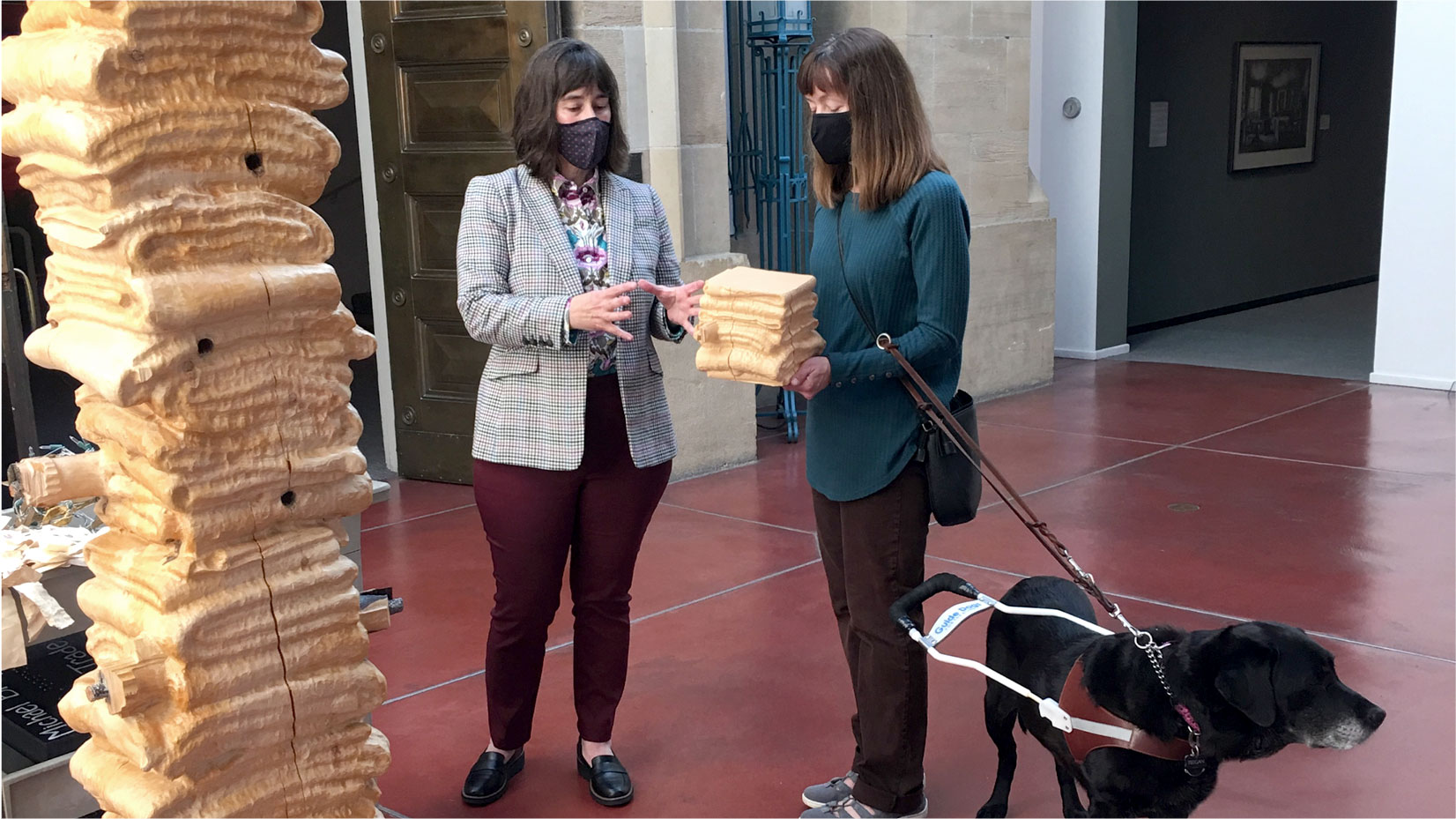
A gallery scene shows two masked adults with light skin tone standing beside a large pale carved wooden form while one holds a smaller matching carved block, with a black guide dog in a harness on our right. On our left, the tall wood sculpture of stacked blankets rises out of the frame and has stacked, wavy, horizontal ridges, visible cracks, knots, and protruding pegs or rods; its warm blond surface catches bright light. Near the center, Melanie Fales, a white woman with shoulder-length dark hair gestures with both hands toward the smaller block as if she's about to grab it. On our right, another woman with straight shoulder-length brown hair holds the small carved block at waist height while a black crossbody bag hangs at her side. The black dog stands in the lower right facing right, wearing a brown and white guide harness; the visible blue text on the harness reads, "Guide Dogs." The setting has a reddish polished floor, pale stone architectural walls, a dark wooden door, a blue metal gate, and an open doorway into a darker gallery where a framed picture hangs on the wall.

PAC and Boise Art Museum used an IMLS Museums Empowered grant to embed inclusive design into Many Wests: Artists Shape an American Idea—spanning galleries, graphics, and media—with visual descriptions, tactile access, ASL/captions, mobile interpretation, staff training, and an Inclusive Design Advisory Group, producing an accessible exhibition and institutional capacity.

Media
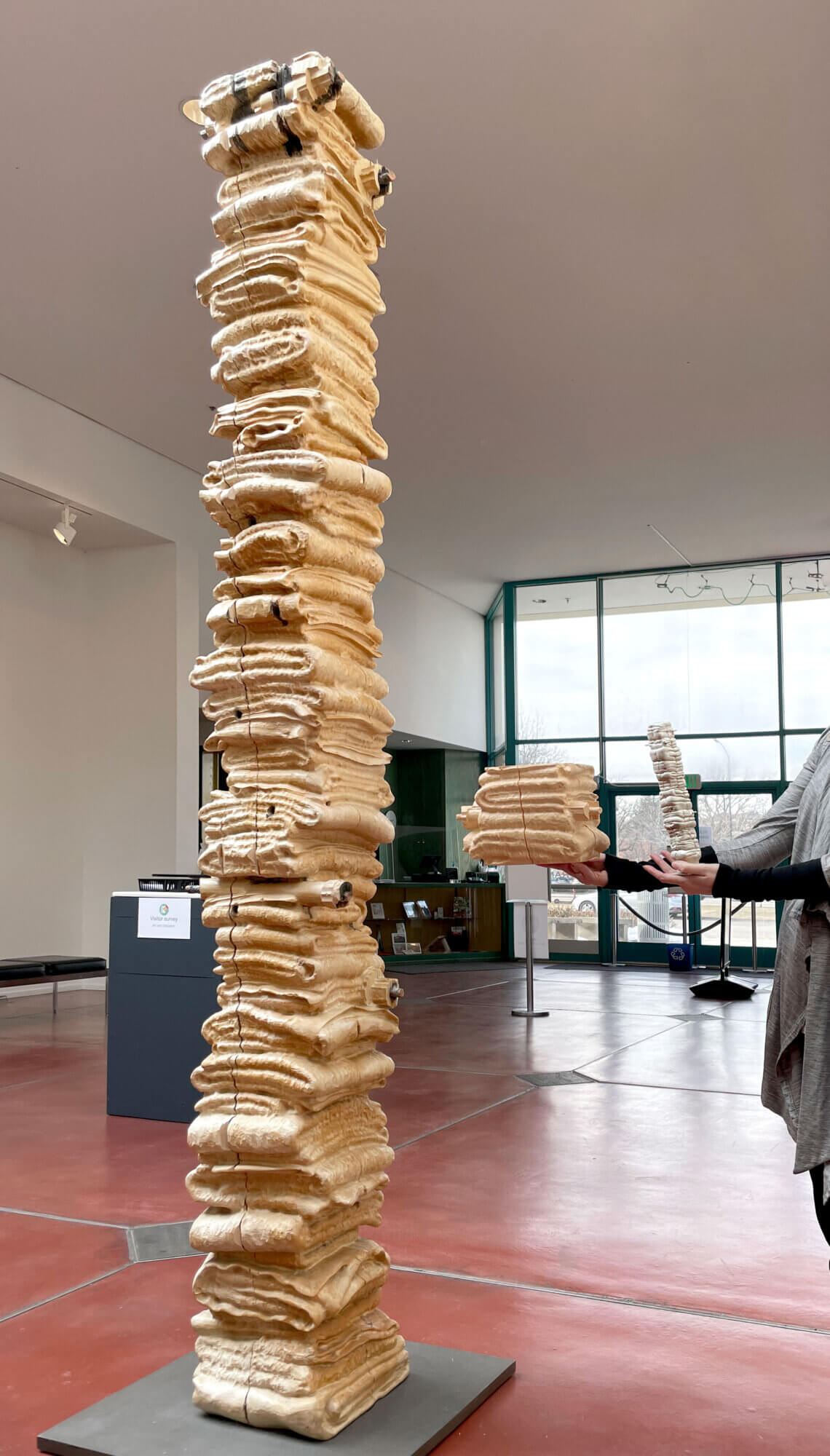
A tall pale wood sculpture stands on a dark rectangular base in a spacious museum lobby, with a rough vertical column made of many carved, layered, folded-looking forms resembling blankets. The main column fills the left-center of the image and extends beyond the top of the frame; its surface is cream and golden brown, with chisel marks, natural grain, cracks, seams, knots, and some darkened end areas. To our right, a partially cropped adult, visible from the torso and hands only, holds two related carved wooden pieces: a blocky horizontal section with the same dimensions as the original sculpture on one palm and a thinner vertical stacked piece in the other hand. Behind them are red-brown floors, white walls, high ceilings, gallery lights, green-framed windows and doors, and another similar carved column or segment farther back.
A rectangular exhibition postcard for the exhibit Many Wests at Boise Art Museum. On our left is a slate-blue information panel and a mostly white mailing panel on our right. The left panel reads at the top: MANY WESTS; Artists Shape an American Idea; July 31, 2021 - February 13, 2022. Below, the main text reads: Ideas about the American West, both in the popular imagination and in commonly accepted historical narratives, are often based on a past that never was, and fail to take into account important events that actually occurred. At once, "The West" can conjure images of rugged colonial settlers, gun-toting-cowboys, or vacant expanses of natural beauty. Many Wests: Artists Shape an American Idea offers multiple views of "The West" through the perspectives of forty-eight modern and contemporary artists. Their artworks question old and racist clichés, examine tragic and marginalized histories, and illuminate the many communities and events that continue to form this region of the United States. The exhibition explores the specific ways artists actively shape our understanding of the life, history and myths of the American West. Near the bottom left are partner logos and text reading: Art Bridges + SAAM Smithsonian American Art Museum. Beneath them, smaller text reads: This is one in a series of American art exhibitions created through a multi-year, multi-institutional partnership formed by the Smithsonian American Art Museum as part of the Art Bridges Initiative. A black, white, and yellow QR code sits near the lower right of the blue panel. On the right white panel, the upper left has a red logo reading: BAM, with smaller text below: BOISE ART MUSEUM, and beneath that: 670 JULIA DAVIS DR | BOISE ID 83702.
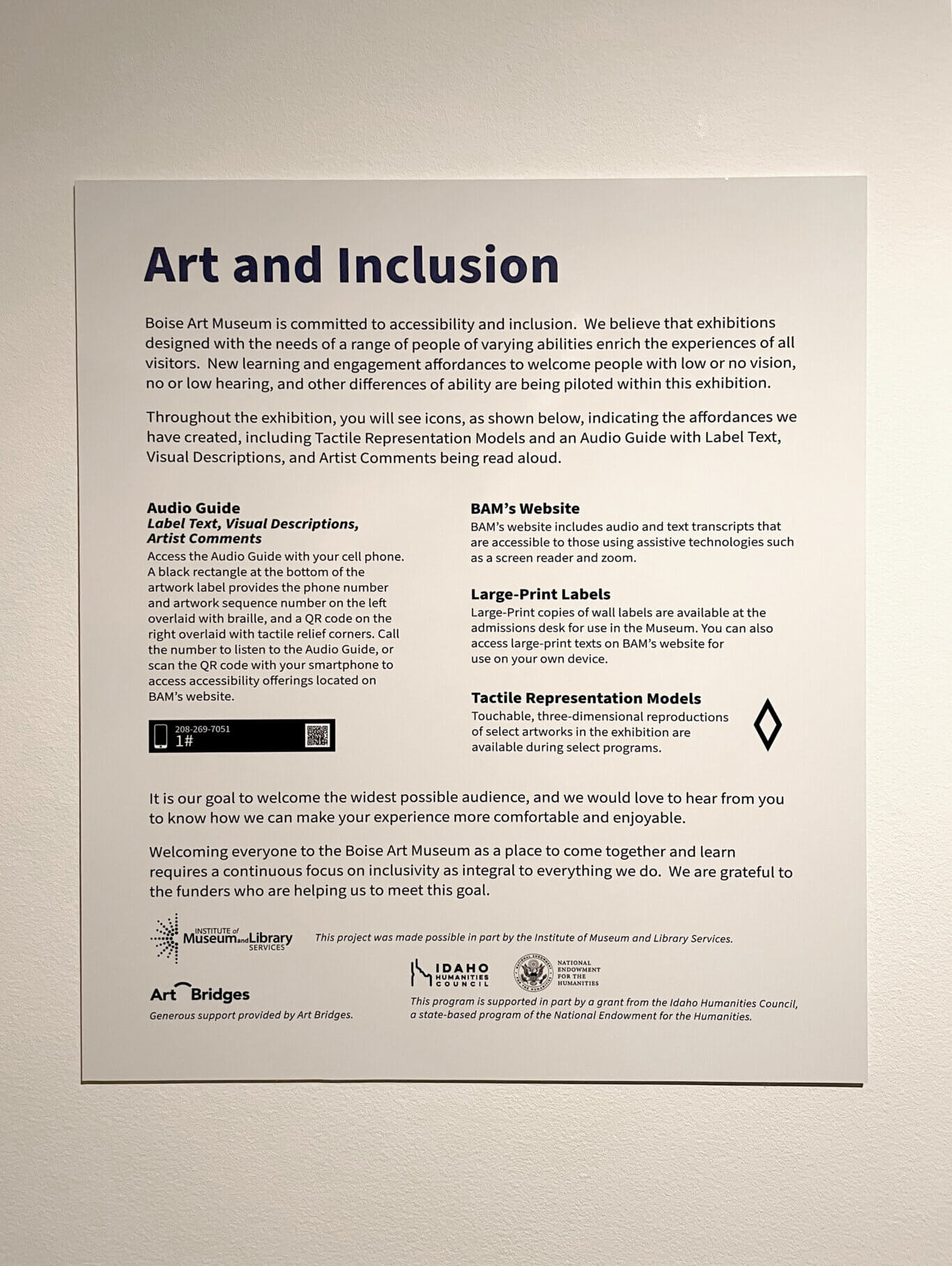
A rectangular white museum wall sign with black text is mounted on a textured off-white wall; it is titled Art and Inclusion and explains accessibility offerings at the Boise Art Museum, with two columns of information featuring an Audio Guide, BAM's Website, Large-Print Labels, and Tactile Representation Models. Underneath that are a small sample audio-guide label, a tactile-representation icon, and funder logos near the bottom. The visible text reads: Art and Inclusion. Boise Art Museum is committed to accessibility and inclusion. We believe that exhibitions designed with the needs of a range of people of varying abilities enrich the experiences of all visitors. New learning and engagement affordances to welcome people with low or no vision, no or low hearing, and other differences of ability are being piloted within this exhibition. Throughout the exhibition, you will see icons, as shown below, indicating the affordances we have created, including Tactile Representation Models and an Audio Guide with Label Text, Visual Descriptions, and Artist Comments being read aloud. In the left column, the heading reads Audio Guide, followed by italic text: Label Text, Visual Descriptions, Artist Comments. The paragraph below reads: Access the Audio Guide with your cell phone. A black rectangle at the bottom of the artwork label provides the phone number and artwork sequence number on the left overlaid with braille, and a QR code on the right overlaid with tactile relief corners. Call the number to listen to the Audio Guide, or scan the QR code with your smartphone to access accessibility offerings located on BAM's website. A black sample label below includes a phone icon, the number 208-269-7051, the sequence 1, and a QR code. In the right column, the heading reads BAM's Website, followed by: BAM's website includes audio and text transcripts that are accessible to those using assistive technologies such as a screen reader and zoom. Below that, another heading reads Large-Print Labels, followed by: Large-Print copies of wall labels are available at the admissions desk for use in the Museum. You can also access large-print texts on BAM's website for use on your own device. A third heading reads Tactile Representation Models, followed by: Touchable, three-dimensional reproductions of select artworks in the exhibition are available during select programs. A black outlined diamond-shaped icon appears beside this section. Across the lower middle, larger text reads: It is our goal to welcome the widest possible audience, and we would love to hear from you to know how we can make your experience more comfortable and enjoyable. Below it, text reads: Welcoming everyone to the Boise Art Museum as a place to come together and learn requires a continuous focus on inclusivity as integral to everything we do. We are grateful to the funders who are helping us to meet this goal. At the bottom left, a logo reads INSTITUTE of Museum and Library SERVICES, with adjacent text: This project was made possible in part by the Institute of Museum and Library Services. Below left, another logo reads Art Bridges, followed by: Generous support provided by Art Bridges. Near the lower center, a logo reads IDAHO HUMANITIES COUNCIL, next to a seal and text reading NATIONAL ENDOWMENT FOR THE HUMANITIES. The final line reads: This program is supported in part by a grant from the Idaho Humanities Council, a state-based program of the National Endowment for the Humanities.
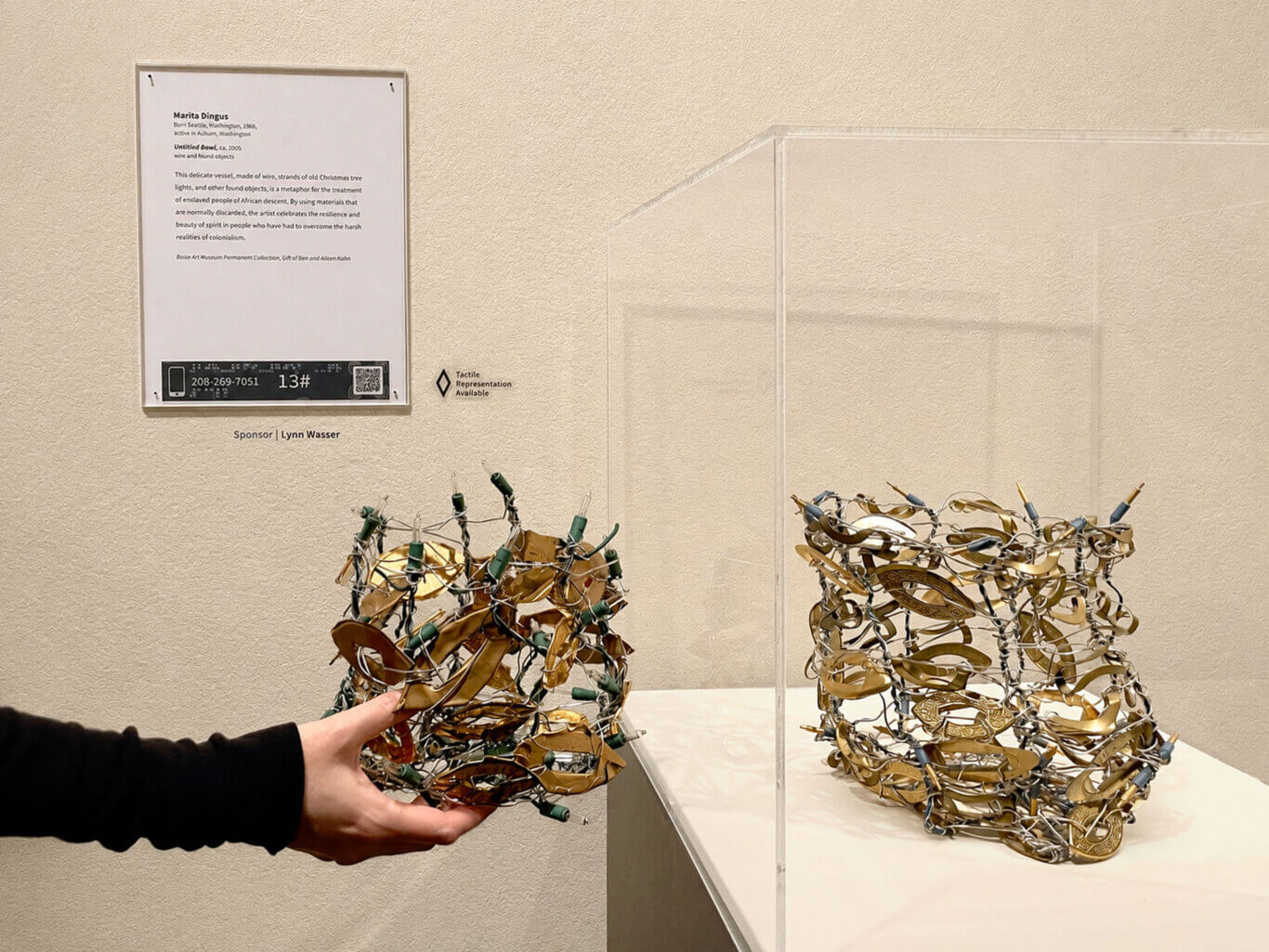
A museum display shows a wall label above and behind part of a sculptural bowl in a glass case made from tangled wire and found objects, with a person's hands holding a similar vessel in the foreground. The sculpture is an open, irregular vessel assembled from silvery wire, amber-gold curved fragments, small green bulb-like pieces, clear glass bulbs, and other small metal or plastic elements. A person wearing a black long sleeve reaches in from the lower left, with light-toned hands holding a very similar, but slightly smaller object. Above, the wall label is mounted in a clear frame with small dark fasteners at the corners. Its text reads: Marita Dingus, Born Seattle, Washington, 1966,, active in Auburn, Washington, Untitled Bowl, ca. 2005, wire and found objects, This delicate vessel, made of wire, strands of old Christmas tree lights, and other found objects, is a metaphor for the treatment of enslaved people of African descent. By using materials that are normally discarded, the artist celebrates the resilience and beauty of spirit in people who have had to overcome the harsh realities of colonialism., Boise Art Museum Permanent Collection, Gift of Ben and Aileen Kolin. At the bottom of the label, a black audio-access panel includes a phone icon, raised braille dots that are too small to read, the number 208-269-7051, the access code 13, and a QR code. To the right of the label, a diamond-shaped tactile icon appears beside text that reads: Tactile Representation Available.
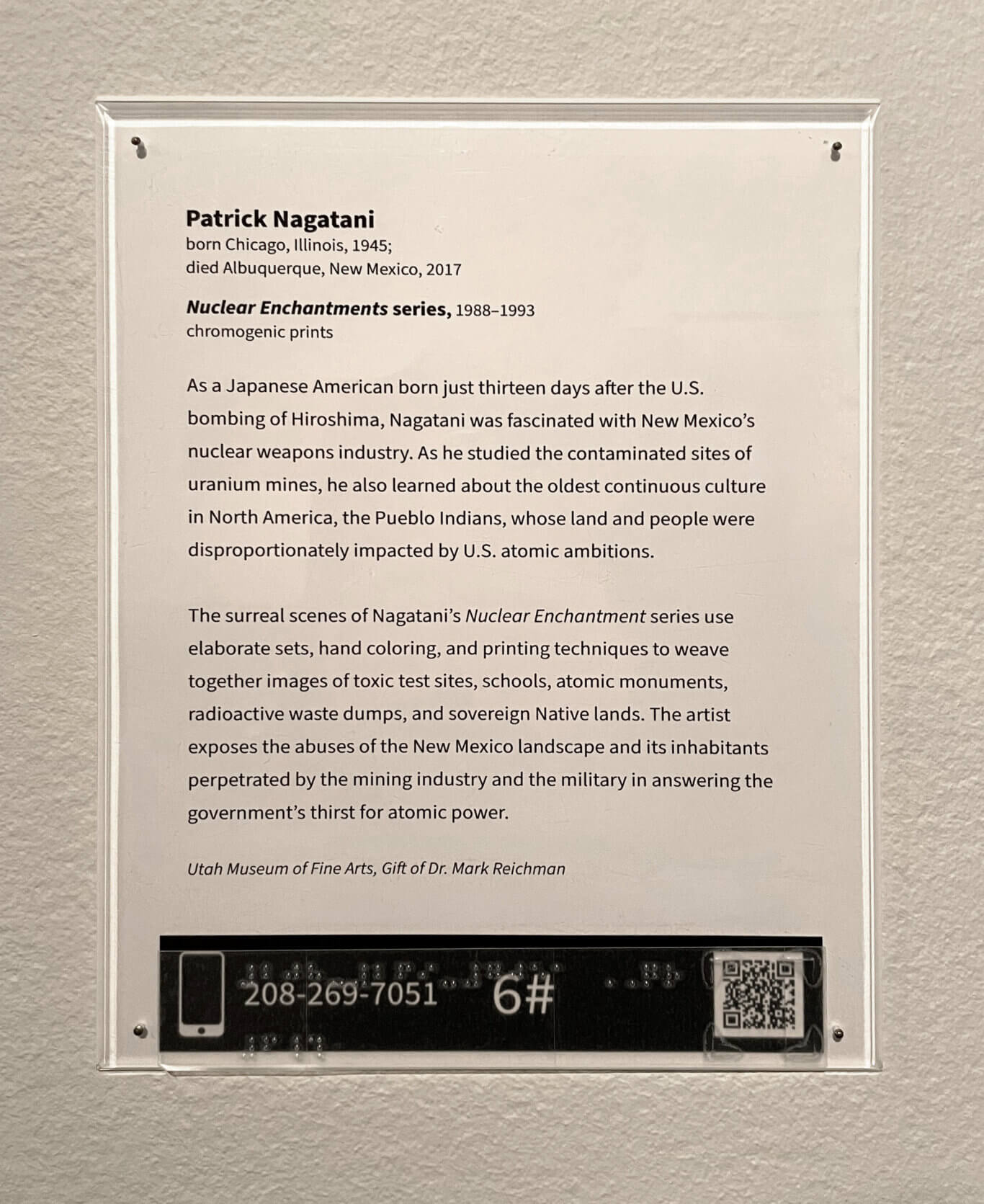
An acrylic-covered museum wall label for an artwork by Patrick Nagatani is mounted on a textured light gray wall; the white label has black printed text, and a black tactile/audio guide strip with raised Braille dots and a QR code along the bottom. The label text reads: Patrick Nagatani; born Chicago, Illinois, 1945; died Albuquerque, New Mexico, 2017; Nuclear Enchantments series, 1988-1993; chromogenic prints; As a Japanese American born just thirteen days after the U.S. bombing of Hiroshima, Nagatani was fascinated with New Mexico's nuclear weapons industry. As he studied the contaminated sites of uranium mines, he also learned about the oldest continuous culture in North America, the Pueblo Indians, whose land and people were disproportionately impacted by U.S. atomic ambitions. The surreal scenes of Nagatani's Nuclear Enchantment series use elaborate sets, hand coloring, and printing techniques to weave together images of toxic test sites, schools, atomic monuments, radioactive waste dumps, and sovereign Native lands. The artist exposes the abuses of the New Mexico landscape and its inhabitants perpetrated by the mining industry and the military in answering the government's thirst for atomic power. Utah Museum of Fine Arts, Gift of Dr. Mark Reichman. On the black strip at the bottom, visible printed text reads: 208-269-7051; 6#
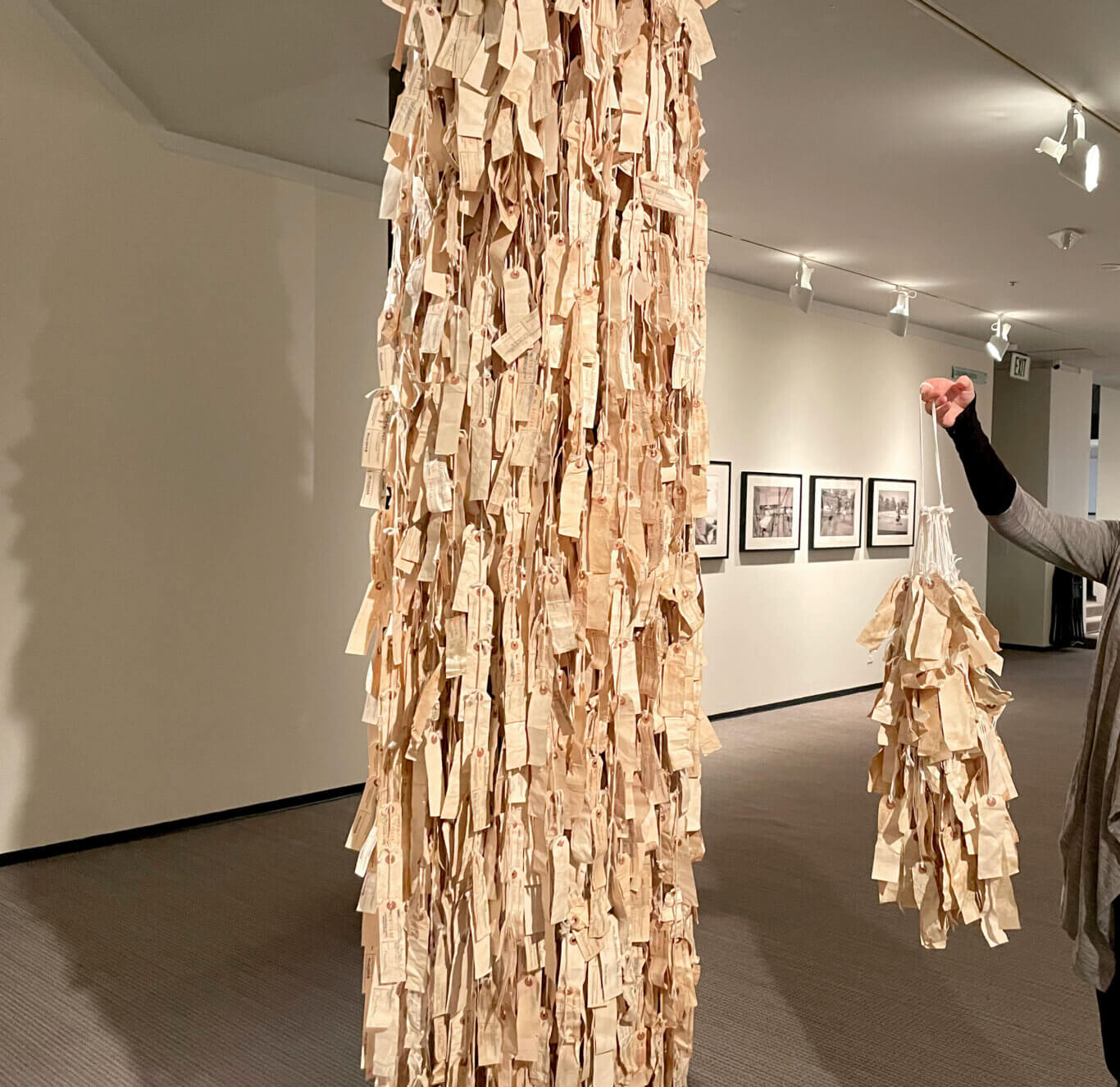
A gallery installation fills the center of the image: a tall hanging column densely covered with cream paper tags dangling from white strings. The tags overlap in thick vertical layers, many with reinforced circular holes in reddish brown and loops of cord tied through them, creating a shaggy, curtain-like surface. Some tags contain printed boxes, handwriting, or stamped marks, but the text on them is too small and blurred to read. On our right, a cropped with light skin tone wearing a gray short-sleeved top over a black long-sleeved layer holds up a white cord attached to a smaller matching bundle of dangling tags. The room has gray carpet, pale walls, and a ceiling with bright track lights aimed at the artworks. In the background on the right wall, several framed black-and-white images hang in a row.
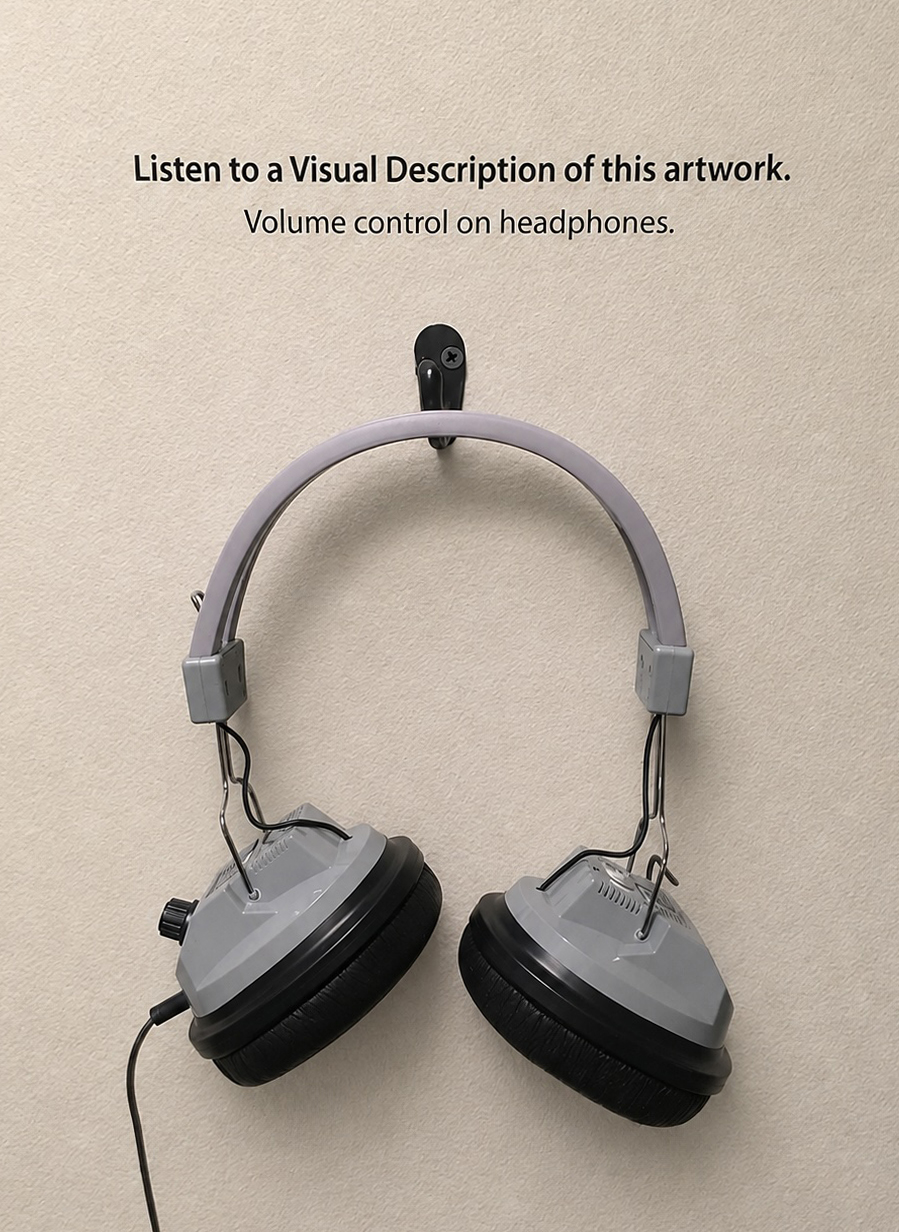
Gray over-ear headphones hanging from a small black wall hook on a lightly textured beige wall. Centered above the headphones, black printed text reads: Listen to a Visual Description of this artwork. Below it, a second centered line reads: Volume control on headphones. The headphones have a pale gray arched headband, silver wire supports, gray plastic earcup housings, and black padded ear cushions. The earcups hang open, with the left earcup angled slightly lower and outward. A small black volume knob is visible on the outside of the left earcup, and a black cable extends from that side downward out of the bottom of the image. The black hook is mounted above the headband with a visible screw near its top.

Project Description

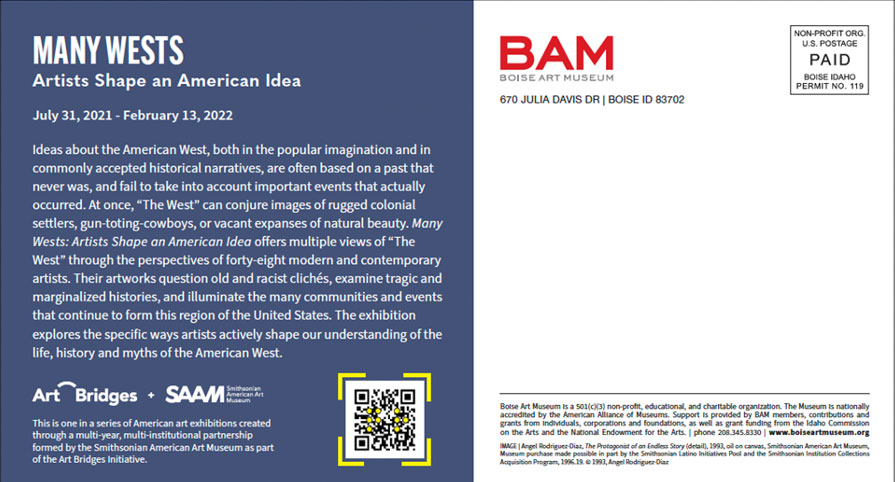
When the Boise Art Museum (BAM) began preparing for Many Wests: Artists Shape an American Idea, the exhibition presented an opportunity to design an inclusive exhibition from the beginning. A mid-sized museum with fewer than 20 full-time staff and an annual operating budget of approximately $2 million, BAM and Prime Access Consulting (PAC) received an IMLS Museums Empowered grant to build its institutional capacity around inclusive design and accessibility. Many Wests became a proving ground for applying that learning across an entire exhibition.

The exhibition itself was ambitious: 87 works by 48 modern and contemporary artists presented across eight galleries. Through paintings, sculpture, photography, video, and other media, the exhibition challenged entrenched and often racist clichés about the American West, brought marginalized histories forward, and explored the many communities that have shaped, and continue to shape, the region.

PAC worked with BAM to ask a parallel question of the exhibition experience: Who gets to participate in that story, and what needs to change for the widest possible audience to do so?

Rather than design the exhibition first and make it accessible afterward, PAC helped BAM apply inclusive design from the outset. The work moved across the full ecosystem of the visitor experience, from gallery layouts, artwork interpretation, and graphic design to digital media, visitor services, staff training, communications, and community engagement.

Building Capacity by Doing the Work

PAC’s work with BAM began with the premise that inclusive design and accessibility are a methodology, not a budget line. While some accessibility interventions require resources, many of the barriers visitors encounter are the result of decisions about workflows, priorities, design standards, and definitions of success. Addressing those decisions early is often considerably easier, and less expensive, than retrofitting an experience once it has been built.

Through staff workshops, hands-on activities, and ongoing consultation, PAC helped build inclusive design knowledge across the museum rather than concentrating responsibility within a single position or department. Staff became active participants in identifying barriers and developing solutions, building the institutional knowledge necessary to carry the work forward.

That internal capacity was paired with community expertise. BAM established an Inclusive Design Advisory Group (IDAG), bringing disabled people into the process to inform practices, test decisions, and share ownership of the work beyond the museum itself. The relationship was critical not only to Many Wests, but to creating a more sustainable approach to accessibility across the institution.

This combination, internal ownership and external lived expertise, allowed inclusive design to become an integral part of the exhibition design framework.

Designing the Whole Exhibition Ecosystem

PAC approached Many Wests as an interconnected experience. A visitor does not encounter accessibility through a single label or accommodation; they encounter it through the cumulative effect of the building, information systems, exhibition design, artworks, media, technology, staff interactions, and services.

That meant examining the galleries themselves. PAC and BAM considered circulation routes, the relationship between object size and viewing distance, lighting, edge detection, heights, reach ranges, and how visitors with various bodies and ways of perceiving space could independently move through eight galleries of two- and three-dimensional work.

Graphic design was treated with the same attention. Exhibition typography, color contrast, and label layouts were developed for legibility, while accessibility considerations extended into printed collateral and other communications. The goal was not to produce a separate accessible version of the exhibition, but to improve the primary experience.

For blind and low vision visitors, PAC and BAM developed multiple ways of accessing artworks beyond sight. Visual descriptions translated essential visual information into language. Selected works were supported by touch objects, allowing visitors to explore form, composition, and spatial relationships through touch. Consistent iconography helped communicate where these opportunities were available.

Digital and audiovisual content expanded that multimodal approach. Captioning, audio description, ASL, volume controls, mobile screen-reader compatibility, and phone-based interpretive content addressed different ways visitors receive and interact with information. Rather than assuming one solution could meet every need, the exhibition offered overlapping ways into the same content.

Access Begins Before the Gallery

An inclusively designed exhibition means little if visitors cannot determine whether the museum will work for them before they arrive, or if their first interaction at the door undermines the experience that follows.

PAC therefore worked with BAM beyond exhibition design itself. Visitor services considered the information, accommodations, and interpersonal service visitors would encounter throughout their visit. Staff training helped connect the physical and digital affordances being developed to the people responsible for welcoming and supporting visitors.

Communications and promotion were similarly part of the inclusive design process. BAM worked with local communities and considered accessibility across print and digital distribution, helping audiences understand what the exhibition offered before deciding to visit.

This was particularly important for disabled communities who’ve been historically excluded by cultural institutions. Accessibility cannot be reduced to making something usable once someone arrives. Museums must also build the relationships and trust that make people want to come in the first place.

An Exhibition as Institutional Change

By the opening of Many Wests, inclusive design was woven across nearly every dimension of the visitor experience: visual descriptions and tactile access to collections; improvements to lighting, circulation, height, and reach; higher-contrast and more legible graphic design; ASL, captions, audio description, and user-controlled audiovisual media; mobile-accessible digital interpretation; large-print and tactile visitor resources; more accessible communications; and a sustained community relationship through the IDAG. But the larger impact was not just any one of those outcomes.

Many Wests demonstrated what could happen when accessibility became part of the architecture of museum practice. PAC helped BAM connect community engagement, staff capacity, collections practices, exhibition development, digital systems, visitor services, communications, and operations rather than treating each as an independent accessibility problem.

For an organization with limited staff and resources, that distinction mattered. The project demonstrated that meaningful inclusive design does not depend on the size of an institution. It depends on when accessibility enters the process, who participates in making decisions, and whether responsibility for inclusion is shared.

The work also created a foundation that could extend beyond a single exhibition. Staff developed knowledge they did apply to future projects, while the Inclusive Design Advisory Group created an ongoing mechanism for disabled community expertise to inform the museum’s work. The project strengthened BAM’s relationship with its local community while demonstrating tangible gains in the inclusiveness of its practices and programming.

Many Wests was therefore both an exhibition and a test of a larger institutional proposition: accessibility works best when it is not treated as something a museum provides for a particular audience, but as a shared methodology for making better decisions.

That approach would become the foundation for BAM’s continued inclusive design work in the years that followed.