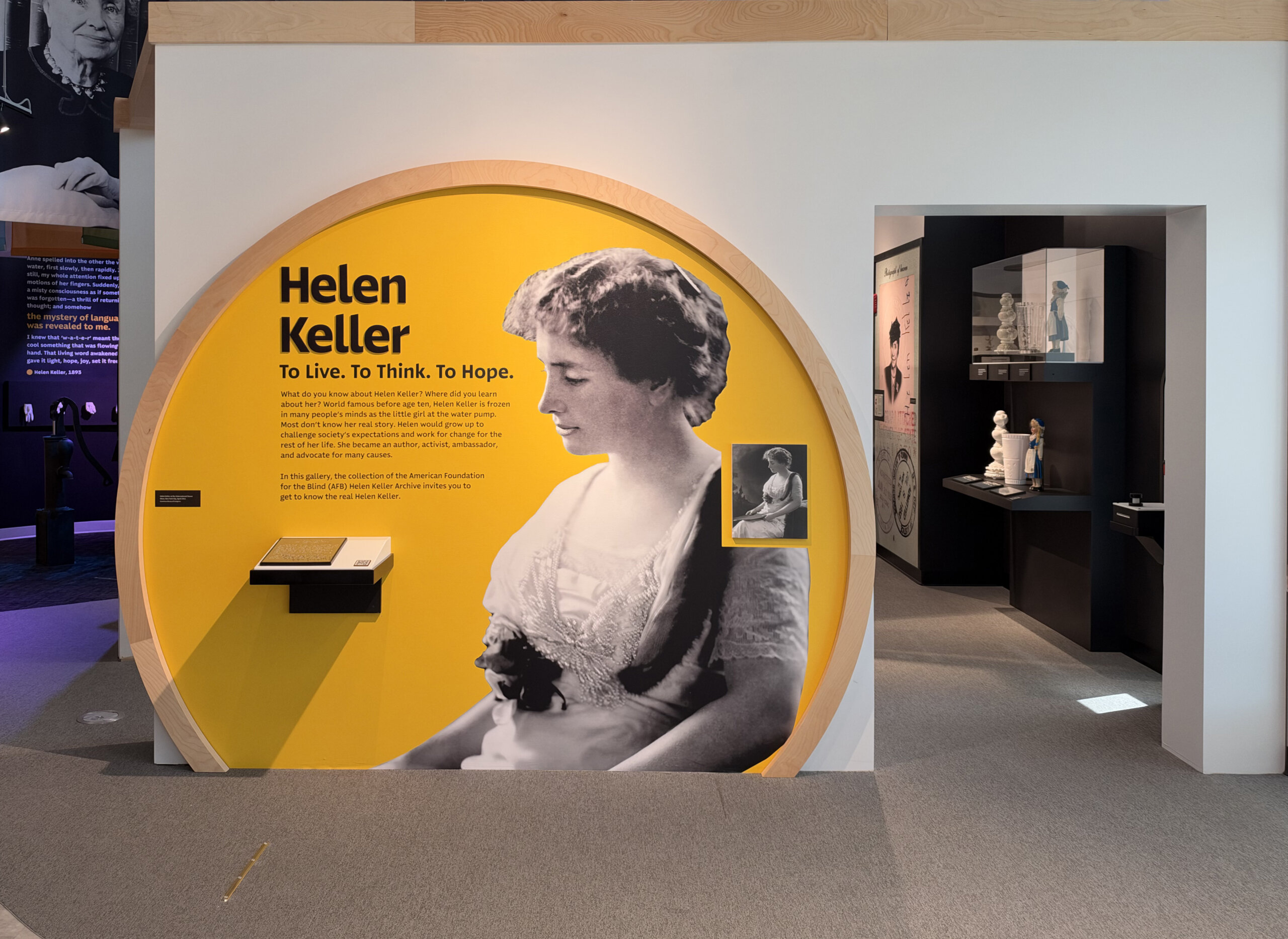
The entrance to a museum gallery about Helen Keller featuring large black and white portrait of her. At center, a large circular wall is painted a bright yellow within a wooden circular frame. Black text reads: "Helen Keller" with the sub title "To Live. To Think. To Hope," and illegible wall text below. Underneath the text is a waist-high interactive station with a tactile panel and QR code. To our left, a large black-and-white portrait of an adult Helen Keller, a white woman, fills the right half of the yellow circle. She sits in profile, wearing a fancy white dress with beaded bodice and lace cuffs. Her wavy dark hair is pinned up. A small framed photograph of the same photo hangs behind her shoulder. Beyond this entry wall are two additional galleries with touch objects and objects in glass cases.

For the American Printing House for the Blind (APH), PAC authored Inclusive Design Standards, conducted design reviews, advised on wayfinding, supported community prototyping, and trained staff—shaping The Dot Experience, APH’s reimagined, multisensory museum in Louisville, centering blind storytellers.

Media
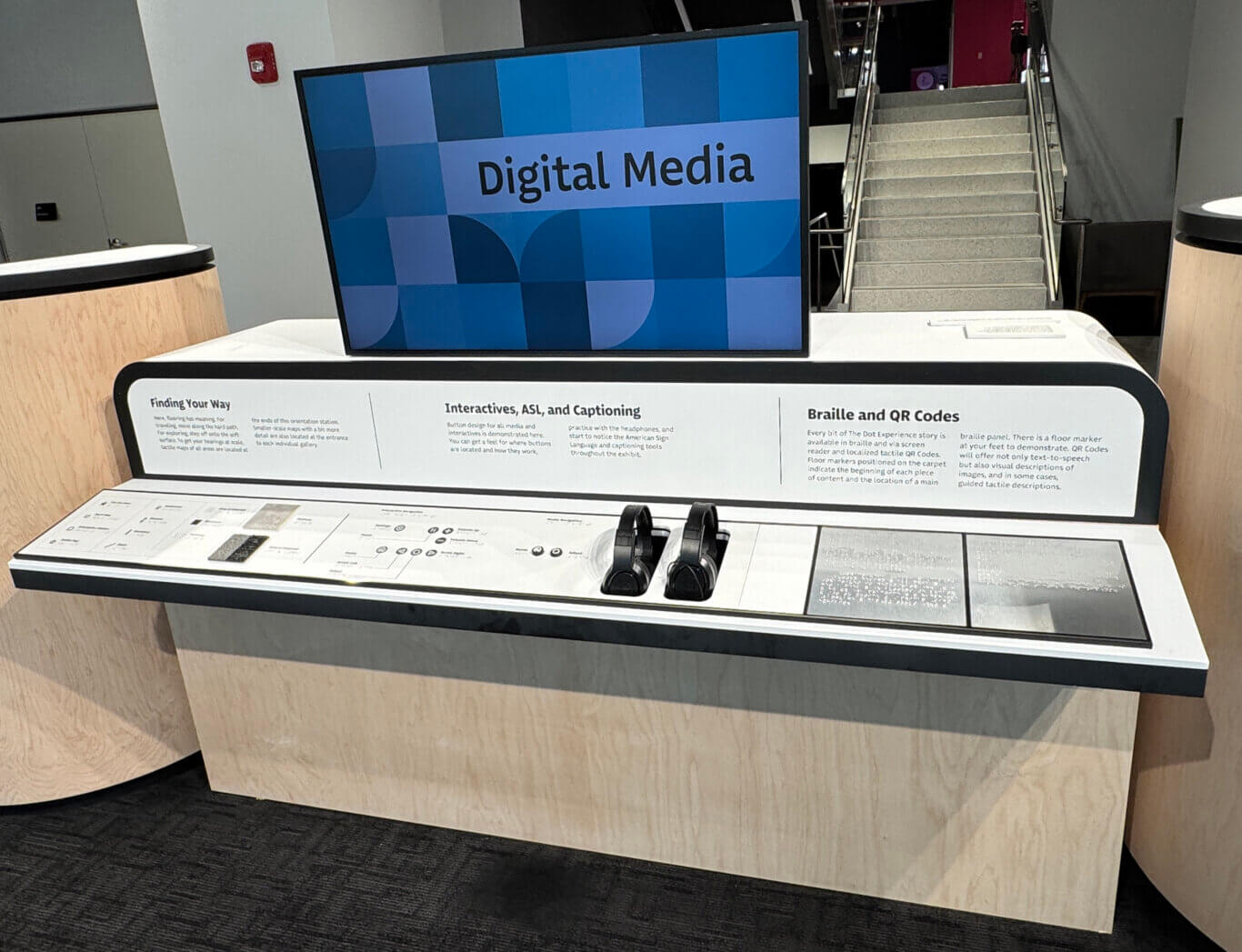
A museum accessibility station titled "Digital Media," stands on a light wood cabinet, with a large monitor above an angled control surface containing two black headphones, diagrams, buttons, tactile panels, and braille. The monitor displays a blue geometric pattern and the centered title: Digital Media. Below it, a wide information panel is divided into three sections. The left heading reads: Finding Your Way with an illegible text and a legend below it. The center heading reads: Interactives, ASL, and Captioning with illegible text, buttons, and two sets of headphones below that rest upright in recessed holders. The right heading reads: Braille and QR Codes with illegible text and two metal braille panels occupy the lower right. Behind the station, a broad staircase with shiny metal railings rises to a dark upper level.
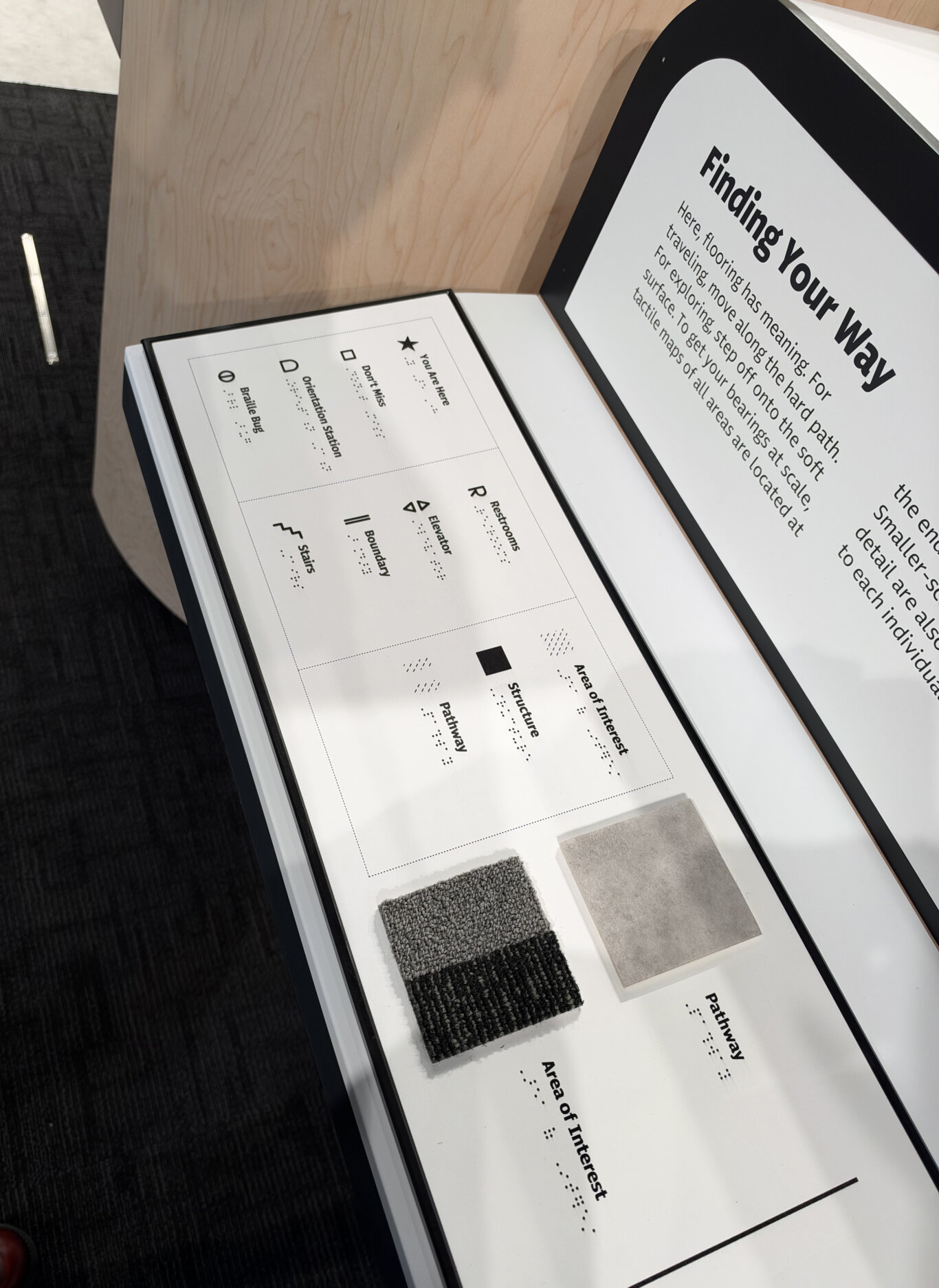
An angled close-up shows an accessible wayfinding display titled "Finding Your Way" above a series of tactile icons, braille labels and texture swatches. A large white panel with a black border is cropped along the upper right; its bold heading reads "Finding Your Way." The smaller introductory paragraph beneath is partly outside the frame. The clearly visible opening reads, "Here, flooring has meaning. For traveling, move along the hard path. For exploring, step off onto the soft surface. To get your bearings at scale, tactile maps of all areas are located..." and then it is cut off. A framed tactile key below contains raised black symbols, printed labels, and corresponding Braille. Its visible labels read, from upper left across and downward: "You Are Here," "Don't Miss," "Orientation Station," "Braille Bug," "Restrooms," "Elevator," "Boundary," "Stairs," "Area of Interest," "Structure," and "Pathway." To our right, are installed texture swatches. Pathway next to a grey square, possibly concrete, and "Area of Interest," next to two different texture grey carpet samples.
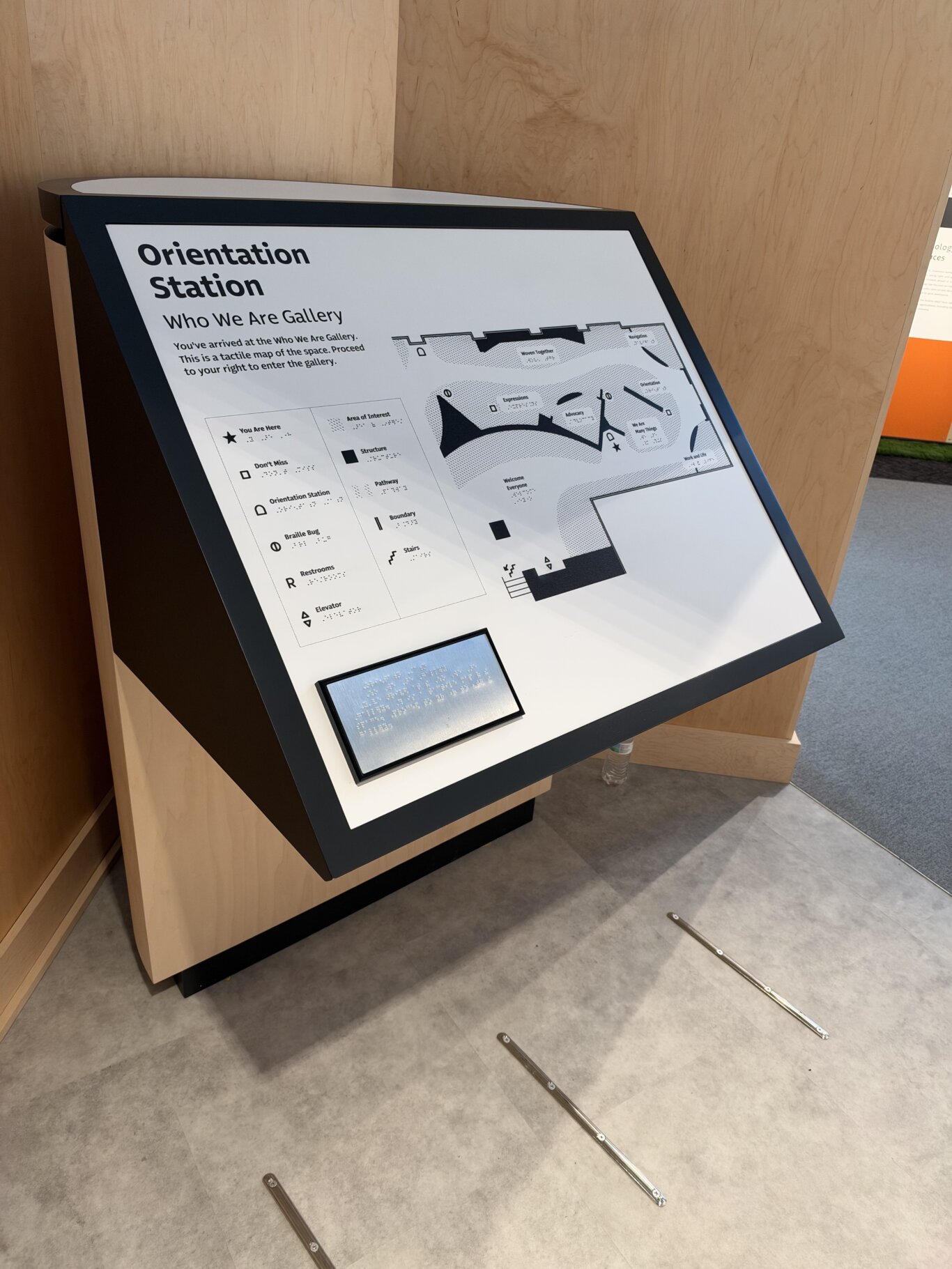
A large angled orientation station of the "Who We Are Gallery" mounted in a light wood structure, with a large black-and-white tactile map, raised symbols, Braille, and a lower metal Braille panel. The main heading reads "Orientation Station," followed by "Who We Are Gallery." Introductory text reads: "You've arrived at the Who We Are Gallery. This is a tactile map of the space. Proceed to your right to enter the gallery." The map on the right uses thick black pathways, outlined spaces, textured areas, symbols, and Braille. A legend with tactile symbols, illegible text, and braille sits along the left side of the station. Additional braille accompanies the map labels, and several lines of braille appear on the silver metal panel below. The station stands above a gray concrete floor crossed by narrow metal tactile floor markers, while a tall wall of pale wood panels fills the background.
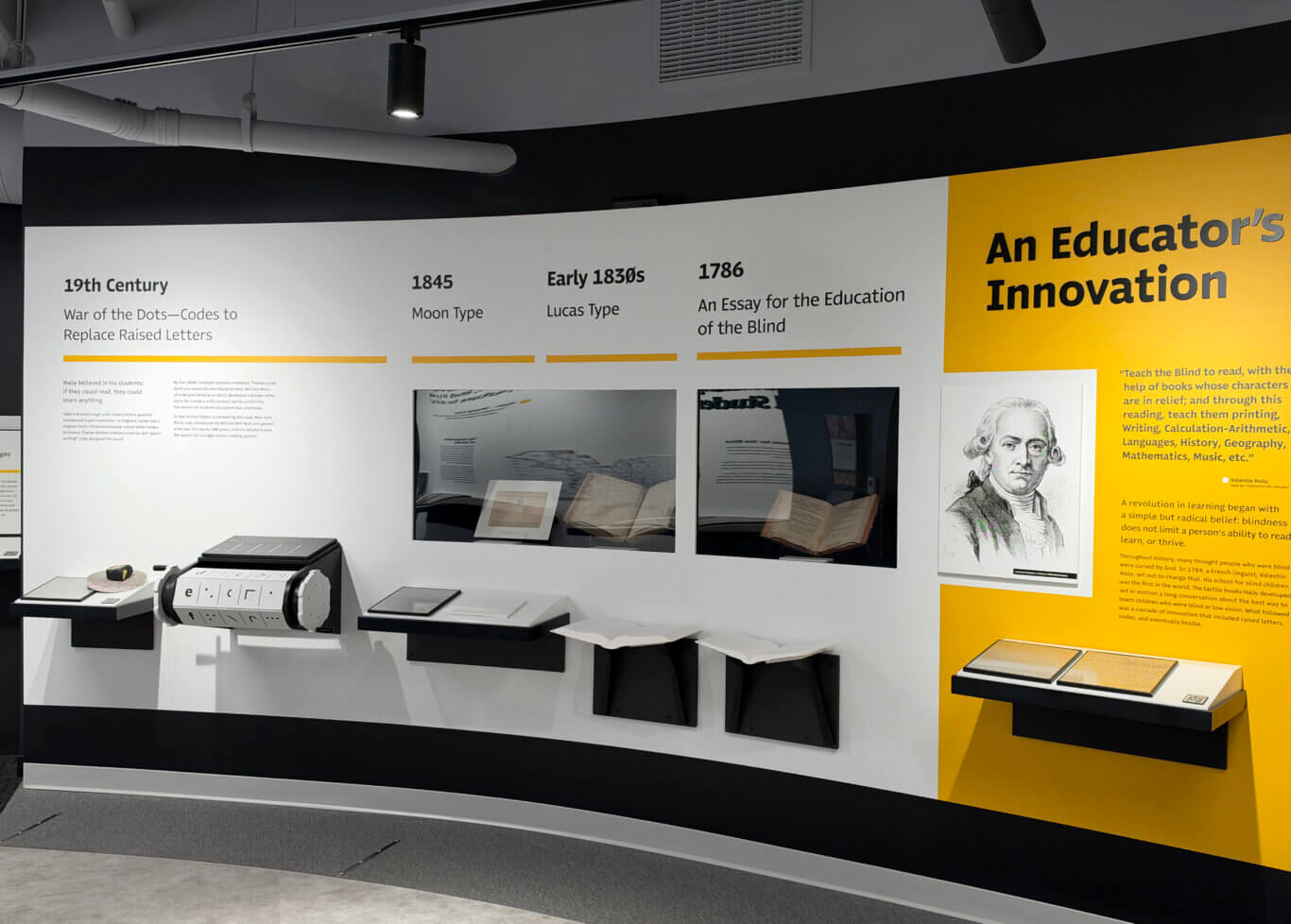
A museum exhibit titled, "An Educator's Innovation," with a timeline from 1786 through the 19th Century with mounted objects below the timeline. The installation uses a black, white, gray, and bright yellow color scheme, with wall panels, illuminated timelines, historical portraits, glass-fronted display cases containing books and documents, and hands-on objects mounted at waist height. Starting from our right to left is the title wall with a drawn portrait of man in 1700's period clothing, and white curled wig. Next to him, a quote reads, "Teach the Blind to read, with the help of books whose characters are in relief; and through this reading, teach them printing, Writing, Calculation-Arithmetic, Languages, History, Geography, Mathematics, Music, etc." Beneath it is the attribution: "Valentin Haüy," and "Essai sur l'éducation des Aveugles." Next is the heading, "1786, An Essay for the Education of the Blind," above a glass case holding a book and a tactile replica in front. Next is the heading, "Early 1830's Lucas Type," above a book in a glass case and a tactile replica below. In the middle of the exhibit is the heading, "1845, Moon Type" above an angled paper in a glass case above a tactile replica." On our far left is the heading, "19th Century, War of the Dots-Codes to Replace Raised Letters." Below it is a large cylindrical tactile teaching device displaying raised symbols and the visible letters "e" and "f." Below the entire timeline is grey carpet with tactile floor markers.
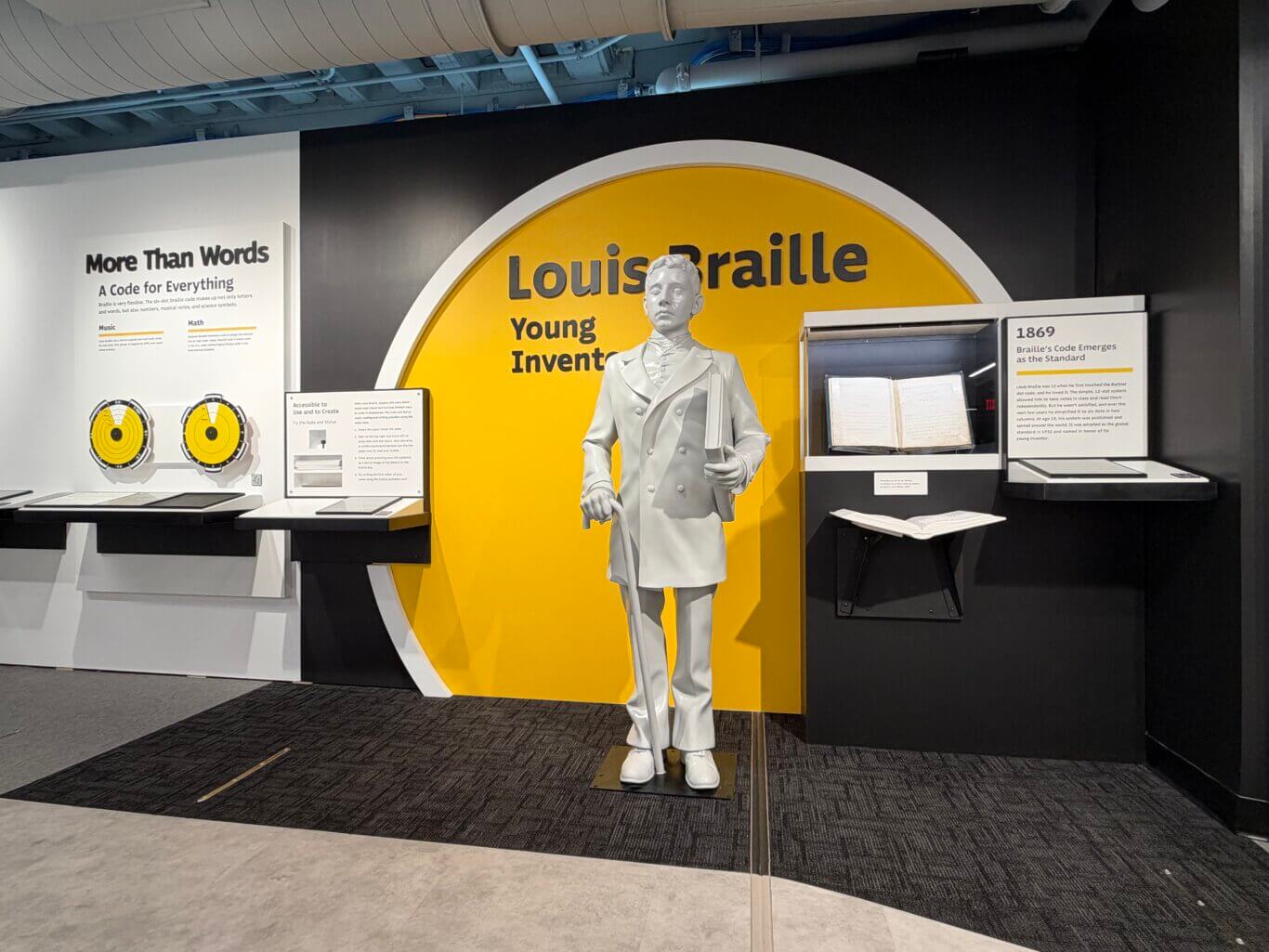
A museum exhibit titled, "Louis Braille, Young Inventor" featuring a life size tactile replica of a young Louis Braille in a white material and smaller displays of objects behind him. Louise, a white young adult man, wears a double breasted coat and high necked button up dress shirt, standing with his eyes closed holding a curved cane in one hand, and a large book tucked under his other arm. Behind him on the right is an open book in a glass case with a tactile replica below it. On his left is a smaller exhibit titled, "More Than Words," followed by "A Code for Everything." The paragraph below reads: "Braille is very flexible. The six-dot braille code makes up not only letters and words, but also numbers, musical notes, and science symbols." Two smaller sections are headed "Music" and "Math." Beneath "Music," a large date reads "1869"; the remaining small text in both sections is too blurred to transcribe reliably. Below the text are two large yellow-and-black rotating discs. Dark patterned carpet with tactile floor markers and a pale concrete walkway fill the foreground.
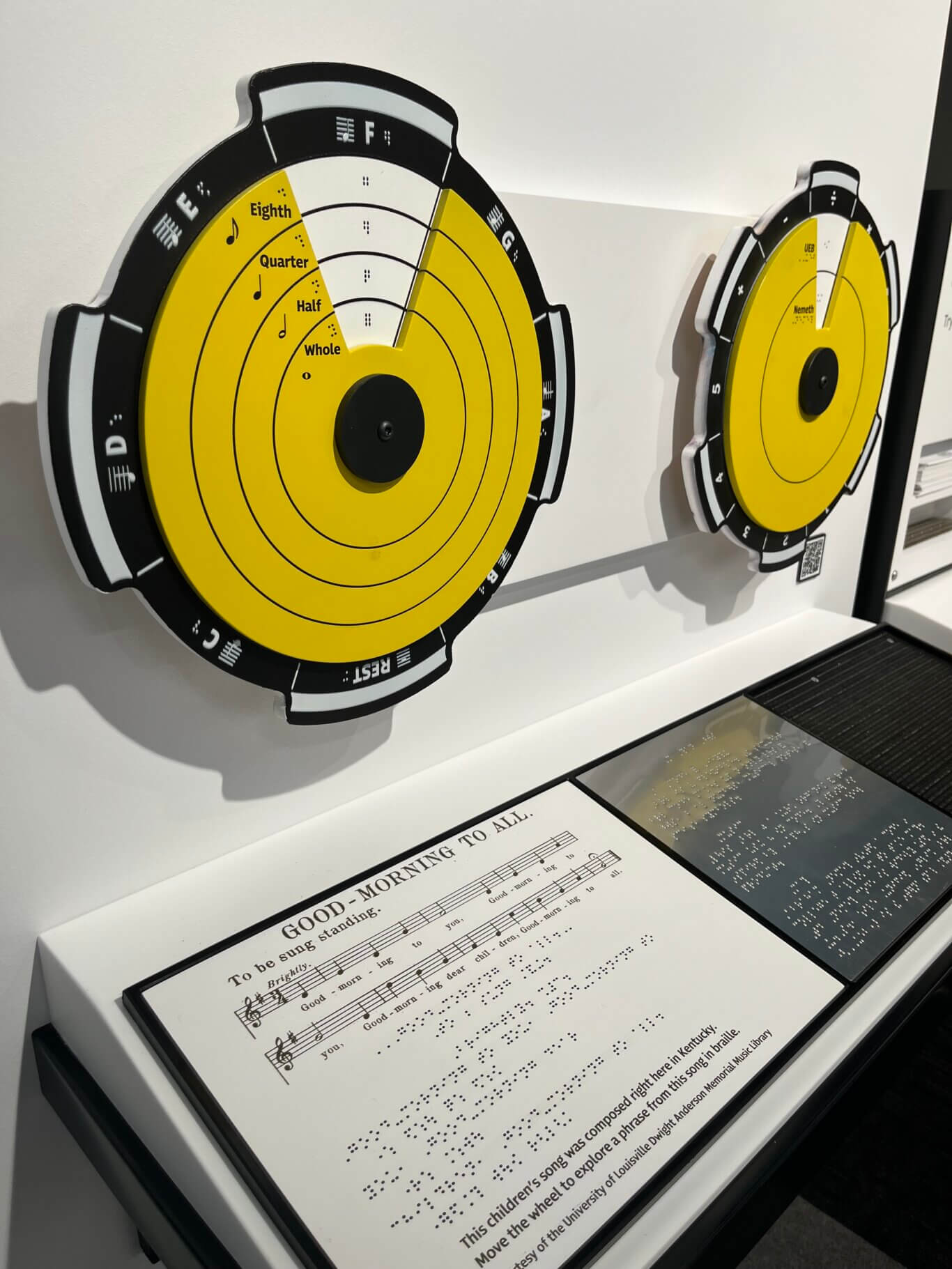
An interactive tactile music exhibit features two wall-mounted black, white, and bright yellow rotating wheels above an angled panel displaying printed sheet music and raised braille. The larger wheel dominates the left side and has concentric yellow bands, printed musical notes, braille dots, and a black central handle. Its clearly visible labels read "Eighth," "Quarter," "Half," and "Whole." Around the outer black ring, visible note letters include "C," "D," "E," "F," "G," "A," and "B," along with "REST"; each is paired with musical notation and braille. A second matching wheel on the right has yellow rings, braille, musical symbols, and the visible numbers "2," "3," "4," and "5"; two small labels on its yellow face are too blurred to read. A QR code appears beneath this wheel. On the foreground angled panel is the sheet music for "GOOD - MORNING TO ALL" The lyrics beneath the musical notation read "Good - morn - ing to you," "Good - morn - ing to all." "You," and "Good - morn - ing dear chil - dren, Good - morn - ing to all." Rows of raised braille fill the lower half of the panel. At the bottom, text reads: "This children's song was composed right here in Kentucky! Move the wheel to explore a phrase from this song in braille. Courtesy of the University of Louisville Dwight Anderson Memorial Music Library." A separate metal braille panel sits to the right. The content of the panel below the second wheel is illegible.
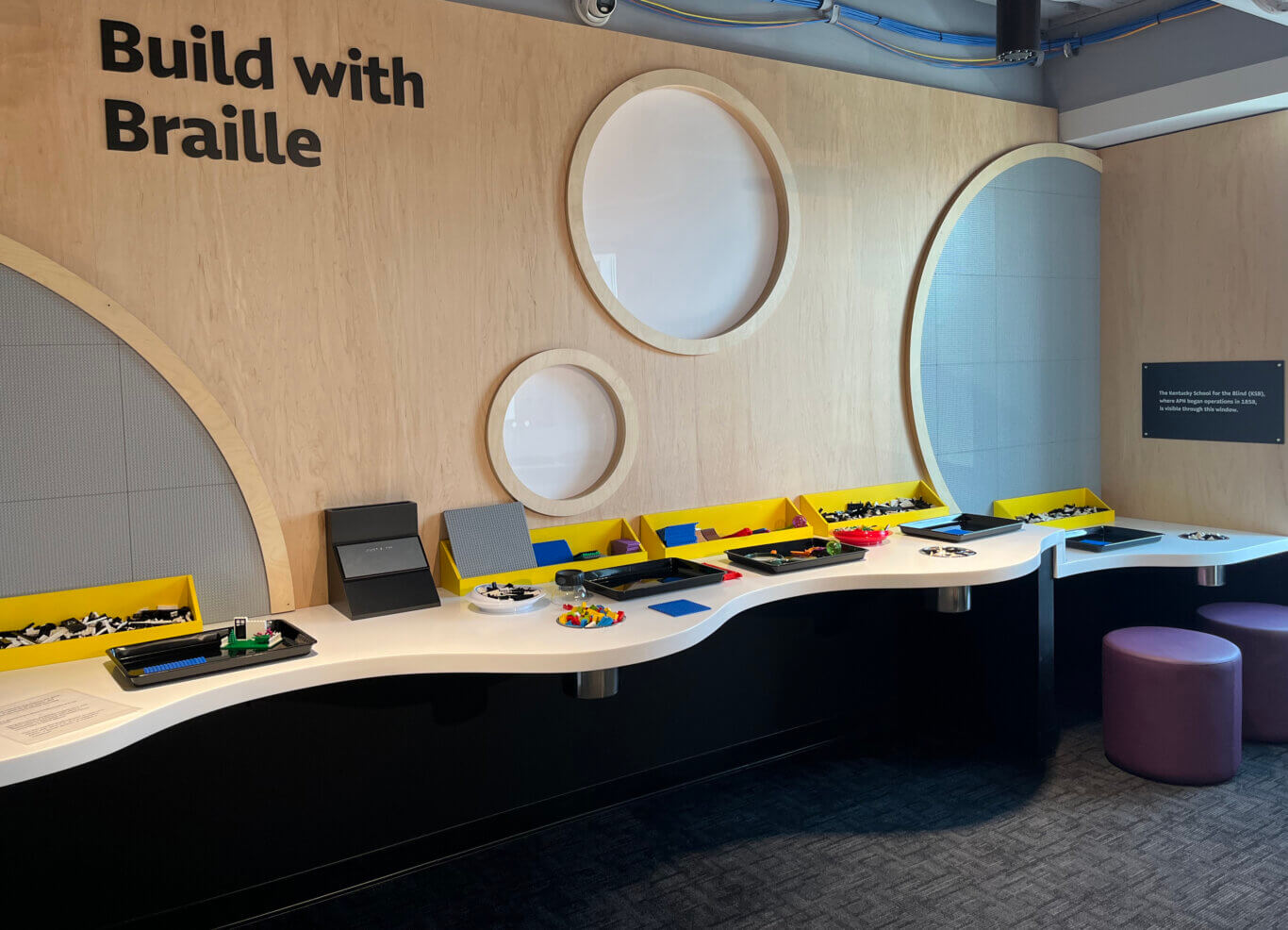
An interactive LEGO building station. Large raised black letters at the upper left read: "Build with Braille". A long, curved white work surface spans the foreground above black cabinetry, with purple cylindrical stools at the right. Bright yellow bins along the wall and tabletop hold many loose black, white, gray, and multicolored LEGO pieces. Black trays contain partially assembled models, loose bricks, blue baseplates, and tactile building materials. The wood wall incorporates several circular or oval openings with thick wooden rims. A dark plaque beside the tall opening reads: "The Kentucky School for the Blind (KSB), where APH began operations in 1858, is visible through this window."
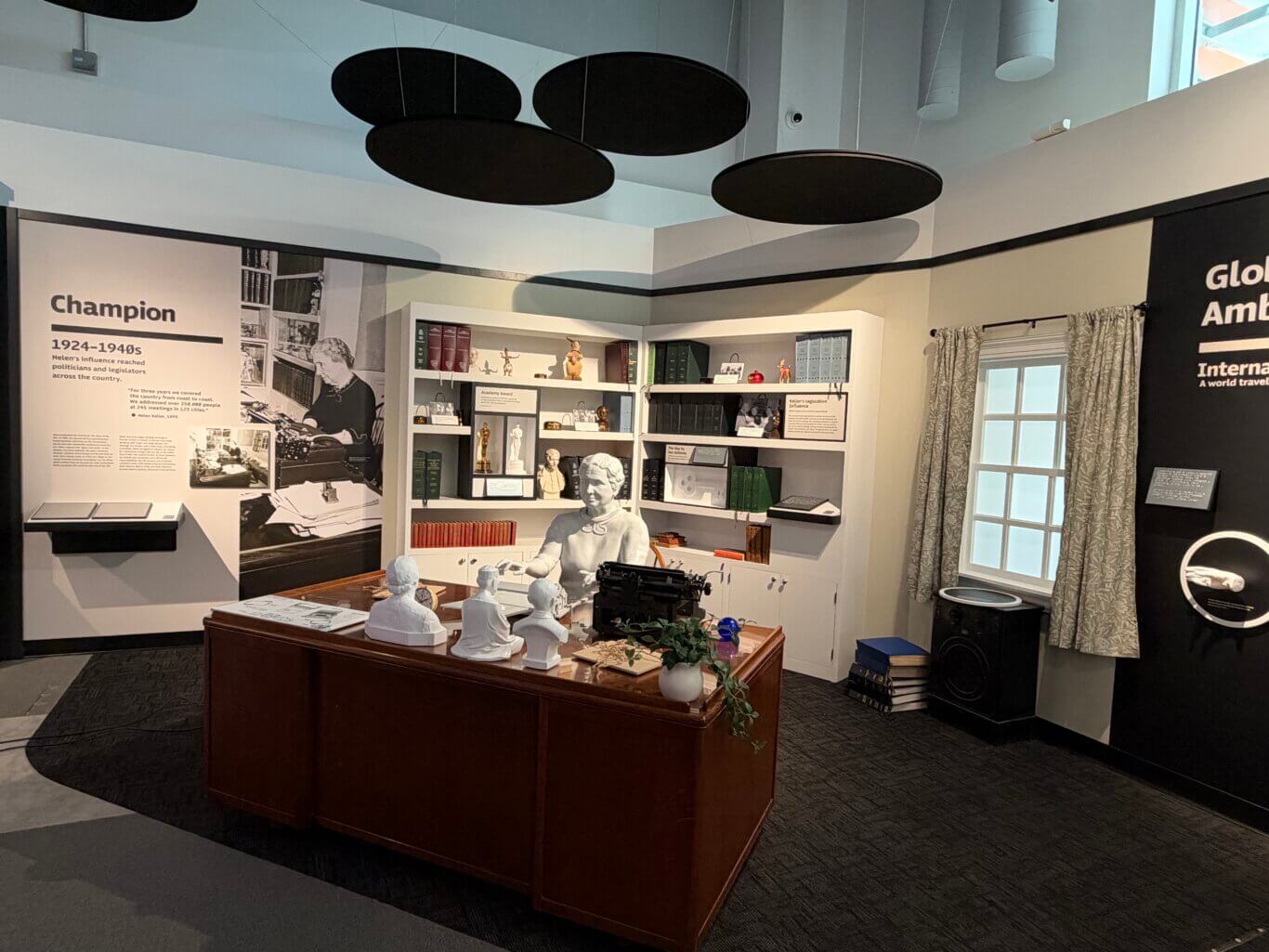
A museum gallery titled "Champion 1924-1940s," of Helen Keller sitting at a desk in a replica of her office. On our left, is a large black and white photo of Helen, an older white woman, sitting at her brailler in an office and illegible wall text underneath the heading above angled braille panels. The exhibit appears to be a recreation of the photo. In the center of the exhibit is a life size tactile replica of Helen sitting at her brailler made out of an all white material. Sitting on her desk are three busts facing away from us, a plant and various books. Behind her, lining the walls, are shelves filled with books and small indiscernible objects. Round black acoustic panels hang in from the ceiling.
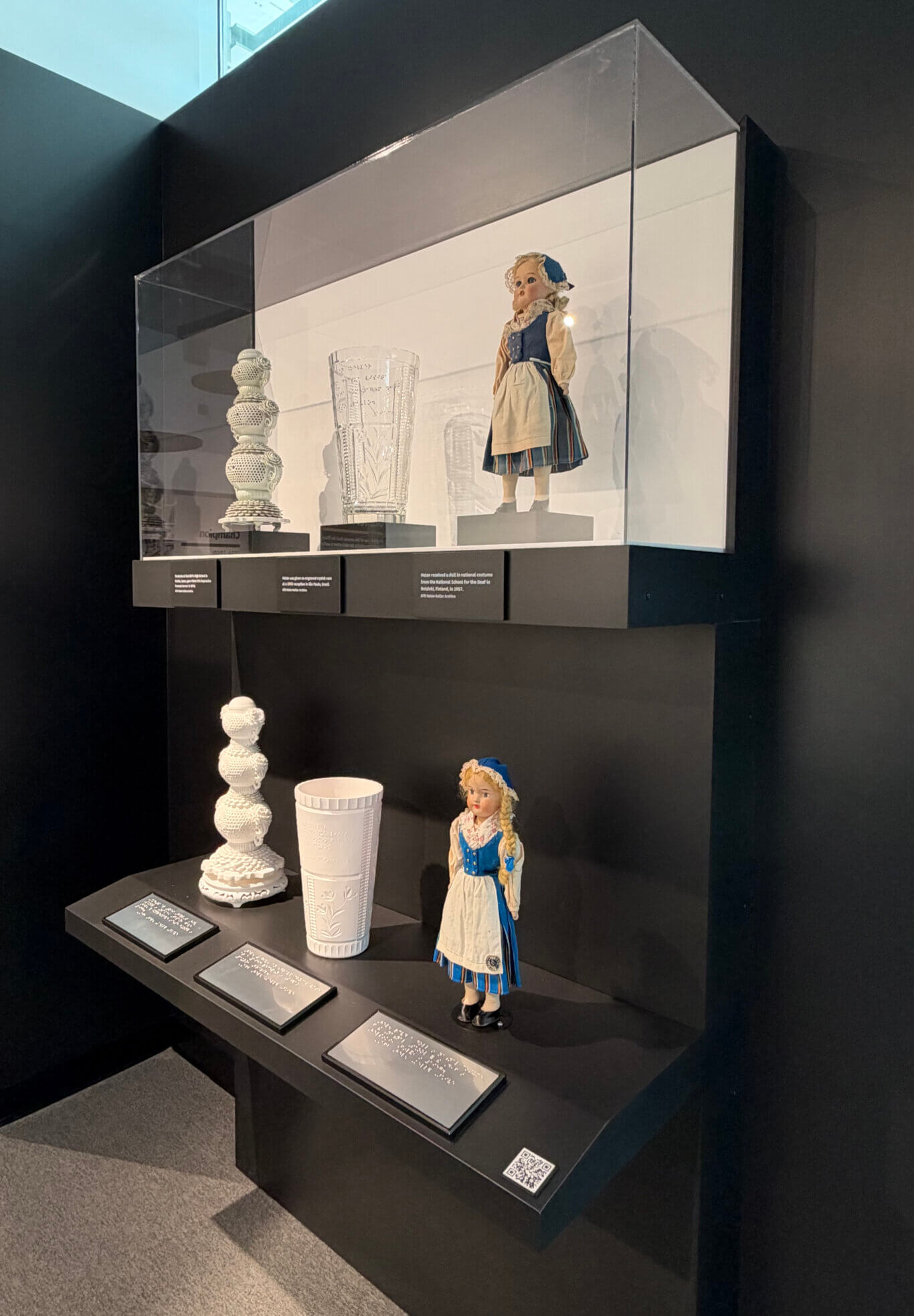
A museum display presents a case with two decorative objects and a doll hung above a shelf with tactile replicas of the same objects installed below. In the upper glass case, starting on our right, stands a vintage white doll wearing a blue bonnet, blue bodice, cream blouse and apron, striped skirt, white stockings, and black shoes. In the center is a large clear cut-glass vessel, possibly a vase. On the far left is a white ornamental sculpture formed from stacked, intricately textured spheres. The are all about the height of the child's doll. Below, an open display shelf contains tactile replicas of the same objects. On our right, the doll is almost the exact same, possibly a slightly more modern version. The vase and sculpture are created from the same white material. Below the touch objects are silver angled labels with Braille. A QR code appears at our lower right of the shelf.
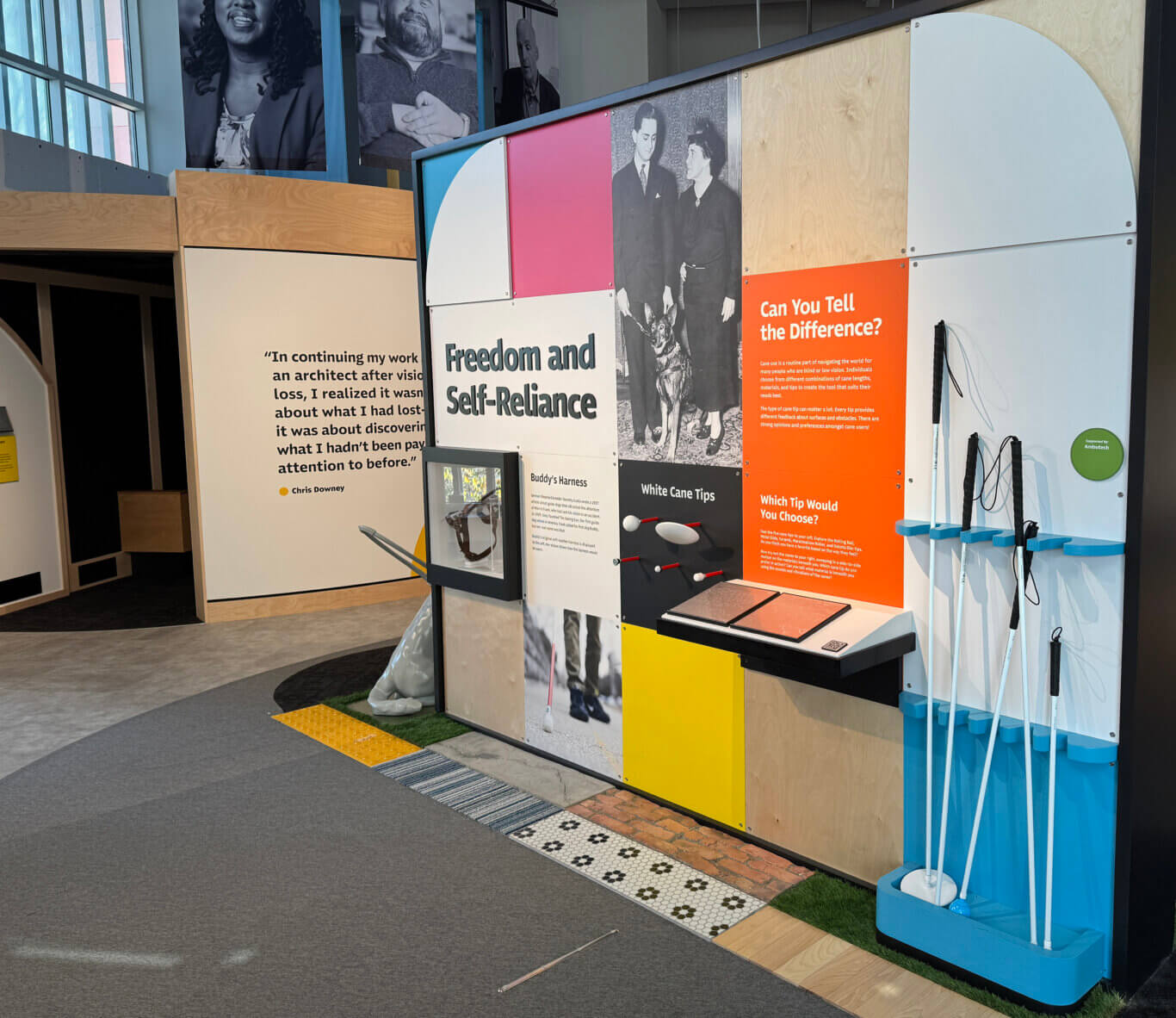
An interactive museum exhibit titled, "Freedom and Self-Reliance," fefaturing information about tactile wayfinding, guide dogs, and white canes. Layered wall panels in pale blue, pink, orange, yellow, gray, black, white, and natural wood surround large black-and-white portraits and historical photographs. Below the exhibit title, a display is headed "Buddy's Harness." Buddy's original soft-leather harness is displayed to the left. To our left, a dark panel reads: "White Cane Tips." Several white cane tips with red stems project horizontally from the wall above textured sample surfaces installed on the ground. On our right, a large orange panel reads: "Can You Tell the Difference?" and "Which Tip Would You Choose?" with illegible text above angled braille panels and a QR code. On our far right, white canes of different heights stand vertically in blue holders. The floor incorporates contrasting tactile areas, including gray carpet, green artificial grass, wood, brick, small hexagonal tiles, striped material, and a yellow truncated-dome warning surface. In the background on the left, a partially visible quotation panel from Chris Downey starts with, "In continuing my work..."
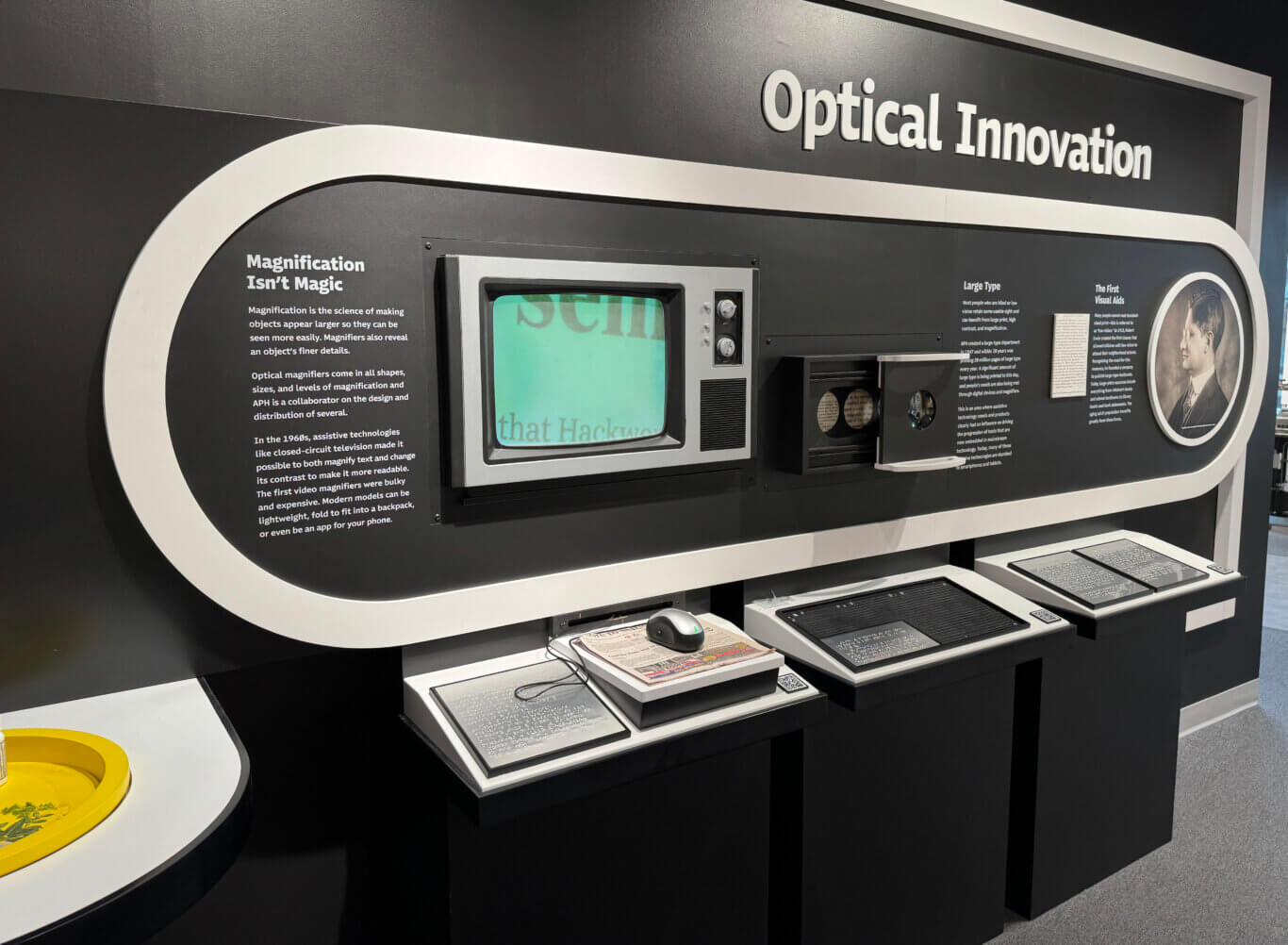
A museum exhibit about titled, "Optical Innovation" includes an electronic magnifier, a computer mouse, and a historical portrait. From our left the first heading reads "Magnification isn't Magic," above illegible text. To the right, installed in the wall is a large gray desktop video magnifier; its turquoise-tinted screen enlarges fragments of printed letters. Control knobs and vertical components flank the screen. Underneath sits an object that looks like a computer mouse that can be moved over a newspaper. In the center is a black box with magnifying lenses. On our far right is a round sepia portrait of a man in profile with light skin tone. Underneath all the objects are Braille labels and small tactile QR codes.
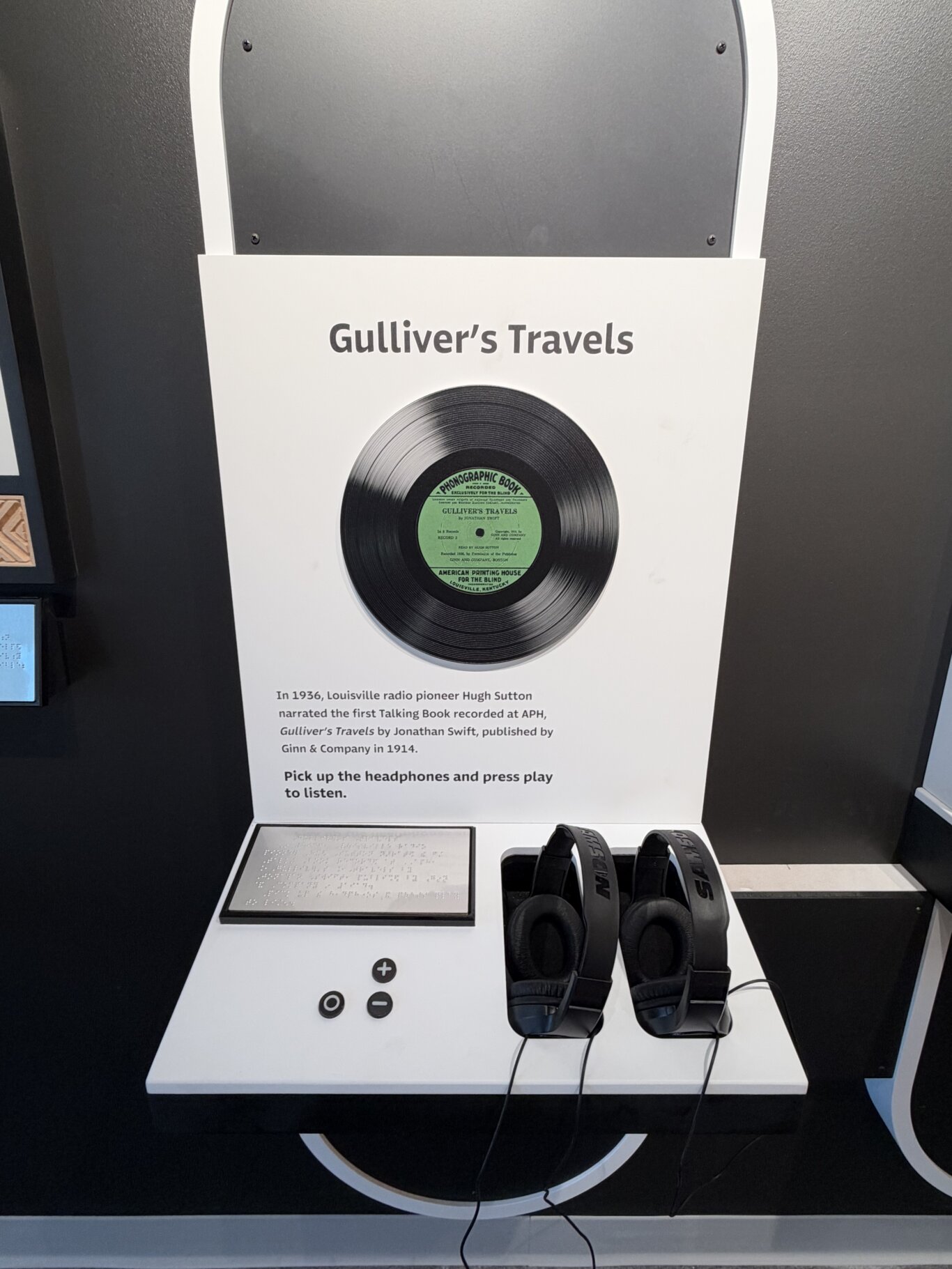
A museum listening station for with the title, "Gulliver's Travels," above a phonograph, or record, and an interactive station with headphones and buttons. The station is white with black text. The record is a large black shiny disc with a green center label with text that reads in part, "Phonographic Book," "Gulliver's Travels." Text beneath the records reads: "In 1936, Louisville radio pioneer Hugh Sutton narrated the first Talking Book recorded at APH, Gulliver's Travels by Jonathan Swift, published by Ginn & Company in 1914." Instruction below reads: "Pick up the headphones and press play to listen." The lower portion of the station projects outward as a white shelf. A rectangular metal panel on the left bears Braille. Three black control buttons below it show a plus sign, a play symbol, and a minus sign. On our right, two pairs of black over-ear headphones hang from a horizontal rail, with their cords descending toward the dark floor.
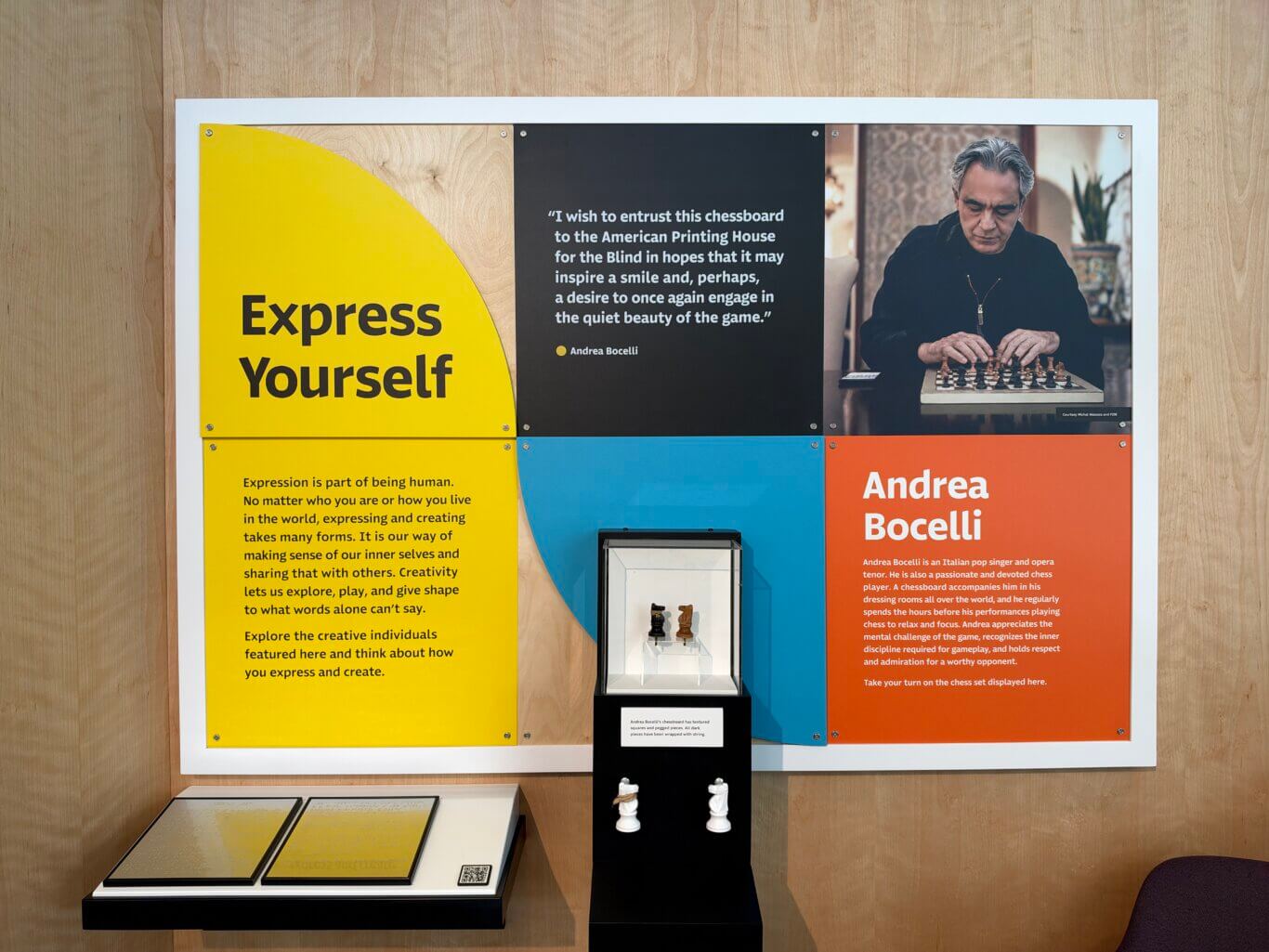
A museum exhibit titled, "Express Yourself," featuring Andrea Bocelli, chess pieces and their tactile replicas, and text set in brightly colored panels against pale wood paneling. A large yellow panel in the upper left reads: "Express Yourself" with the following body text, "Expression is part of being human. No matter who you are or how you live in the world, expressing and creating takes many forms. It is our way of making sense of our inner selves and sharing that with others. Creativity lets us explore, play, and give shape to what words alone can't say. Explore the creative individuals featured here and think about how you express and create." Underneath the text are two angled braille metal panels and a tactile QR code in the lower right hand corner. In the center, a black panel contains the quotation: "I wish to entrust this chessboard to the American Printing House for the Blind in hopes that it may inspire a smile and, perhaps, a desire to once again engage in the quiet beauty of the game." Below the quotation are two wooden chess pieces in a glass case, a black and brown knight, horse heads on top of bases. Underneath these pieces are tactile replicas made our of a white material. At the upper right, a color photograph of Andrea Bocelli, an older man with medium-light skin and swept-back gray hair, wearing black leans over a chessboard, his hands resting lightly on the top of the pieces. Below him is large white text on an orange background with the title "Andrea Bocelli" and illegible body text below.
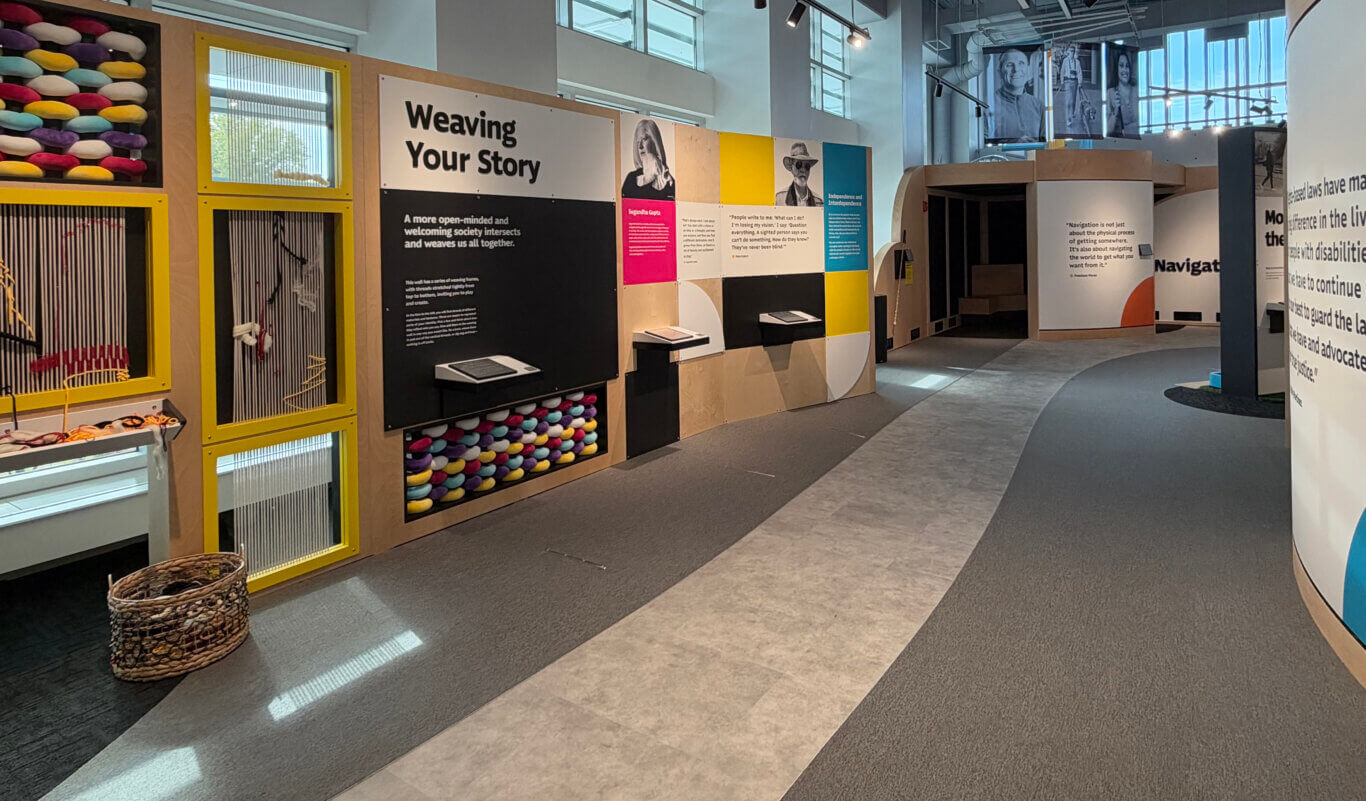
A brightly lit museum exhibit titled "Weaving Your Story" fills a modern gallery with layered wooden partitions, mirrors in yellow frames, black display panels, vertical weaving threads, and rows of soft oval pieces in yellow, red, purple, pale blue, white, and gray. Large text near the upper right reads: "Weaving Your Story". A central black panel reads: "A more open-minded and welcoming society intersects and weaves us all together." Below it, smaller wall text is illegible above an angled braille panel. On our left, several interactive open weaving frames hold taut parallel strings, some interlaced with red, yellow, white, and dark fibers. In the foreground, a stack of loosely woven brown twig or fiber rings rests beside the interactive. At the back of the exhibit, not able to visually make out are additional black-and-white portrait photographs above additional wall text and angled braille labels. Tactile floor markers are installed underneath each braille panel.
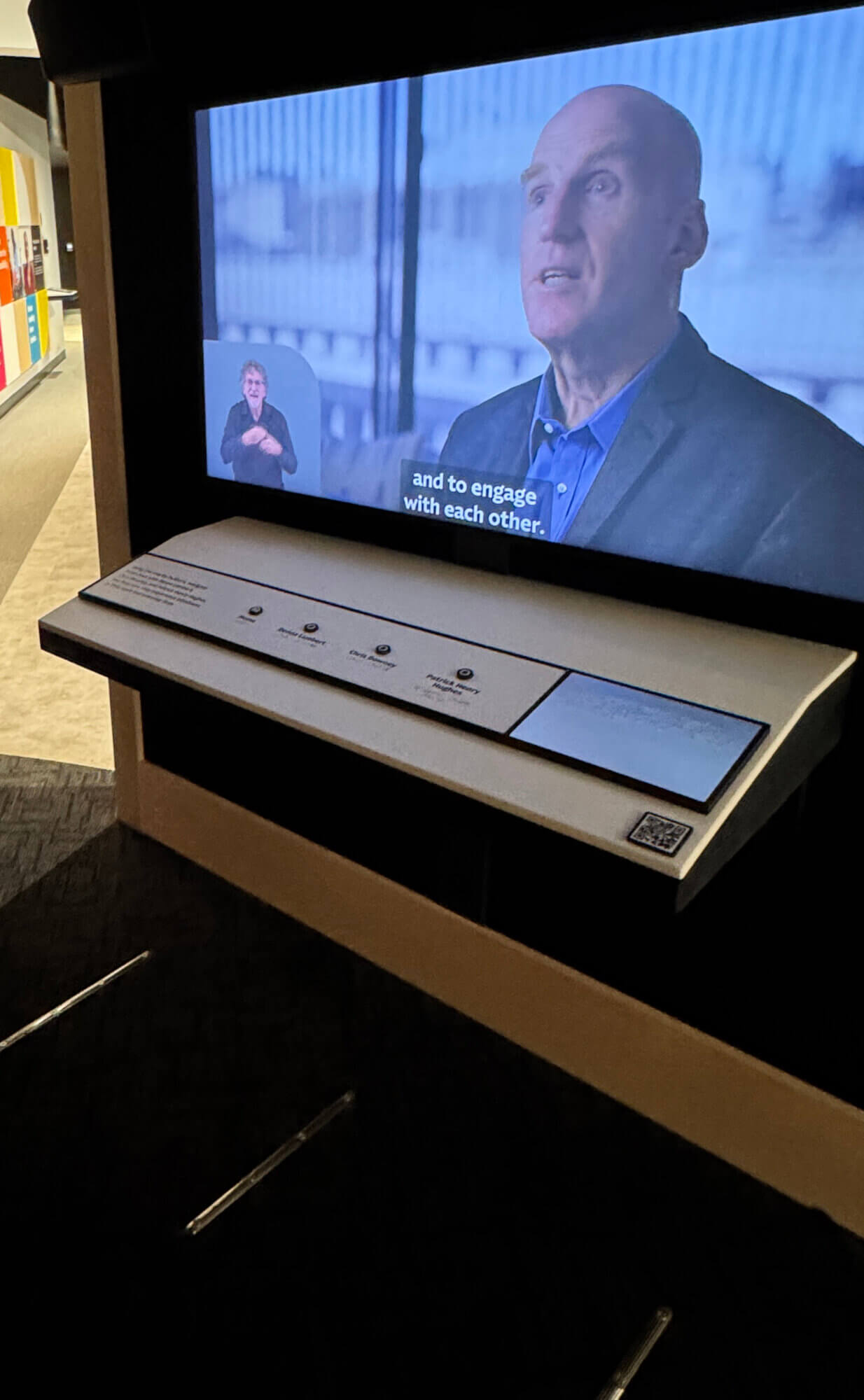
A museum-style multimedia station features a large video screen above a slanted control panel. On the screen, a bald white man with light skin wears a blue collared shirt and dark jacket while speaking in front of a softly blurred blue-gray background. A smaller inset at lower left shows another adult with light skin tone and short gray hair signing with both hands. White subtitles near the bottom read: "and to engage with each other." The station's pale control panel contains several round buttons, printed instructions, a blue rectangular section, and a QR code at our lower right; the small printed text and button labels are too blurred to read. Three metal tactile floor markers stand out in contrast against the dark rug underneath at spaced intervals, while a brightly lit corridor with colorful wall displays appears along the left edge.
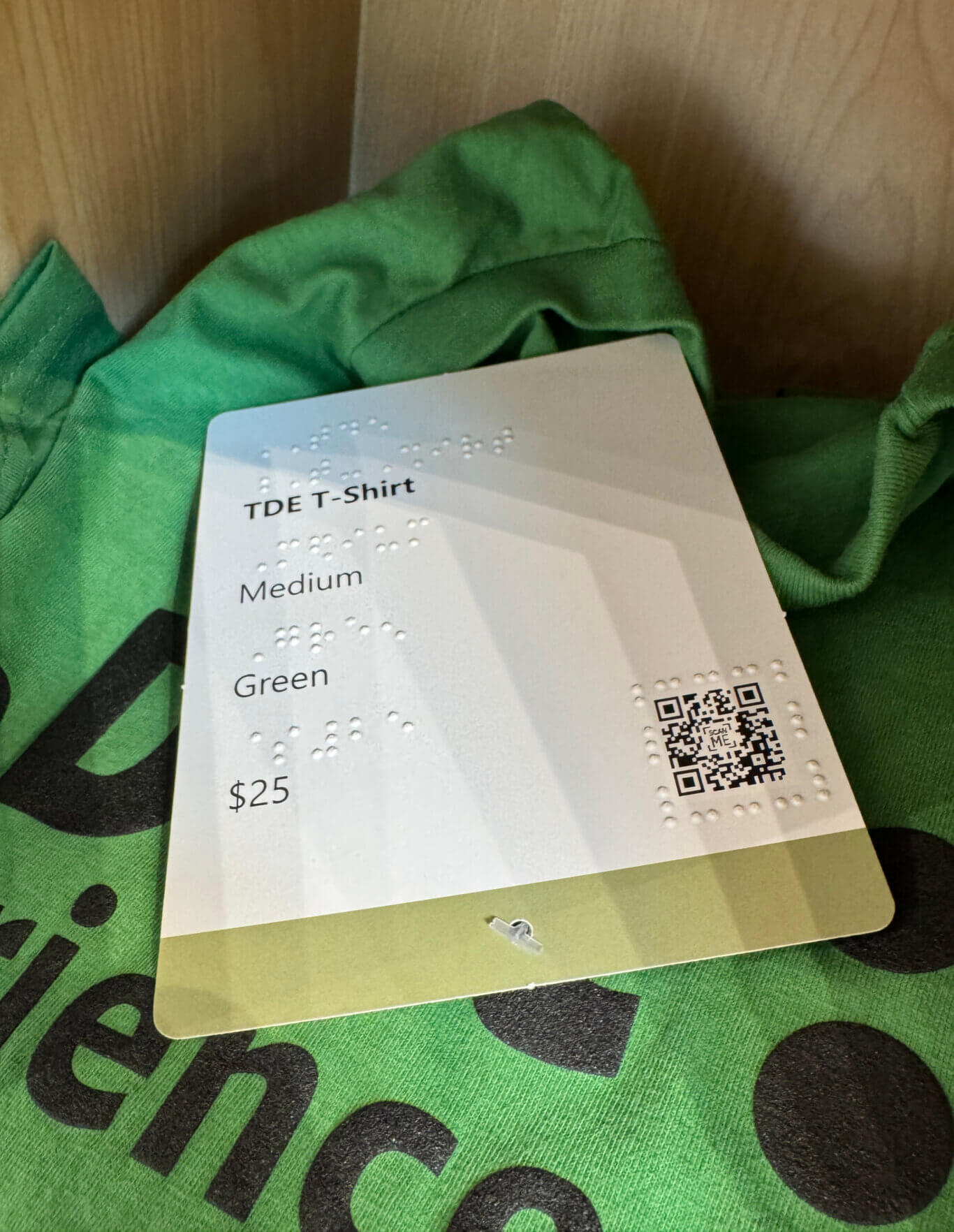
A close-up of a green T-shirt loosely folded inside a shelf, with a white rectangular product tag resting diagonally across the fabric. Braille and printed text on the left side of the tag reads, from top to bottom: "TDE T-Shirt," "Medium," "Green," and "$25." A black QR code appears at the lower right with small central text reading "SCAN ME." Large black printed graphics and partial lettering on the shirt are cropped and cannot be read in full but may say, "The Dot Experience."
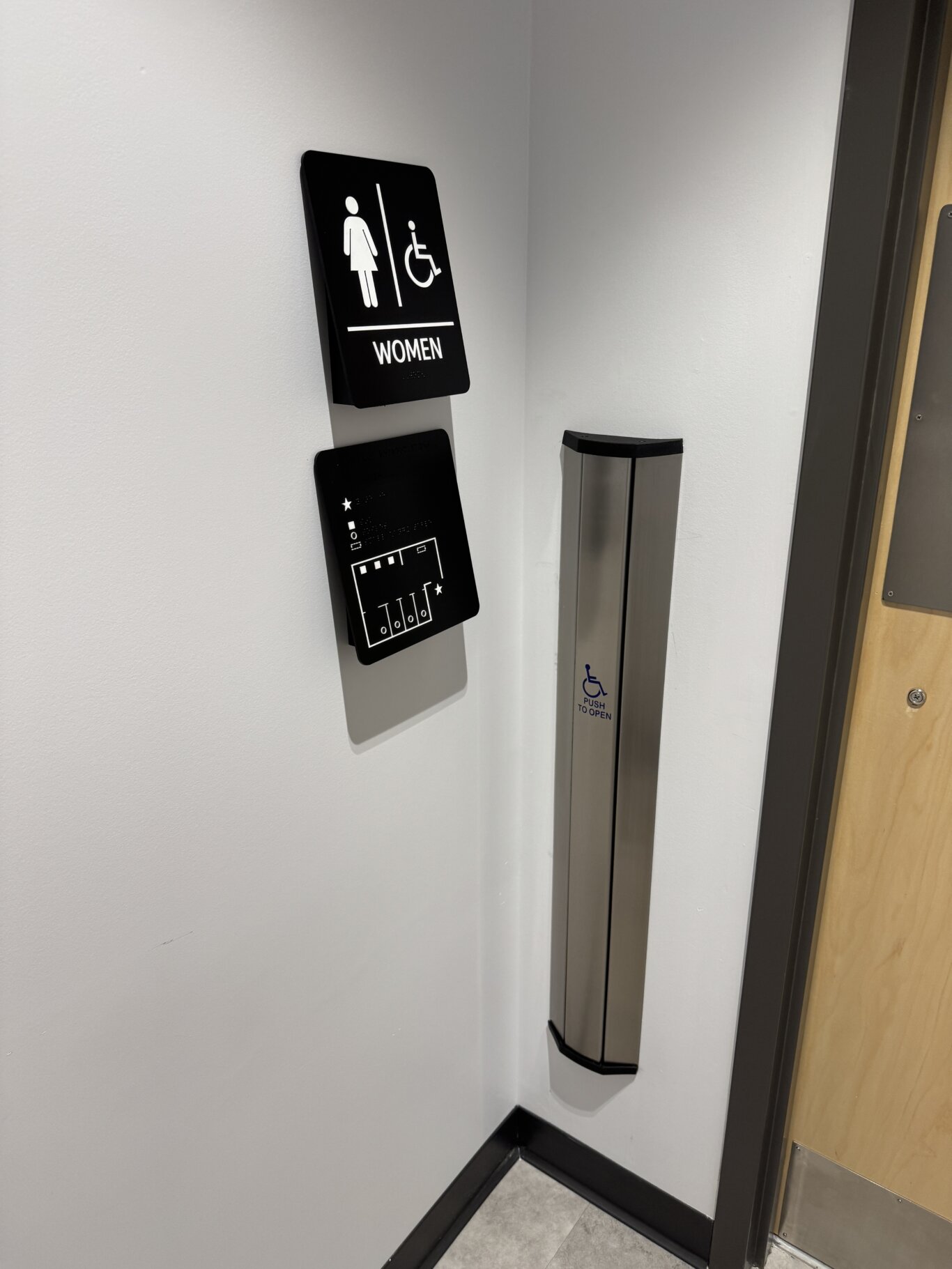
An accessible women's restroom sign and tactile map installed on a wall. At the top, a black standard women's restroom sign is angled off the wall. Below it is another black angled sign, a tactile map of the restroom with a simple floor plan. To our right, a tall, narrow, vertical metal push plate with a blue wheelchair accessibility symbol and the text "PUSH TO OPEN." To the right of the push plate is a partially visible wooden door.

Project Description

The opportunity to house the American Foundation for the Blind’s Helen Keller Archive prompted the American Printing House for the Blind (APH) to reimagine its museum in Louisville, Kentucky. The Dot Experience, named for the six dots of a braille cell, opened to the public on October 30, 2026. Blind and low vision people tell their own stories throughout the galleries and helped shape how visitors encounter them. On a separate tour of APH’s working factory, visitors can learn how braille books and tactile graphics are embossed.

Under Jo Haas’s leadership, APH set out to build the world’s most inclusive museum. Part of that ambition was taking seriously the many reasons a blind person might come through the door. A parent bringing a child to find out how books are made has a different afternoon in mind from someone who wants to hear another person’s story or show a friend how a familiar tool works. Each should get to decide what kind of visit to have.

Prime Access Consulting (PAC) wrote the museum’s first Inclusive Design Standards in 2022. This reference document guided PAC’s design reviews with APH and Solid Light, the exhibition designer and fabricator. Someone using a tactile map has to be able to find it, get close enough to read it, and distinguish one route from another by touch. The architect, the fabricator, and the mapmaker each have a hand in whether that visitor can decide where to go next.

What Changed in the Prototype Studio

In community prototyping sessions at Solid Light’s studio, paid participants from the Louisville area tried full-scale mockups of rooms as well as individual objects. The group included blind, low vision, deafblind, and neurodivergent people, wheelchair users, and both new and experienced braille readers. They returned as the work progressed, giving them a say while the designs could still change.

Scott Spaulding, one of the prototypers, recalled a fellow participant suggesting that a wall-mounted sign would be easier to read by touch if it were tilted. The suggestion echoed PAC’s standard advice to angle braille panels for a more natural hand position, and the team tilted the panels. At another exhibit, raising a mechanical spinner made it easier for a wheelchair user to reach because they could pull in underneath it. During opening week, PAC’s Rob Itri Vincent and Maria Braswell checked the clearance beneath tactile exhibits and the placement of floor markers in the installed galleries.

Finding Your Way and Exploring Together

At the lobby orientation station, visitors can explore a tactile map and learn the cues they will encounter in the galleries. PAC’s wayfinding work included advising on how a change of floor texture could signal a transition between spaces and how a distinct marker could draw attention to an exhibit. A visitor who recognizes that marker has the freedom to stop, pass the exhibit by, or come back to it later.

Printed interpretation is paired with braille, and media include descriptive narration and American Sign Language. PAC also trained APH staff in visual description, including how to write a guided tactile description, and developed a style guide with them. A description can suggest where to begin exploring an object and explain why a detail matters just as a visitor’s fingers reach it. APH staff can bring that same judgment to the next object they interpret.

One exhibit that PAC principals Sina Bahram and Corey Timpson especially appreciate invites visitors to try different white cane tips on wood, marble, grass, and carpet. For a cane user visiting with a friend, part of the pleasure might be in handing over a cane and explaining what to listen and feel for as the tip crosses from carpet onto marble. It might also be in trying a tip they’ve never used. The exhibit makes room for what each visitor already knows and what they came to discover.

The People Behind the Objects

Among the museum’s cast of storytellers are photographer Pete Eckert, who filed notches into his camera to set focusing distances by touch, and chef Christine Ha, who drew on smell, taste, and memory to recreate her mother’s Vietnamese dishes. A visitor who comes in curious about blindness can leave with a question they would like to ask a photographer or a chef.

In the Helen Keller gallery, a life-size figure of Keller sits at her own walnut desk with her fingers on a replica of her brailler. Nearby, her Oscar is displayed behind glass with a tactile reproduction alongside it. Visitors are welcome to touch the original desk, where raised wooden rails run along the back and sides. Following one with a fingertip, a visitor can discover how Keller kept the pages she was working on from slipping away. That small feature brings visitors into the daily working life of a writer and advocate whose career spanned decades.

Concluding Thoughts

During opening week, what moved us at PAC was watching people get on with exploring a museum we had known for years through drawings, prototypes, and conversations. In an interview with APH, Sina described visiting a museum with Corey, who might look closely at an object while Sina explores it through touch or listens to a description. “What matters is that we experience it at the same time,” he said. That timing leaves room for either person to notice a detail first and start a conversation while they are both still with the work.

We’re grateful to APH and Solid Light for carrying that idea through years of design decisions, and to the prototypers and storytellers who made those visits possible. We hope people take that expectation with them from Louisville, whether the next place they visit together is an art museum, a science center, or a historic house.